

Kegel Exercises for Premature Ejaculation: How They May Help
By Ezra Allen, Jan-29-2025


 Dr. Arjun Srivastav Medical Reviewer (Pharm D)
Premature ejaculation (PE) can be frustrating, especially when ejaculation happens sooner than you want and you feel you have little control over it. Kegel exercises are often suggested as a simple way to work on the pelvic-floor muscles, but there is more to them than repeatedly squeezing the muscles used to stop urine flow.
If you are considering Kegels for PE, it helps to know what the exercises actually do, how to perform them correctly, how often to practise them, and when strengthening the pelvic floor may not be the right approach.
TL;DR: Can Kegel Exercises Help With Premature Ejaculation?
Kegel exercises may help some men improve ejaculation control by training the pelvic-floor muscles. Research supports pelvic-floor muscle training as a possible non-drug approach, although the evidence is not strong enough to promise the same result for everyone.
Correct technique, regular practice and proper relaxation all matter. If you have pelvic pain, urinary symptoms or a very tight pelvic floor, speak with a healthcare professional before simply doing more Kegels.
What Are Kegel Exercises?
Kegel exercises are pelvic-floor muscle exercises. They involve deliberately contracting and relaxing the muscles at the base of the pelvis.
The pelvic floor supports the bladder and bowel and also has a role in male sexual function. These muscles are involved in ejaculation, which is why pelvic-floor training has been studied as one possible way to improve control over ejaculation.
Unlike exercises that require weights or gym equipment, Kegels can be practised at home and in different positions. The challenge is identifying the correct muscles and learning to contract them without unnecessarily tightening the surrounding muscles.
Can Kegel Exercises Help With Premature Ejaculation?
They may help, particularly for men who have difficulty controlling the pelvic-floor muscles during sexual activity.
A 2024 review of pelvic-floor muscle training studies found improvements in ejaculation time and premature ejaculation severity across the studies it assessed. However, the authors also noted differences in study quality, small sample sizes and a need for better-designed research.
More recent research published in 2026 provides a useful reason to keep expectations realistic. A systematic review and meta-analysis of five randomised studies involving many men found that pelvic-floor muscle training improved outcomes, but isolated exercise programmes had a smaller effect on ejaculation latency than dapoxetine or some combined approaches. The researchers also reported substantial variation between the studies.
So, Kegels are worth considering as one part of premature ejaculation management, rather than treating them as a guaranteed standalone solution.
What the evidence means in practical terms
| Question | What we know |
| Can pelvic-floor training help? | Research suggests it can help some men |
| Will everyone respond in the same way? | No |
| Is there one proven Kegel routine for every man? | No |
| Can Kegels be used alongside other premature ejaculation approaches? | They may form part of a broader treatment plan |
| Should you keep increasing the exercises if they cause symptoms? | No; professional assessment may be more appropriate |
How Do Kegels Affect Ejaculation Control?
Ejaculation involves several processes working together, including sexual arousal, the nervous system and pelvic-floor muscle activity.
Kegel training gives you greater awareness of the muscles involved in that process. Over time, practising controlled contraction and relaxation may help some men become more aware of pelvic-floor activity as arousal increases.
The aim is not to keep the pelvic floor clenched throughout sex. Being able to relax the muscles is also important. This becomes particularly relevant if your pelvic floor is already tense or overactive.
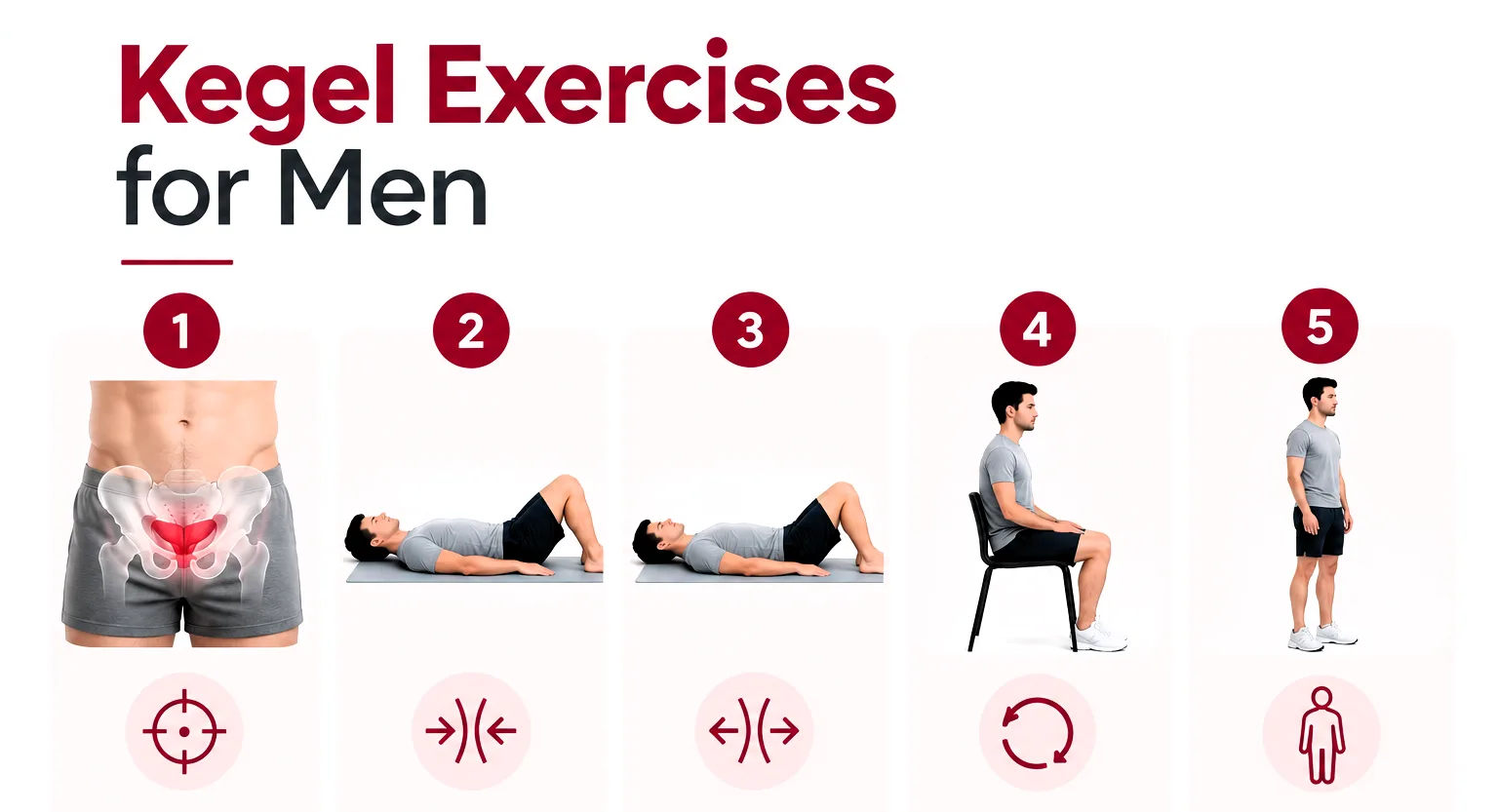
How to Do Kegel Exercises Correctly
Doing Kegels properly is more useful than simply trying to complete as many repetitions as possible.
1. Identify the Right Muscles
The muscles you use to prevent passing gas are part of the pelvic floor. You can also briefly notice the muscles involved when stopping urine flow.
Do not turn stopping your urine stream into a regular exercise. That method can help you identify the muscles, but repeatedly interrupting urination is not recommended as your normal Kegel routine.
2. Start With a Gentle Contraction
Once you know which muscles you are looking for:
- Contract the pelvic-floor muscles.
- Hold the contraction for about three seconds.
- Relax completely for about three seconds.
- Repeat at a controlled pace.
Some studies recommends this three-second contraction and three-second relaxation approach as a starting point and advises gradually progressing as the muscles become stronger.
3. Do Not Tighten Your Abdomen or Thighs
Your stomach, thighs and buttocks should stay relaxed while you work the pelvic floor.
You should also keep breathing normally rather than holding your breath. Focusing on the correct muscles helps prevent surrounding muscles from taking over.
4. Practise in Different Positions
You may find it easier to learn the movement while lying down. Once you are comfortable with the technique, you can practise while sitting and standing.
The goal is to maintain the same controlled movement rather than relying on a particular body position.
How Often Should You Do Kegels for Premature Ejaculation?
A regular routine is more sensible than doing a large number of contractions in one session.
Medical guide advises working towards at least three sets of 10 repetitions a day for pelvic-floor exercises used in premature ejaculation. NIDDK similarly suggests working towards 10 to 15 repetitions per exercise session and practising three times a day.
A practical progression looks like this:
| Stage | Main goal |
| Starting | Learn to identify and isolate the pelvic-floor muscles |
| Early practice | Use controlled contractions followed by full relaxation |
| Regular routine | Work towards consistent daily sessions |
| Progression | Maintain good technique while practising in different positions |
You do not need to force yourself through a session if the muscles become sore or increasingly difficult to relax.
How Long Does It Take for Kegels to Help With Premature Ejaculation?
There is no reliable number of days or weeks that applies to every man.
Pelvic-floor training programmes used in research have varied in duration and exercise methods. Some studies have assessed outcomes after several weeks or months rather than expecting an immediate change. The available evidence therefore supports consistent practice, but it does not justify promising a particular result after a fixed period.
If you practise correctly for a reasonable period and your premature ejaculation remains unchanged, continuing to increase the number of contractions may not solve the underlying problem. That is a good point to discuss the issue with a doctor or pelvic-floor physiotherapist.
Can Kegels Make Premature Ejaculation Worse?
More strengthening is not automatically better.
Some men have pelvic-floor muscles that are overactive or too tight rather than simply weak. Healthy Male specifically highlights the difference between strengthening the pelvic floor and learning to relax it when the muscles are already overactive.
You may need professional advice if you experience:
- pelvic or genital pain
- difficulty relaxing the pelvic-floor muscles
- urinary urgency
- difficulty starting or emptying your urine
- constipation or difficulty emptying your bowel
- symptoms that become worse while doing pelvic-floor exercises
In these situations, a pelvic-floor physiotherapist can assess how the muscles are functioning and determine whether strengthening, relaxation work or another approach is appropriate.
Common Kegel Mistakes to Avoid
Kegels can be easy to get wrong, particularly when someone focuses on squeezing harder rather than controlling the movement. Watch out for these common mistakes:
- Using the wrong muscles: Your abdomen, thighs and buttocks should not be doing most of the work.
- Holding your breath: Keep breathing naturally throughout the exercise.
- Skipping the relaxation phase: The muscles need to release after each contraction.
- Doing excessive repetitions: Increasing the number does not automatically improve the result.
- Practising while urinating: Use urine flow only to recognise the muscles, not as your regular exercise.
- Ignoring pain: Pelvic pain or worsening symptoms should be assessed rather than pushed through.
What Else Can Help With Premature Ejaculation?
Kegels are only one option for managing premature ejaculation. The most suitable approach depends on what is contributing to the problem. Other approaches can include:
- Stop-start technique: Sexual stimulation is paused when ejaculation feels close, then resumed after the urge settles.
- Pause-squeeze technique: A brief squeeze can be used when ejaculation feels imminent.
- Condoms: Reducing penile sensitivity may help some men delay ejaculation.
- Counselling or sex therapy: This can be useful when anxiety, relationship difficulties or other psychological factors are involved.
- Medical treatment: A doctor may recommend medication or a topical treatment when appropriate.
Some meddical guidance notes that local anaesthetic sprays are available from Australian pharmacies without a prescription, while doctors may prescribe other medicines to help delay ejaculation. Any medicine should be used according to professional advice and product instructions.
If erectile dysfunction is also present, treating the erection problem may be relevant to the overall sexual difficulty. This is one reason a medical assessment can be useful when premature ejaculation persists rather than simply adding more exercises.
When Should You See a Doctor About Premature Ejaculation?
Occasional early ejaculation is not necessarily a sign of a medical disorder. It becomes more worth discussing with a healthcare professional when it happens regularly, feels difficult to control and causes distress or relationship problems.
Consider making an appointment if:
- PE is happening regularly and affecting your sex life.
- The problem began after a period of normal ejaculation control.
- You also have erectile difficulties.
- You have pelvic pain or urinary symptoms.
- Kegel exercises are causing discomfort.
- You have been practising consistently without seeing improvement.
A GP can discuss possible causes and guide you towards suitable treatment. Depending on the situation, this may include a pelvic-floor physiotherapist, psychologist, sex therapist or other healthcare professional.
Conclusion
Kegel exercises can be a useful part of premature ejaculation management for some men, but the goal is not simply to strengthen the pelvic floor as much as possible. Correct muscle control, proper relaxation and a consistent routine matter. If premature ejaculation continues despite appropriate practice, or if you have pelvic pain, urinary problems or other symptoms, professional assessment can help identify the approach that fits your situation.
FAQ
Can Kegel exercises help premature ejaculation?
Kegel exercises may help some men improve ejaculation control by strengthening awareness and control of the pelvic-floor muscles. However, premature ejaculation can have different causes, including physical, psychological and relationship factors, so Kegels may not be the right solution for everyone. Consistent practice with the correct technique is important for seeing potential benefits.
How long does it take for Kegels to work for PE?
There is no fixed timeframe because results can vary between individuals. Some men may notice changes after several weeks of consistent pelvic-floor training, while others may need more time or a different approach depending on the cause of premature ejaculation. Correct technique and regular practice are more important than doing a large number of exercises quickly.
How many Kegels should I do a day for premature ejaculation?
Many health professionals recommend starting gradually and building towards regular practice. A commonly suggested routine is around three sets of 10 contractions per day, with each contraction followed by complete relaxation. If you experience pain, increased tension or difficulty relaxing the muscles, reduce the intensity and consider speaking with a healthcare professional.
How do I know if I am doing Kegel exercises correctly?
You are likely using the correct muscles if you feel a gentle tightening in the pelvic-floor area without strongly squeezing your stomach, thighs or buttocks. You should be able to breathe normally and fully relax the muscles after each contraction. If you are unsure, a pelvic-floor physiotherapist can help you identify and use these muscles correctly.
Can doing too many Kegels make PE worse?
Doing excessive Kegel exercises may not be helpful, especially if the pelvic-floor muscles are already tight or overactive. Pelvic-floor function involves both contraction and relaxation, so constantly tightening these muscles without allowing them to relax may contribute to discomfort or tension in some people.
What other exercises or techniques can help PE?
Besides Kegel exercises, some men may benefit from behavioural techniques such as the stop-start method or pause-squeeze technique. Relaxation exercises, counselling or sex therapy may also be helpful when anxiety or other psychological factors contribute to premature ejaculation. If symptoms continue, a healthcare professional can discuss additional treatment options.

Years of Experience: 12+ Years Education: Master of Sexology - [University of Sydney] MBBS (Bachelor of Medicine, Bachelor of Surgery) - [Torrens University Australia] BSc in Medical Laboratory Technology -…

