

There Is A Difference Between The Sexuality Of Men And Women
By Erica Wilson, Aug-24-2023


 Dr. Arjun Srivastav Medical Reviewer (Pharm D)
If you have ever wondered whether men and women experience passion the same way, you are not alone. The difference between male and female sexuality is one of the most frequently asked questions in relationships, therapy offices, and online searches, and the honest answer is that the gap is real but far more nuanced than stereotypes suggest. Biology sets the stage, psychology writes much of the script, and the context of a person’s life decides how the whole story plays out.
This guide breaks down male vs female sexuality using decades of research, so you can understand not just what differs, but why. We will cover desire, arousal, hormones, age, stress, and the age-old question of whether one sex truly wants sex more than the other.
We will cover desire, arousal, hormones, age, stress, and the age-old question of whether one sex truly wants sex more than the other, including how libido for men and women can change over time.
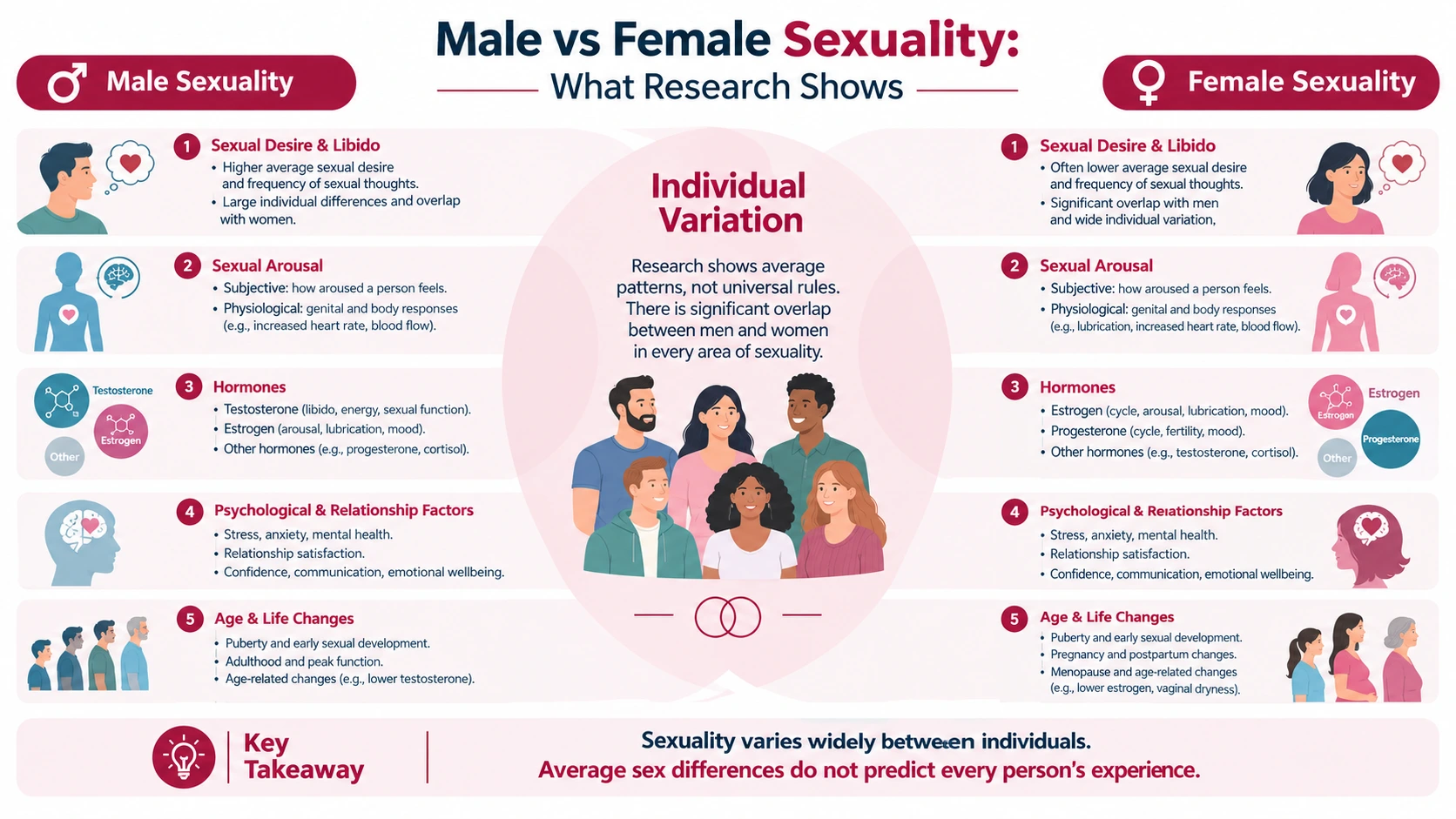
Yes, research has identified some average differences between male and female sexuality, particularly in areas such as sexual desire, sexual thoughts and responses to sexual stimuli. However, these differences are not absolute. Sexuality varies widely between individuals and can be influenced by hormones, age, physical health, stress, relationships, medications and psychological factors.
In simple terms, men and women can show different patterns of sexual desire and arousal, but there is considerable overlap between the two. Individual experiences are often more important than broad assumptions about sex.
Is There a Difference Between Male and Female Sexuality?
Yes, but the differences are patterns, not rules. When researchers aggregate hundreds of studies, they find consistent average gaps between men and women, yet those averages hide enormous individual variation. A large meta-analysis combining 211 studies and more than 620,000 people found that men report a stronger sex drive than women, with a medium to large effect size. Men think about sex more often, fantasize more frequently and variably, and masturbate more than women do.
That said, other researchers argue the picture is more complicated. When scientists measure unconscious sexual motivation or genital responses rather than self-reported questionnaires, the male-female gap shrinks considerably, suggesting that social learning and cultural expectations shape how people report desire even when the underlying drive is similar. So the differences between men and women sexually are partly genuine and partly a reflection of how sexuality is expressed and measured.
Relationship context can also influence how people experience and express desire, making sexual responsiveness an important part of understanding sexual differences.
Decades of research point to four broad patterns that consistently appear across studies:
- Men show greater sexual desire on average than women do.
- Women place more emphasis on committed relationships as a context for sex.
- Aggression is more closely linked to sexuality for men than for women.
- Women’s sexuality tends to be more flexible and changeable over time.
Do Men Have a Higher Sex Drive Than Women?
On average, yes. This is one of the most robust findings in the field. Across spontaneous thoughts, frequency of fantasies, desired frequency of intercourse, desired number of partners, masturbation, and willingness to initiate or refuse sex, men consistently report stronger and more frequent sexual motivation. No major study has found the reverse pattern, that is, no credible body of evidence shows women having a systematically higher drive than men.
However, higher does not mean always higher for every person. There is substantial overlap between the sexes, and the gap is about averages, not absolutes. A few points are worth keeping in mind:
- At any given age, many women have a stronger libido than most men of that age.
- The reported gap narrows when researchers adjust for biased or socially desirable responding.
- A stronger drive says nothing about who enjoys sex more or whose capacity for pleasure is greater.
So while the male vs female sexual desire difference is real, treating it as an absolute would be a mistake. Those are separate questions entirely.
It also matters that the difference does not extend to enjoyment. Men having a stronger drive says nothing about who enjoys sex more, who reaches orgasm more reliably, or whose capacity for pleasure is greater, those are separate questions entirely.
Sexual desire can also change with age, relationships, health and lifestyle, which is why some people may want to be more sexually active at different stages of life.
Male vs Female Libido: Spontaneous vs Responsive Desire
One of the most important insights in modern sexology is that desire does not always arrive uninvited. For much of the 20th century, the standard model based on Masters and Johnson’s work described a linear path: desire leads to arousal, which leads to a plateau, orgasm, and resolution. That model fits many men well, because men more often experience spontaneous desire, a drive that appears on its own.
Women, however, frequently experience responsive desire. Rosemary Basson’s influential circular model reframes female sexuality as intimacy-based: a woman may begin a sexual encounter feeling sexually neutral, but emotional closeness, receptive context, and physical stimulation gradually ignite arousal, and desire emerges after arousal begins rather than before it. This is not a dysfunction, it is simply a different, equally valid pathway.
The practical takeaway is that differences in sexual desire between partners often reflect a mismatch between spontaneous and responsive styles, not a deficit in either person. Understanding this can defuse a great deal of unnecessary conflict in relationships.
Sexual Arousal in Men and Women: How the Body Responds
Both sexes move through the same four phases of the male and female sexual response, excitement, plateau, orgasm, and resolution, but the timing and intensity differ. A systematic review of brain imaging studies found that the neurological differences between women and men are most pronounced during the excitement and plateau phases, while the brain activity during orgasm itself looks remarkably similar across sexes. In other words, the destination is alike; the journey there is not.
The conditions required for arousal also differ. For men, arousal tends to be more direct and genitally focused, driven strongly by visual and physical cues. For women, arousal is more multifaceted and context-dependent, mood, emotional safety, relationship quality, and environment all play a larger role. The clitoris and penis share similar vascular mechanisms, but the psychological landscape around them is shaped very differently.
After orgasm, the contrast becomes physical. Men enter a refractory period during which they cannot become aroused again, a state driven partly by a surge of prolactin that temporarily suppresses desire. Women generally do not have an equivalent refractory period, which is why multiple orgasms are possible for many women. Notably, after climax, sexual arousal and desire fall faster and more consistently in men than in women, whose arousal may linger longer.
Persistent difficulties with desire, arousal, orgasm or sexual comfort can sometimes fall under conditions such as female sexual dysfunction and may warrant professional assessment.
Hormones and Sexual Desire: The Biological Engine
Hormones are the backstage machinery behind male and female sexual differences, but they work differently in each sex. Testosterone has roles beyond sexual desire, which is why understanding the effects of testosterone on men’s health provides useful context when discussing male libido.
In men, testosterone is the primary conductor. It regulates desire, arousal, and erectile function through coordinated pathways involving dopamine and nitric oxide. When testosterone drops below healthy levels, desire and erectile function tend to decline, and testosterone therapy can restore them in clinically deficient men. Male hormone production is also relatively steady, cycling slowly rather than monthly, which helps explain why men’s desire tends to be more stable over short periods.
In women, the hormonal story is more layered. Testosterone plays a role, it is linked to solitary desire and to overall sexual function in women, but it is not the whole story. Estrogen is positively correlated with desire, while progesterone tends to dampen it, meaning a woman’s libido can rise and fall across her menstrual cycle as these hormones shift. Oxytocin, released during intimacy and orgasm, deepens bonding and emotional receptivity, adding another layer that makes female desire more emotionally entwined. Crucially, testosterone in women is linked negatively to partnered desire when stress is accounted for, showing that factors affecting sexual desire interact rather than act in isolation.
| Hormone | Role in Men | Role in Women |
|---|---|---|
| Testosterone | Primary driver of desire and erection; steady production | Linked to solitary desire; interacts with stress; lower levels |
| Estrogen | Supports some sexual function | Positively correlated with desire; cycles monthly |
| Progesterone | Minor role | Tends to reduce desire, especially in luteal phase |
| Oxytocin | Supports bonding and afterglow | Enhances bonding, receptivity, and emotional intimacy |
| Prolactin | Triggers refractory period after orgasm | Less directly tied to a refractory period |
Are Sexual Differences Biological or Psychological?
The most accurate answer is: both, intertwined. The male vs female libido gap has biological roots in hormones and neurochemistry, but it is also shaped by psychology, culture, relationship context, and even how people are taught to think about sex.
Women’s desire is more strongly influenced by relational and emotional factors, and it tends to be more malleable, capable of shifting more dramatically over a lifetime. Men’s desire, by contrast, is more stable and more closely tied to biological signals. Yet when researchers strip away social expectations and measure implicit motivation or genital response, the sexes look far more similar than questionnaires suggest. This tells us that at least part of the reported difference is a product of sexual scripts learned from culture rather than hardwired biology.
So if you are asking whether the male and female sexual differences are real, the answer is that the biological foundation is real, but the psychological and social layers amplify, shape, and sometimes distort it.
Does Age Affect Male and Female Sexuality?
Yes, and the effect is not symmetric. Sexual desire declines with age in both sexes, but the decline is steeper and begins earlier for women, particularly around menopause. A large study of over 8,000 participants found that men maintain higher levels of desire into older age, while women experience a sharper drop, especially after 50, so the gap between the sexes actually widens over time.
Interestingly, the peaks also differ. Male libido often peaks in the 20s, while many women report their desire cresting in their 30s, a pattern that may reflect a mix of biological timing, growing sexual confidence, and changing relationship dynamics. After 60, men’s average desire finally falls below the highest levels women ever report.
Menopause deserves special mention. Three out of four major studies of the menopause transition noted declines in sexual desire, driven by falling estrogen, vaginal changes, and shifting life circumstances. But age is not a cliff. Many older adults remain sexually active and motivated well into their 70s and 80s, with sexual receptivity remaining meaningful for women even as spontaneous proceptivity declines.
Can Stress Affect Sexual Desire in Men and Women?
Absolutely, and stress is one of the most powerful factors affecting sexual desire in both sexes, though, again, the impact is uneven. Feelings of stress inhibit moment-to-moment desire and arousal, consistent with the brain’s dual control system that can either accelerate or brake sexual response.
Chronic stress is especially damaging. Sustained cortisol exposure suppresses libido and disrupts the hormonal balance that supports arousal, and in women, high chronic stress has been shown to lower genital arousal even when psychological arousal remains intact. Women appear more vulnerable to stress-related drops in desire, particularly emotional and relational stress, while men’s stress more often works through testosterone suppression and erectile function.
There is a curious wrinkle: acute, moderate stress can sometimes stimulate sexual activity as a coping mechanism, whereas prolonged or intense stress reliably erodes desire. The lesson is that managing stress is not just good for general health, it is one of the most direct levers for protecting a healthy sex drive.
What Affects Libido in Men and Women? A Quick Summary
- Hormones, testosterone in men; estrogen, progesterone, and testosterone in women.
- Relationship quality, emotional intimacy weighs more heavily on female desire.
- Stress, chronic stress suppresses libido in both sexes, with women often more affected.
- Age, desire falls in both, but drops earlier and more steeply for women.
- Mental health, depression and anxiety dampen desire and arousal in both sexes.
- Medications, antidepressants, hormonal birth control, and blood pressure drugs can alter libido.
- Lifestyle, sleep, exercise, alcohol, and body image all shift the baseline of desire.
- Cultural scripts, learned expectations shape how desire is felt, expressed, and reported.
The Bottom Line
The difference between male and female sexuality is not a myth, but neither is it a rigid rule. Men tend to have a stronger, more spontaneous, and more stable drive, while women’s desire is more responsive, context-sensitive, and changeable. Hormones set the biological stage, but relationships, stress, age, culture, and individual psychology all direct the performance.
Understanding these patterns is not about labeling one approach as normal and the other as broken. It is about recognizing that sexual arousal in men and women can follow different routes to the same destination, and that honoring those differences, rather than judging them, is the foundation of a healthier, more fulfilling intimate life.
Visit Our Site: australiarxmeds.com
FAQ
Is there a difference between male and female sexuality?
Yes. On average, men report stronger and more frequent sexual desire, while women's desire is more context-dependent, emotionally influenced, and responsive rather than spontaneous. These are statistical patterns, though, individual variation is wide.
Do men have a higher sex drive than women?
On average, yes. Research consistently shows men think about sex more, fantasize more, and masturbate more than women. But the gap narrows when biased responding is adjusted for, and many individual women have higher drive than many individual men.
What is the difference between male and female sexual desire?
Men more often experience spontaneous desire that arises on its own, while women more often experience responsive desire that emerges from emotional intimacy and stimulation. Women's desire also fluctuates more across the lifespan and the menstrual cycle.
Do men and women experience sexual arousal differently?
They share the same four-phase response cycle, but arousal conditions are more complex and multifaceted for women, while men's arousal is more directly genitally focused. Brain activity differs most during excitement and plateau, but looks similar during orgasm.
What affects libido in men and women?
Hormones, relationship quality, stress, age, mental health, medications, lifestyle, and cultural expectations all shape libido, with hormones and stress being especially powerful.
Are sexual differences biological or psychological?
Both. Biology provides the hormonal and neurological foundation, but psychology, relationships, and culture amplify or reshape it. When social expectations are removed, the sexes look more similar than questionnaires suggest.
Can stress affect sexual desire in men and women?
Yes. Chronic stress suppresses libido in both sexes by disrupting hormones and arousal. Women are often more vulnerable to stress-related desire loss, especially from emotional and relational stress.

Years of Experience: 10+ years Education: B.Sc. in Biomedical Science (Monash University, Melbourne, Australia) PG Diploma in Health & Medical Communication (University of Sydney, Australia) Experience: Erica Wilson is an…