

The Symptoms of an Unhealthy Relationship: Signs to Watch For
By Erica Wilson, Dec-11-2023


 Dr. Arjun Srivastav Medical Reviewer (Pharm D)
Most couples disagree, and that is completely normal. Two people will not see everything the same way, and working through those differences is part of being together.
The concern begins when disrespect, control, manipulation or ignored boundaries stop being rare moments and start becoming a routine. Repeated patterns like these are the real symptoms of an unhealthy relationship, not a single difficult day.
It helps to remember that unhealthy does not automatically mean abusive. A relationship can be unhealthy because of poor communication or unbalanced choices, while still being free from threats or fear. Recognising where things sit on that spectrum helps people make better decisions.
This guide walks through the symptoms of an unhealthy relationship across emotional, behavioural, digital, financial and sexual warning signs so you can recognise what is happening and understand your options.
Quick Answer: What Are the Symptoms of an Unhealthy Relationship?
An unhealthy relationship may involve repeated patterns that affect your
respect, trust, boundaries, independence or sense of safety.
- 🚩 Constant criticism or disrespect
- 🚩 Controlling or possessive behaviour
- 🚩 Repeated boundary violations
- 🚩 Isolation from friends or family
- 🚩 Manipulation, pressure or intimidation
- 🚩 Feeling anxious, unheard or like you are walking on eggshells
What Is an Unhealthy Relationship?
An unhealthy relationship is one where the balance of respect, trust and shared choices has broken down. The connection starts to feel draining, unsafe or one sided instead of supportive.
Several features tend to show up together. Poor communication means concerns go unheard or turn into arguments. A lack of respect shows up when feelings or opinions are treated as unimportant. A lack of trust turns ordinary moments into suspicion.
Unbalanced decision making leaves one person carrying most of the control. Boundary problems appear when personal space, privacy or time are not respected. Controlling behaviour can shape where someone goes and who they see.
Emotional manipulation can make a person doubt their own judgement. Isolation slowly cuts someone off from their support network. Persistent stress becomes the normal background feeling of the relationship.
An unhealthy relationship is not simply one where two people disagree. Disagreement is healthy when both people can speak freely and repair the problem, much like the fulfilling connection described in Satiating Relationships. What makes a relationship unhealthy is when the same harmful patterns repeat and one person feels smaller or less free over time. Knowing the symptoms of an unhealthy relationship helps you tell the difference early.
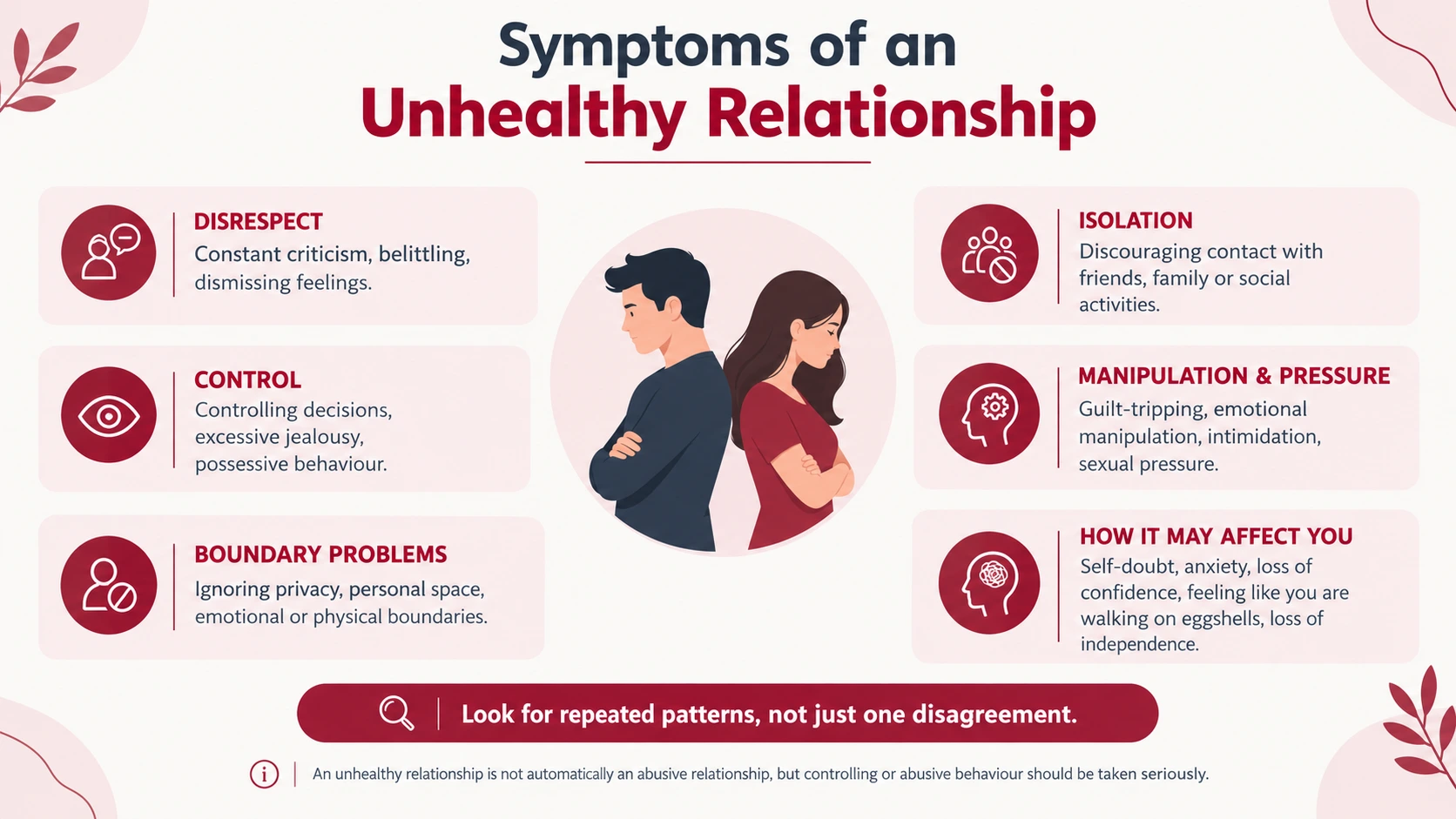
10 Common Symptoms of an Unhealthy Relationship
1. You Feel Disrespected or Dismissed
Respect is the foundation that holds everything else together. When it is missing, your opinions may be ignored during conversations and your feelings minimised or brushed aside.
Your needs can be treated as unimportant compared to your partner needs. Over time this teaches you that speaking up is pointless, so you start staying quiet to avoid frustration.
Feeling dismissed regularly is one of the earliest symptoms of an unhealthy relationship. It often appears before the more obvious behaviours do.
2. Communication Is Constantly Negative
Poor communication in relationships does not always mean silence. Sometimes it looks like frequent arguments over small things, shouting instead of talking, or blaming the other person instead of looking at the problem.
The silent treatment can be used as punishment. Personal attacks can replace real conversation, and the same issues come up again and again without ever being resolved.
When every discussion turns into a battle, communication has stopped being a tool for connection and has become a source of stress. This is one of the most common symptoms of an unhealthy relationship.
3. Trust Is Replaced by Suspicion
A healthy connection needs trust to function. When trust fades, it is often replaced by constant accusations and checking your whereabouts.
You may face extreme jealousy over ordinary interactions and suspicion aimed at your friends or coworkers. A lack of trust in a relationship turns simple moments into tests you have to pass.
Jealousy in relationships becomes a problem when it is used to limit who you see or to make you feel guilty for normal social contact.
4. Your Partner Tries to Control You
A controlling relationship often centres on everyday decisions that should be yours to make. Your partner may decide where you go, who you see, what you wear, and what you do with your time.
They may also control who you communicate with. Controlling behaviour in relationships can be obvious or subtle, but the result is the same.
Your choices shrink and your independence narrows until you are checking with someone else before making basic decisions about your own life. This level of control is among the key symptoms of an unhealthy relationship.
5. Your Boundaries Are Repeatedly Ignored
Relationship boundaries are the lines that keep each person feeling safe and respected. When those lines are crossed again and again, boundary violations become a pattern.
This can involve your privacy being invaded, your personal space treated as optional, and your time consumed without consideration. Your physical or emotional boundaries may be pushed past what you have said is okay.
Boundaries only work when both people respect them, and ignoring them is a clear warning sign.
6. You Are Becoming Isolated
Isolation from friends and family is one of the most damaging patterns because it often happens slowly. You may notice you see your friends less and family gatherings become difficult.
Social activities can feel like too much effort, and your hobbies quietly disappear. Sometimes this happens because your partner discourages outside contact, and sometimes because you withdraw to avoid conflict.
Either way, your support network shrinks right when you need it most. This quiet withdrawal is something people often miss.
7. You Are Constantly Criticised or Put Down
Criticism that never stops wears away at how you see yourself. This can sound like insults, belittling comments, and humiliation in front of others.
It can include attacks on your appearance or your abilities. The message underneath is that you are not enough, and hearing it often enough can make you start to believe it.
Healthy feedback helps someone grow. Constant criticism only makes a person smaller and should not be ignored.
8. You Feel Like You Are Walking on Eggshells
Walking on eggshells describes the feeling of constantly monitoring your partner mood. You avoid topics you know will cause a reaction and change your normal behaviour to prevent an outburst.
You start editing yourself before you speak. Your focus shifts from living your life to managing someone else emotions.
This is exhausting, and it shows the relationship has become unsafe in an emotional sense.
9. You Keep Sacrificing Your Needs
In a balanced relationship both people give and take. In an unhealthy one, you may find you are always apologising and always giving in to keep the peace.
You can feel responsible for managing your partner emotions. Your needs move to the bottom of the list, and the relationship starts to revolve around avoiding conflict rather than genuinely connecting.
Constant self sacrifice is a pattern that tends to grow worse over time.
10. You Feel Like You Are Losing Yourself
Over time, unhealthy patterns take a real toll on your identity. You may notice you are abandoning hobbies you used to love and losing friendships that mattered.
You might change your personality to suit your partner, give up personal goals, and lose your independence bit by bit. These are relationship red flags that show the impact has gone beyond difficult moments and into who you are as a person.
Losing your sense of self is one of the deepest symptoms of an unhealthy relationship because it affects who you are, not just how you feel.
Emotional Symptoms of an Unhealthy Relationship
Most lists focus on what a partner does. It is just as important to notice what happens inside you.
The emotional symptoms of an unhealthy relationship often appear before you can name what is wrong. They are valid warning signs on their own.
You Constantly Second Guess Yourself
Self doubt creeps in when your judgement is questioned often enough. You start checking your memory, wondering if you are overreacting, and looking to someone else to confirm what you think.
This relationship stress can make even simple decisions feel uncertain, and people rarely connect it to their situation.
You Feel Anxious or On Edge
A fear of conflict keeps your nervous system alert. You might feel tense before your partner comes home and worry about how they will react to small things.
You carry a background hum of anxiety that never quite switches off. Changes in intimacy can also affect how someone experiences a relationship emotionally. For some couples, it may be useful to understand the emotional impact of a sexless relationship separately from broader relationship problems.
Your Confidence Has Changed
Reduced confidence is one of the clearest emotional signs. If you used to feel sure of yourself and now second guess your worth, your abilities or your appearance, the relationship may be part of why.
You Feel Responsible for Their Emotions
Emotional exhaustion often comes from carrying responsibility that is not yours. When you believe it is your job to keep your partner happy, calm or stable, you end up living around their moods instead of your own life.
You No Longer Feel Like Yourself
When the person you are in the relationship does not match the person you are outside of it, something needs attention. This sense of disconnection is common in situations that involve emotional abuse, even when nothing physical has happened.
Look for Patterns, Not Just One Bad Moment
One of the most useful ways to read your relationship is to look at patterns instead of isolated moments. A single argument, one jealous comment or a difficult week does not automatically define a relationship.
Everyone has bad days. What matters is what happens over time. Four things help you tell the difference.
- Frequency asks whether the behaviour happens repeatedly. A one off mistake is different from something that shows up week after week.
- Intensity asks whether the behaviour is becoming more severe. Arguments that get louder, control that tightens, or criticism that gets harsher are signs of escalation.
- Impact asks how the behaviour is affecting you. Is it changing your confidence, your freedom or your wellbeing?
- Response asks what happens when you raise a concern. Does the person listen and take responsibility, or does the concern get turned back on you?
Thinking in these terms gives you a clearer framework than a simple red flag checklist. It helps you understand how to know if your relationship is unhealthy based on what is actually happening, not just on how a single moment felt. Tracking these patterns is how you separate normal ups and downs from the true symptoms of an unhealthy relationship.
Digital Signs of an Unhealthy Relationship
Technology has added a new layer to how relationships work, and it has added new warning signs too. Digital abuse can include checking your phone without permission, demanding your passwords, and monitoring your social media activity.
It can also involve tracking your location, expecting immediate replies to messages, questioning your online contacts, and becoming angry when you do not respond fast enough.
There is an important difference between communication and surveillance. Staying in touch is healthy. Keeping tabs on someone, reading their messages, or tracking where they go is controlling behaviour in relationships, not care. Phone monitoring in relationships and social media monitoring become problems when they are used to watch, limit or pressure a partner. These digital behaviours are modern symptoms of an unhealthy relationship.
Sexual Pressure and Ignored Boundaries
Sexual boundaries are a core part of any intimate relationship. Healthy intimacy also involves being able to communicate openly about preferences, comfort and boundaries. Understanding sexual responsiveness in a relationship can help couples recognise that intimacy should involve mutual communication rather than pressure. Warning signs can include pressure to have sex when you do not want to and feeling guilty after saying no.
You may find a refusal ignored, or be pressured around contraception. Unwanted touching and being pushed to send intimate images are also warning signs.
The core idea is simple. Consent in relationships must be freely given, and it can be withdrawn at any time. Sexual pressure is not passion. It is one of the symptoms of an unhealthy relationship that deserves serious attention.
Financial Control Can Be a Warning Sign
Money is another area where control can quietly take hold. Financial control in relationships can look like controlling access to money, monitoring every purchase, and taking someone income.
It can also involve preventing someone from working, controlling bank accounts, or creating financial dependence that makes leaving difficult.
It helps to distinguish between normal financial disagreements and something more serious. Couples argue about money all the time. The concern is when money is used to control another person choices or independence. When finances become a tool for limiting freedom rather than a shared responsibility, that is a warning sign and another of the symptoms of an unhealthy relationship.
When Control Is Disguised as Love or Concern
Some of the hardest behaviours to recognise are the ones wrapped in caring language. A partner might say they are only checking your phone because they care, that they dislike your friends because they are protecting you, or that they need to know where you are because they are worried.
The stated reason does not automatically make the behaviour healthy. Possessive behaviour and manipulation in relationships often hide behind concern.
The question to ask is whether the behaviour respects your privacy, your boundaries, your freedom and your independence. If it does not, the reason behind it does not change what is actually happening.
Unhealthy Relationship vs Abusive Relationship
Understanding the difference helps you respond in the right way. They sit on the same spectrum, but they are not the same thing.
An unhealthy relationship may involve poor communication, frequent conflict, boundary problems, jealousy, emotional distance and unequal decision making. These are serious problems that cause real harm and deserve attention.
A potentially abusive relationship may involve threats or intimidation, fear based control, repeated boundary violations, extreme control, deliberate emotional abuse and coercive control.
The key distinction is that abuse involves a pattern of behaviour used to create fear, domination or control. Not every unhealthy relationship is abusive, but abuse and coercive control are serious forms of unhealthy relationship behaviour. If fear is present, the situation has moved beyond ordinary relationship difficulty.
Unhealthy Relationship vs Normal Conflict
It is also worth separating an unhealthy relationship from normal conflict. Even healthy couples argue.
Normal relationship conflict can include different opinions, occasional arguments, misunderstandings and frustration. In healthy conflict both people can generally communicate openly, listen to each other, disagree safely, compromise when needed, apologise when they are wrong, and repair the problem afterwards.
An unhealthy pattern instead involves repeated unresolved conflict, fear, control, humiliation and ignored boundaries. The repair never quite happens, and the same issues return in the same forms. Learning to tell these apart is how you spot the symptoms of an unhealthy relationship without overreacting to normal bumps in the road.
How to Know If Your Relationship Is Unhealthy
Reflective questions can be more useful than a scoring quiz because they help you notice what is actually true for you. If you recognise these patterns, it can help to step back and think about what needs to change before deciding what comes next. For couples who are dealing with relationship difficulties, learning how to rebuild a long-term relationship can be one possible starting point.
Consider the following:
- Can I say no without being punished?
- Can I disagree without being afraid?
- Can I spend time with friends and family?
- Are my boundaries respected?
- Can I make decisions independently?
- Do I feel supported?
- Do I feel like myself?
- Am I constantly trying to prevent their reaction?
- Has the same behaviour happened repeatedly?
If several of your honest answers point in a worrying direction, that is useful information about how to tell if you are in an unhealthy relationship. You do not need a certain number of signs before your concerns are valid. The symptoms of an unhealthy relationship are worth taking seriously even when only a few show up.
What Can You Do If You Recognise These Signs?
If something in this guide sounds familiar, there are practical steps you can take.
- Recognise the pattern. Repeated behaviour is information. Try not to automatically dismiss it or explain it away as a one off.
- Talk to someone you trust. A friend, a family member or a professional can help you see the situation more clearly. Isolation grows in silence.
- Set boundaries where it is safe. Boundaries are healthy, but your safety comes first. If raising a concern could put you in danger, prioritise safety over confrontation.
- Consider professional support. Counselling or specialist support may help depending on your situation. You do not have to figure it out alone.
- Prioritise safety. If there are threats, violence, stalking or coercive control, safety should come before anything else. For Australian readers, 1800RESPECT offers confidential support, and 000 is the number for immediate danger.
How to Support Someone in an Unhealthy Relationship
If someone you know is going through this, your response matters. The way you show up can make a real difference.
Listen without judging and do not blame them for what is happening. Avoid asking why they do not just leave. Take their concerns seriously and stay connected even when it is hard.
Offer practical support, respect their decisions, and help them access professional support when they are ready. Leaving is often more complicated than it looks from the outside.
When to Seek Immediate Help
Some situations need an urgent response. Seek immediate help if there is physical violence, sexual violence, threats, stalking, severe intimidation or any sense of immediate danger.
Final Takeaway
A healthy relationship does not have to be perfect. What matters is whether both people can communicate, maintain boundaries, feel respected and make choices without fear or control.
The most useful way to read your situation is to look at the pattern, the impact, the boundaries, the control, the safety and the independence involved. One difficult moment is not a diagnosis. A repeated pattern that leaves you smaller, less free or less like yourself is worth taking seriously.
Understanding the symptoms of an unhealthy relationship gives you the language to name what is happening and the confidence to act on it.
FAQ
What are the main symptoms of an unhealthy relationship?
The main symptoms of an unhealthy relationship include disrespect, poor communication, lack of trust, controlling behaviour, ignored boundaries, isolation, constant criticism, and feeling like you are losing yourself over time.
What are the warning signs of an unhealthy relationship?
Warning signs include suspicion replacing trust, your partner deciding who you see or where you go, digital monitoring, sexual pressure, financial control, and feeling anxious or on edge around them.
Is arguing normal in a relationship?
Yes, arguing is normal. Healthy couples disagree, but they can also listen, compromise, apologise and repair the problem. The concern is when conflict repeats without resolution or involves fear and control.
What is the difference between an unhealthy and abusive relationship?
An unhealthy relationship has serious problems like poor communication and boundary issues. An abusive relationship involves fear, threats, intimidation or coercive control used to dominate another person.
Can an unhealthy relationship become healthy?
Yes, when both people recognise the patterns, take responsibility and are willing to change, an unhealthy relationship can improve. Professional support can help. Where abuse or control is present, safety comes first.

Years of Experience: 10+ years Education: B.Sc. in Biomedical Science (Monash University, Melbourne, Australia) PG Diploma in Health & Medical Communication (University of Sydney, Australia) Experience: Erica Wilson is an…