

How to Fix Muscle Imbalances: Causes, Exercises and a Step by Step Plan
By Erica Wilson, May-15-2024


 Dr. Arjun Srivastav Medical Reviewer (Pharm D)
Correcting a muscle imbalance is not simply a matter of doing a few extra repetitions on your weaker side. Before you add any volume, it helps to understand what kind of difference you are actually dealing with. The gap could involve strength, muscle size, flexibility, stability, or movement control, and each one calls for a slightly different approach. Once you know what you are looking at, unilateral training and small technique adjustments become far more effective tools than blindly training one side harder.
What Is a Muscle Imbalance?
A muscle imbalance is a noticeable difference between the two sides of your body. That difference can show up in several ways:
- Left and right strength differences: One side produces less force than the other during the same movement.
- Differences in muscle size: One arm or leg may look smaller or less developed.
- Mobility differences: One side may move through a smaller range of motion. If muscle tightness or tension is also affecting your movement, you can explore our range of muscle relaxation medicines for additional information.
- Stability differences: One side may wobble or struggle to hold a position.
- Movement control differences: One side may coordinate a movement less smoothly.
One important point to keep in mind: a muscle can look smaller without necessarily being the weaker muscle. Visual symmetry and functional strength are not always the same thing, which is why you should not treat every visible difference as a problem that needs fixing.
Are Muscle Imbalance Normal?
Yes, to a degree. Perfect symmetry is not realistic. Most people have a dominant side, and small differences between left and right are common. The question is not whether a difference exists, but whether that difference is large enough or consistent enough to matter.
| What you notice | What it may indicate |
|---|---|
| Slight size difference | Normal variation may be involved |
| One side consistently weaker | Worth monitoring |
| Repeated movement compensation | May need attention |
| Persistent pain | Professional assessment may be appropriate |
| Sudden weakness | Seek medical evaluation |
You may have heard the idea that a difference of 10 percent or more between sides signals a problem. Be careful with that rule. Research has found considerable variation in how asymmetry is measured and interpreted, so a specific percentage does not automatically mean someone has a problematic imbalance. Context matters more than a single number.
Why Do Muscle Imbalance Happen?
Most imbalances develop from repeated patterns rather than from a single event. Here are five practical causes:
1. Dominant side habits
Using your preferred hand or leg repeatedly throughout the day builds up small differences over time.
2. Training habits
Bilateral exercises can hide differences because your stronger side does more of the work. Poor technique, uneven loading, and repeating the same movement patterns without variation can all reinforce an existing gap.
3. Previous injury
A previously injured side may remain weaker or move differently even after it has healed, especially if you unconsciously protected it during recovery. If you are dealing with unexplained muscle discomfort or strain, it can also help to understand what causes muscle strain without injury.
4. Everyday habits
Carrying a bag on one shoulder, standing predominantly on one leg, sitting in the same crossed position, or doing repetitive work can all contribute.
5. Sport specific activity
Tennis, golf, throwing, and other sports naturally involve asymmetrical movement. This is not inherently bad, but it can create differences that are worth managing.
How Do You Know If You Have a Muscle Imbalance?
This is where most people guess. A few simple observations can tell you a lot.
Common signs
- One arm or leg looks noticeably smaller
- One side fatigues earlier than the other
- You have a different range of motion on each side
- Your balance feels uneven
- One knee collapses or moves differently during squats
- Your weight shifts to one side during a movement
- Your bar path is uneven during presses
- One side feels tighter than the other
Try This 5 Minute Muscle Imbalance Check
Use this as a practical self check. It takes about five minutes and needs minimal equipment.
- Compare single leg movement: Try a controlled step down or a single leg sit to stand on each side. Notice control, depth, and stability.
- Compare single leg bridges: Do the same number of repetitions on each side and compare stability and control.
- Compare single arm movements: Use a light resistance and perform the same movement on each side. Notice where one side struggles.
- Record a bilateral movement: Film a squat, press, or similar movement from the front and the side. Watch for shifting and uneven paths.
- Repeat the test: Do not decide you have an imbalance based on one poor repetition. Test again on another day to confirm the pattern.
Important: this is a self check, not a medical diagnosis. If something feels wrong or painful, stop and seek professional advice.
How to Find Which Side Is Actually Weak
This is where a lot of people get it wrong. The side that looks smaller is not automatically the side that needs more training. To find the genuinely weaker side, compare the following:
- Controlled repetitions you can complete on each side
- The resistance you can use with good form
- Range of motion
- Stability throughout the movement
- How quickly each side fatigues
- Overall movement quality
The side that performs worse across these measures is the one to focus on, regardless of how it looks in the mirror.
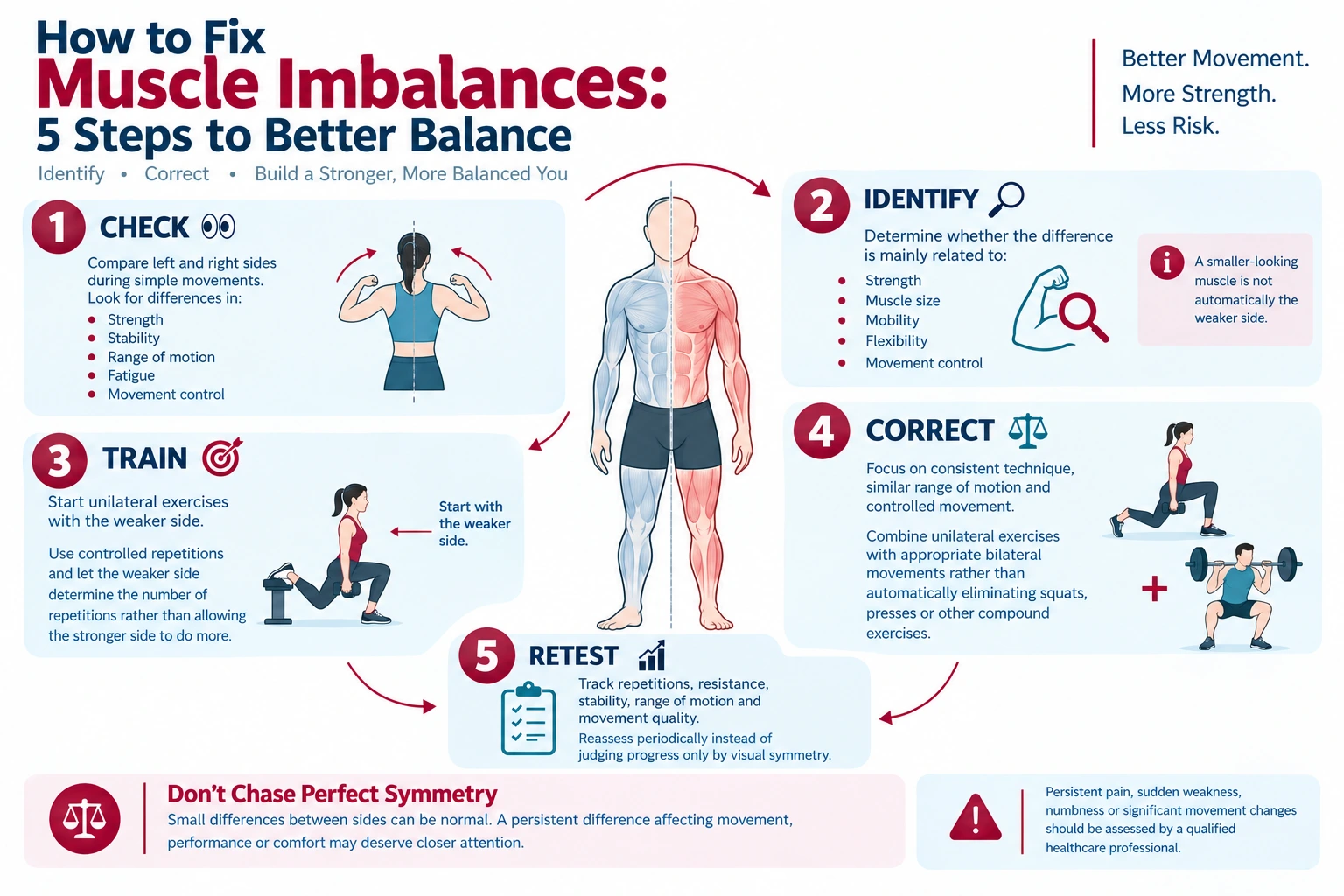
How to Fix Muscle Imbalance Step by Step
Once your technique becomes more consistent, gradually increase resistance or repetitions while allowing enough recovery between sessions. Understanding how often you should work out can also help you avoid repeatedly loading the same muscles without adequate recovery.
1. Start With the Weaker Side
Perform your unilateral exercises with the weaker side first. When you are fresh, you can focus on control and quality, which gives the weaker side the best chance to improve.
2. Let the Weaker Side Set the Reps
If your weaker side performs 8 controlled repetitions, do not automatically perform 12 on the stronger side. Match the stronger side to the weaker side. This lets the weaker side catch up rather than letting the stronger side pull further ahead.
3. Use Unilateral Exercises
Single side movements prevent the stronger side from compensating for the weaker one. Because each side works independently, you cannot hide a difference the way you can in a bilateral exercise.
4. Improve Your Technique
Use video to review your movement and look for:
- Hip shifting to one side
- Uneven bar movement
- Different depth on each side
- Rotation of the torso
- Weight transfer to one foot
Small technique faults can reinforce an imbalance even when your program is well structured.
5. Do Not Automatically Abandon Bilateral Exercises
You do not have to stop squats, deadlifts, or bench presses. Bilateral movements are still valuable for building overall strength. Use unilateral exercises to complement them, not to replace them entirely.
6. Progress Gradually
Once your control improves, you can start to progress:
- Increase the resistance
- Increase the number of repetitions
- Increase your range of motion
- Progress to a more challenging exercise variation
Each step should build on stable control from the previous one.
Should You Train the Weaker Side More?
It depends on the size of the difference and how it behaves.
- Mild difference: Equal sets with unilateral training may be enough. Matching the stronger side to the weaker side is often all you need.
- Persistent difference: Some additional work on the weaker side may be appropriate, added gradually.
- Pain or significant weakness: Do not simply keep adding volume. Get assessed before increasing the load.
The oversimplification of “just train the weak side twice as much” often leads to frustration or setbacks. A measured approach works better.
• Single-arm triceps extensions
• Single-arm cable press
• Single-arm pulldown
• Step-ups
• Single-leg press
• Single-leg curl
Glutes
• Single-leg hip thrust
Keep each repetition controlled and use a similar range of motion on both sides. The goal is balanced movement, not simply lifting heavier or doing more repetitions.
Muscle imbalance and muscle discomfort are not always the same problem. If you are specifically researching medicines used for muscle relaxation, you can also read about muscle relaxant medicines and their uses.
How Do You Know If Your Muscle Imbalance Is Improving?
You don’t need to achieve perfect symmetry to make progress. Small differences between the left and right sides can be normal. More useful signs are better control, more consistent movement and a gradual reduction in performance differences.
Look for:
- More controlled repetitions on the weaker side
- Better balance and stability
- Less shifting, rotating or compensating during exercises
- A smaller difference in repetitions or resistance between sides
- More consistent range of motion
- Smoother movement with better technique
Tip: Retest the same exercises with similar resistance, repetitions and technique. Comparing different exercises or changing several parts of your routine at once can make it difficult to tell whether the imbalance is actually improving.
Common Mistakes That Can Keep an Imbalance Going
- Doing extra reps only because one side feels weaker
- Adding too much weight too quickly
- Ignoring technique
- Training only the muscle rather than the movement
- Stretching without understanding the restriction
- Trying to achieve perfect symmetry
- Changing exercises constantly
- Ignoring persistent pain
When Should You See a Physiotherapist or Doctor?
Most minor imbalances can be managed with sensible training. However, seek professional assessment if you notice any of the following:
- Persistent pain that does not settle
- Sudden weakness
- Numbness or tingling
- A major loss of movement
- Weakness after an injury
- Recurrent injuries on the same side
- Sudden noticeable changes in how you move
- Symptoms that do not improve with rest and adjustment
Normal asymmetry is not a medical condition. The goal is to recognise when something moves beyond the ordinary and deserves professional attention. For people experiencing recurring muscle spasms alongside an imbalance, our muscle spasm category provides further information on available treatment options.
Conclusion
Fixing a muscle imbalance is not simply about doing more repetitions on the weaker side. Start by identifying what is actually different, whether it is strength, muscle size, mobility, stability, or movement control. From there, use controlled unilateral exercises, let the weaker side guide your repetitions, and continue to include suitable bilateral movements as part of your training.
Track your progress by looking at movement quality, strength, stability, and how consistently both sides perform rather than trying to achieve perfect symmetry. If an imbalance is accompanied by persistent pain, sudden weakness, numbness, or a noticeable change after an injury, speak with a qualified healthcare professional for an appropriate assessment.
FAQ
Can muscle imbalances be fixed?
Yes, most muscle imbalances can be improved with consistent unilateral training, better technique, and gradual progression. Some minor differences may always remain, and that is normal.
How do I fix an imbalance between my left and right sides?
Start with unilateral exercises on the weaker side, let the weaker side set the repetition count, match the stronger side to it, and improve your technique. Track your progress over time rather than guessing.
Should I train my weaker side more?
For a mild difference, equal unilateral sets are often enough. For a persistent difference, some additional work may help. If there is pain or significant weakness, get assessed before adding volume.
Is it normal for one arm to be stronger than the other?
Yes. Small differences between sides are common, especially if you have a dominant arm. The concern is when the difference is large, consistent, or accompanied by pain or poor movement.
What exercises are best for muscle imbalances?
Unilateral exercises such as single arm rows, single leg presses, Bulgarian split squats, and single leg bridges are effective because each side works independently and cannot compensate.
How long does it take to correct a muscle imbalance?
It varies. Small differences may improve within a few weeks of consistent training, while larger or longer standing imbalances can take several months. Consistency and gradual progression matter more than speed.
Can muscle imbalance cause pain?
It can contribute to pain, especially if it leads to repeated compensation or poor movement patterns. However, pain has many causes, so persistent or sudden pain should be assessed by a professional rather than assumed to come from an imbalance.

Years of Experience: 10+ years Education: B.Sc. in Biomedical Science (Monash University, Melbourne, Australia) PG Diploma in Health & Medical Communication (University of Sydney, Australia) Experience: Erica Wilson is an…