


 Dr. Arjun Srivastav
Luliconazole Cream 20g (branded as Lulifin Cream by Sun Pharmaceutical Industries Ltd.) is a broad-spectrum, topical imidazole antifungal formulated with 1% w/w luliconazole. Engineered with a high binding affinity for keratinized tissue, Lulifin targets persistent dermatophyte skin infections including athlete’s foot (tinea pedis), jock itch (tinea cruris), and ringworm (tinea corporis). Its concentrated antifungal activity allows for a simple, once-daily application protocol with shorter treatment courses compared to conventional topical azoles.
Product specifications:
| Clinical & Product Details | Specifications |
| Product Name | Luliconazole Cream 20g |
| Brand / Trade Name | Lulifin Cream (लुलिफ़िन क्रीम) |
| Active Pharmaceutical Ingredient (API) | Luliconazole 1% w/w (10 mg per gram) |
| Pharmacological Class | Chiral Imidazole Antimycotic / Ergosterol Synthesis Inhibitor |
| Formulation | Non-greasy, fast-absorbing topical cream base |
| Packaging Size | 20 g collapsible tube |
| Primary Clinical Indications | Tinea Pedis (Athlete’s Foot), Tinea Cruris (Jock Itch), Tinea Corporis (Ringworm) |
| Daily Application Frequency | Once daily (OD) |
| Standard Course Duration | 7 days (Tinea Cruris/Corporis); 14 days (Tinea Pedis) |
| Administration Route | External cutaneous use only (Not for oral, ophthalmic, or intravaginal use) |
What is Lulifin (Luliconazole Cream 20g)?
Lulifin Cream 20g, is a topical antifungal designed to treat superficial dermatophytic fungal skin infections. The active moiety, luliconazole, is an optically active (R)-enantiomer imidazole molecule containing a distinct dithiolane core.
Unlike older fungistatic treatments that merely pause fungal cell division, luliconazole demonstrates potent fungicidal activity at low concentrations against dermatophytes such as Trichophyton rubrum, Epidermophyton floccosum, and Trichophyton mentagrophytes. This profile enables faster symptomatic relief and reduced treatment duration compared to multi-week, multi-daily alternatives.
How Luliconazole Cream Works: Mechanism of Action
Fungal cells depend on a specific sterol called ergosterol to maintain the stability, fluid transport, and integrity of their cell membranes.
                Fungal Lanosterol
                        │
                        ▼  ◄── [Luliconazole Blocks: Lanosterol 14α-demethylase]
          Ergosterol Biosynthesis Halted
                        │
                        ▼
    Accumulation of Toxic Methylated Sterols
                        │
                        ▼
Perforated Fungal Membrane & Loss of Cellular Contents
                        │
                        ▼
                 FUNGICIDAL CLEARANCE
1. Inhibition of Lanosterol 14α-Demethylase: Luliconazole Cream selectively binds to and inhibits the fungal cytochrome P450 enzyme lanosterol 14α-demethylase.
2. Ergosterol Depletion: By preventing the conversion of lanosterol into ergosterol, the structural backbone of the fungal cell wall collapses.
3. Keratin Reservoir Retention: Lulifin penetrates the stratum corneum (the outermost layer of the epidermis) and binds to local keratin. This creates a sustained reservoir of active medicine that continues eradicating fungal hyphae for up to 24 hours between single applications.
Clinical Uses: What Does Lulifin 20g Treat?
Luliconazole Cream 20g is indicated for superficial dermatophyte infections across the body:
- Athlete’s Foot (Interdigital Tinea Pedis): Eliminates fungal growth localized between the toes that causes maceration, cracking, scaling, peeling, and sharp burning sensations.
- Jock Itch (Tinea Cruris): Treats well-demarcated, intensely itchy fungal rashes within the groin, perianal folds, and upper thighs exacerbated by moisture and friction.
- Body Ringworm (Tinea Corporis): Clears red, circular, raised annular plaques with scaly perimeter margins on the torso, arms, neck, or legs.
Important Limitation: Luliconazole 1% skin cream is not formulated for onychomycosis (fungal nail infections) or tinea capitis (scalp fungal infections). Creams applied to the skin cannot penetrate the dense keratin plate of fingernails or toenails.
Directions for Use: The “1-Inch Margin Rule”
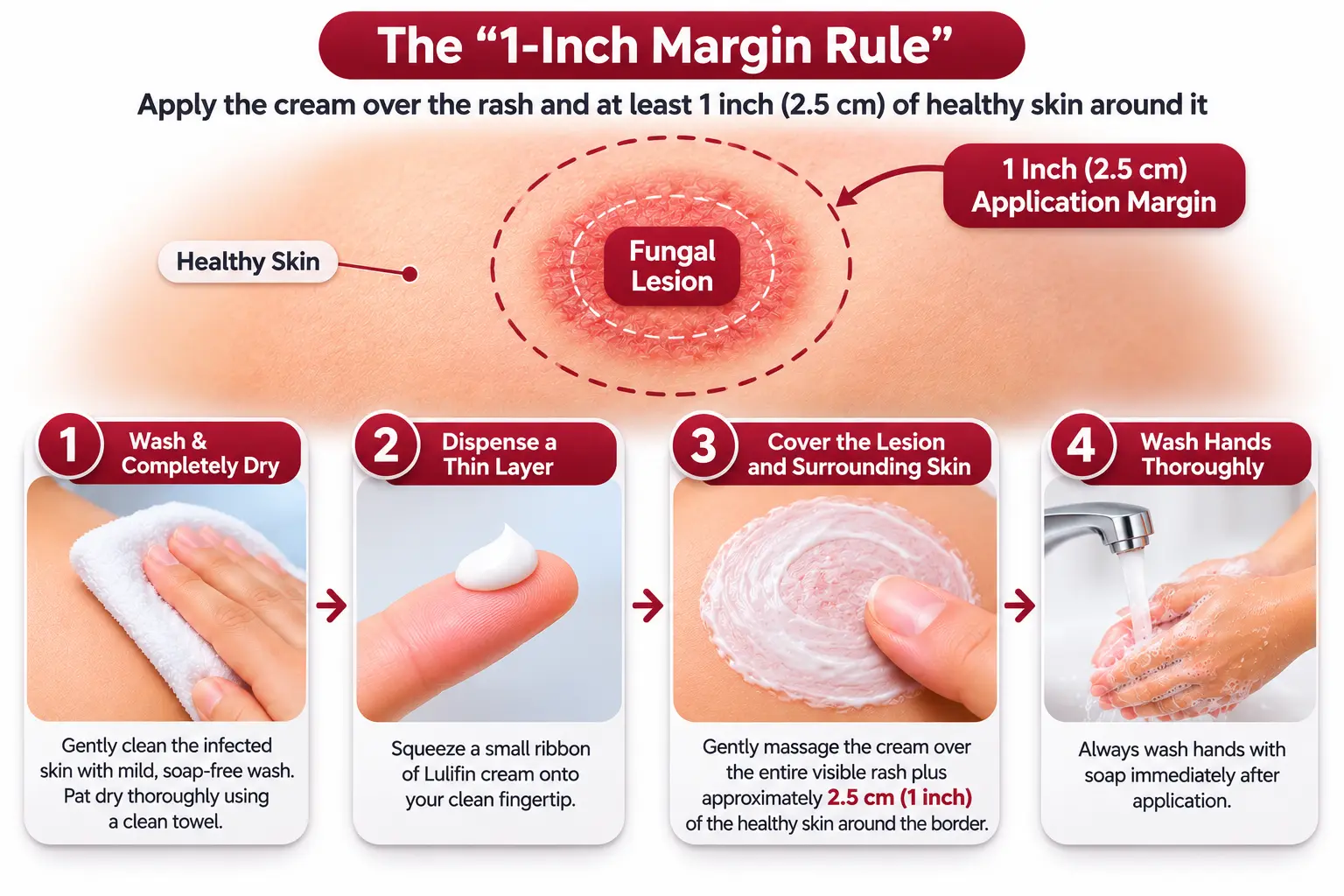
Recommended Treatment Schedules
- Tinea Cruris (Jock Itch): Apply once daily for 1 full week (7 consecutive days).
- Tinea Corporis (Ringworm): Apply once daily for 1 full week (7 consecutive days).
- Tinea Pedis (Athlete’s Foot between toes): Apply once daily for 2 full weeks (14 consecutive days).
Note: Do not stop applying the cream as soon as itching stops. Completing the recommended course ensures complete eradication of subclinical fungal spores, preventing recurring flare-ups.
How Luliconazole Cream Compares to Traditional Antifungals
| Feature | Luliconazole (Lulifin) 1% | Clotrimazole / Miconazole 1–2% | Terbinafine 1% |
| Manufacturer | Sun Pharmaceutical Industries Ltd. | Various Generic Brands | Various Brands |
| Antifungal Action | Highly potent fungicidal (kills fungi) | Fungistatic (slows fungal growth) | Fungicidal (kills fungi) |
| Frequency of Use | Once daily | 2 to 3 times daily | Once or twice daily |
| Jock Itch Course | 7 Days | 14 to 28 Days | 7 to 14 Days |
| Keratin Affinity | Very High (reservoir in stratum corneum) | Moderate | High |
| Texture & Absorption | Smooth, non-greasy absorption | Can feel heavy or occlusive | Light cream |
Safety Profile, Precautions & Potential Side Effects
Because Luliconazole Cream is applied topically to localized areas, systemic absorption into the bloodstream is negligible. Most users experience no significant side effects.
Common, Mild Reactions (Occurring at application site)
- Mild, temporary stinging, warmth, or burning sensation upon initial application.
- Minor localized erythema (redness), dryness, or peeling skin.
Important Clinical Precautions
- External Topical Use Only: Avoid contact with eyes, nostrils, inside the mouth, or genital mucous membranes. If accidental eye contact occurs, rinse immediately and thoroughly with clean water.
- No Tight Occlusive Dressings: Do not cover treated skin with airtight bandages or plastic films unless explicitly directed by a healthcare professional. Occlusion traps moisture, which encourages bacterial proliferation.
- Open Wounds: Do not apply directly to open, weeping, or deeply lacerated skin.
- Pregnancy & Lactation: If pregnant, planning a pregnancy, or breastfeeding, seek medical advice before beginning any new antifungal regimen. If applied near the torso, avoid application to the breast area when nursing.
Storage and Handling
Store your Luliconazole Cream 20g tube at controlled room temperature between 20°C and 25°C, away from excessive direct heat and moisture. Ensure the screw cap remains tightly closed after each use to keep the cream base stable and uncontaminated. Keep securely out of reach of children.
FAQs
What is Lulifin Cream 20g used for?
Lulifin Cream 20g is a topical antifungal cream, containing 1% luliconazole. It is clinically formulated to treat fungal skin infections including athlete's foot (tinea pedis), jock itch (tinea cruris), and ringworm (tinea corporis).
How often do I apply Luliconazole Cream 20g?
Luliconazole Cream is applied once daily to the affected area and approximately 2.5 cm (1 inch) of the surrounding healthy skin. Applying it more than once per day will not speed recovery and may irritate the skin.
How long does a 20g tube of Lulifin last?
A 20g tube provides sufficient volume for typical treatment courses: 7 days of once-daily application for jock itch or ringworm, or 14 days for athlete's foot across both feet.
Can I use Luliconazole Cream on my face?
Lulifin is primarily indicated for the feet, groin, and body. The skin on the face is thinner and more sensitive, and application close to the eyes, nose, or mouth carries a risk of mucous membrane irritation. Always consult a GP or dermatologist before applying topical antifungals to facial rashes.
What is the difference between Luliconazole and Clotrimazole?
While both are imidazole antifungals, luliconazole is a newer generation agent with significantly higher potency against dermatophytes. Clotrimazole typically requires application 2 to 3 times daily for 2 to 4 weeks, whereas luliconazole works with once-daily application and shorter treatment periods (1 to 2 weeks).


