






Fertomid 50 is an oral ovulatory stimulant manufactured by Cipla Ltd., containing 50 mg of Clomiphene Citrate IP. It is the internationally recognized first-line medical therapy for women experiencing subfertility caused by anovulation (failure to produce or release an egg), irregular cycles, and Polycystic Ovary Syndrome (PCOS). By temporarily blocking estrogen receptors in the hypothalamus, Fertomid 50 prompts the pituitary gland to increase production of natural Follicle-Stimulating Hormone (FSH) and Luteinizing Hormone (LH), facilitating the development, maturation, and release of a viable egg.
Product Specifications
| Clinical Parameter | Formulation Details |
| Product Trade Name | Fertomid 50 / Fertomid-50 |
| Active Pharmaceutical Ingredient (API) | Clomiphene Citrate IP (50 mg per tablet) |
| Pharmacological Class | Selective Estrogen Receptor Modulator (SERM) / Ovulation Stimulant |
| Dosage Strength & Format | 50 mg oral scored tablet |
| Primary Indication | Female Infertility, Oligo-ovulation, PCOS |
| Standard Regimen | 5 consecutive days per menstrual cycle |
| Expected Ovulatory Response | 5 to 10 days after the final tablet of the 5-day cycle |
| Elimination Half-Life | ~5 to 7 days (the zuclomiphene isomer persists longer in tissue) |
| Australian Schedule | Schedule 4 (S4 / Prescription Only Medicine) |
| Pregnancy Classification | Category X (Must never be taken during pregnancy) |
What is Fertomid 50? The Standard Starting Dose for Female Infertility
Fertomid 50 mg is the clinically standard starting strength for ovulation induction. When women experience difficulty conceiving due to anovulatory cycles, the underlying issue is often a signaling disruption between the brain and the ovaries: the body produces resting follicles, but the hormonal signal (FSH) is insufficient to select and mature a dominant follicle through to egg release.
Fertomid 50 acts as a targeted neuroendocrine catalyst. It is not a hormone itself; rather, it prompts your body’s own pituitary gland to release the natural hormones required to complete the ovulatory cycle.
How Fertomid 50 Works: The Hypothalamic-Pituitary-Ovarian Pathway
Natural ovulation requires a precise feedback loop within the brain’s Hypothalamic-Pituitary-Ovarian (HPO) axis.
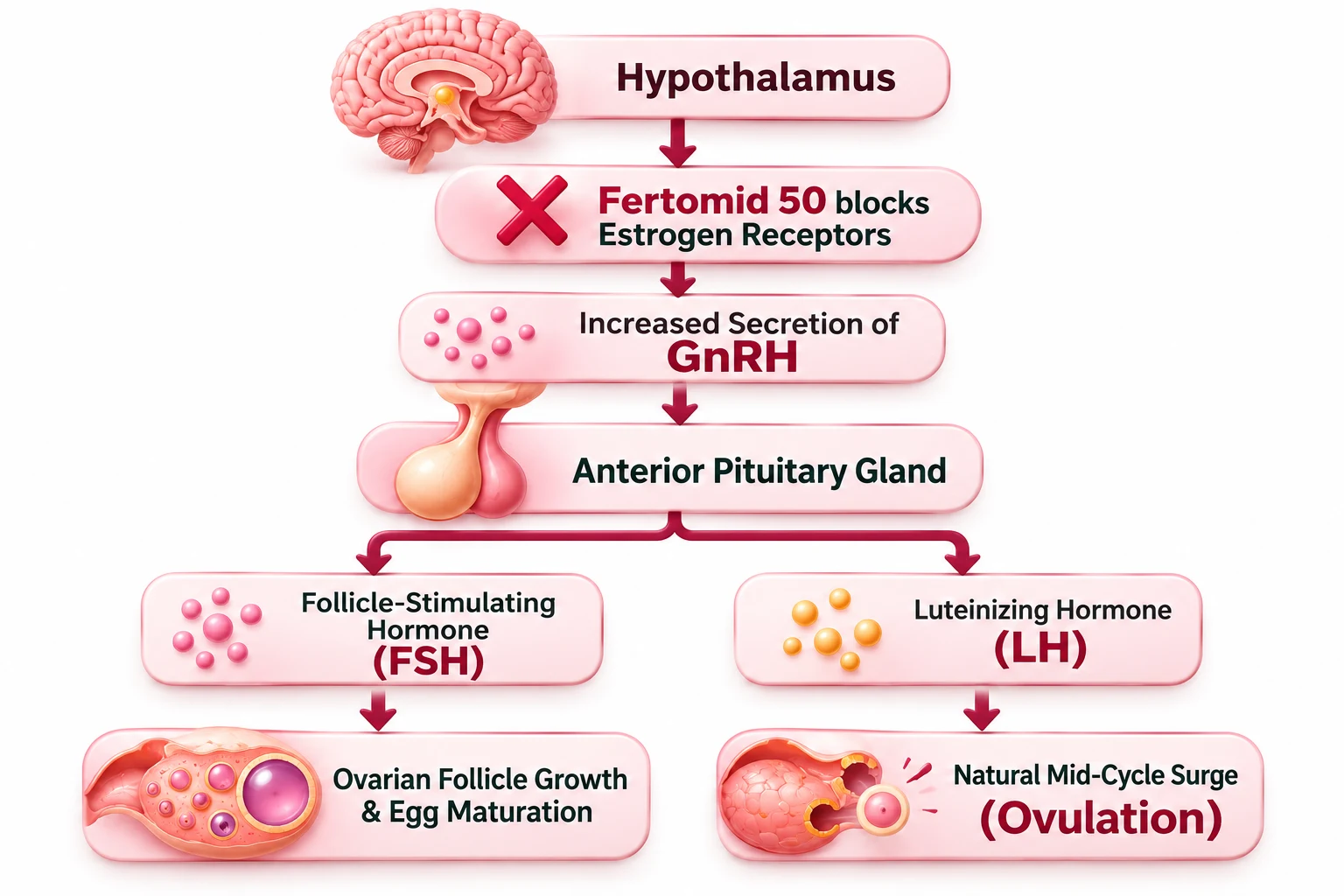
- Receptor Blockade: Clomiphene molecules competitively bind to nuclear estrogen receptors located in the hypothalamus and anterior pituitary gland for prolonged periods.
- Interruption of Negative Feedback: Because estrogen receptors are blocked, the brain perceives that circulating estrogen levels are deficient.
- Pulsatile GnRH Elevation: In response, the hypothalamus releases elevated pulses of Gonadotropin-Releasing Hormone (GnRH).
- Endogenous Gonadotropin Surge: This signals the anterior pituitary to synthesize and release elevated waves of FSH and LH into systemic circulation.
- Follicular Maturation: Increased FSH drives the recruitment and enlargement of ovarian follicles. As the dominant follicle matures, it produces high concentrations of natural estradiol, eventually triggering a spontaneous, mid-cycle LH surge that releases a fertile egg into the fallopian tube.
Primary Uses of Fertomid 50 for Female Infertility
- Ovulation Induction in Polycystic Ovary Syndrome (PCOS)
Women with PCOS frequently have high numbers of small follicles in their ovaries that become “arrested” in development, leading to long, unpredictable cycles or no periods at all (amenorrhea). Fertomid 50 delivers the necessary increase in FSH to overcome this arrest, helping a single dominant follicle complete its maturation and ovulate.
- Managing Normogonadotropic Anovulation (WHO Group II)
For women with normal basal estrogen and gonadotropin levels who nonetheless fail to release an egg regularly, a 5-day cycle of Fertomid 50 re-establishes a dependable ovulatory rhythm, creating a predictable fertility window for timed intercourse or Intrauterine Insemination (IUI).
- Correcting Luteal Phase Defects
When a woman ovulates “weakly,” the resulting corpus luteum (the structure left behind after egg release) may not produce enough progesterone to sustain the uterine lining. By stimulating stronger follicle growth in the early follicular phase, Fertomid 50 supports a more robust, functional corpus luteum, improving post-ovulatory progesterone production to support embryo implantation.
Fertomid vs. Clomid: Understanding the Difference
Patients often ask whether Fertomid is identical to the widely known brand name Clomid.
| Characteristic | Fertomid 50 (Cipla) | Clomid (Original Innovator Brand) |
| Active Pharmaceutical Ingredient | Clomiphene Citrate (50 mg) | Clomiphene Citrate (50 mg) |
| Chemical Structure | Identical ratio of zuclomiphene & enclomiphene | Identical ratio of zuclomiphene & enclomiphene |
| Therapeutic Classification | Selective Estrogen Receptor Modulator (SERM) | Selective Estrogen Receptor Modulator (SERM) |
| Clinical Indication | Anovulatory female subfertility | Anovulatory female subfertility |
| Clinical Efficacy | Equivalent biological and ovulatory profile | Reference standard |
Verdict: Fertomid 50 and Clomid are bioequivalent pharmaceutical equivalents containing the identical active ingredient. Fertomid is manufactured by Cipla Ltd., a major global pharmaceutical manufacturer adhering to Good Manufacturing Practices (GMP).
Fertomid 50 vs. Letrozole: Which is Better for Pregnancy?
In reproductive medicine, Fertomid (Clomiphene Citrate) and Letrozole (Femara) are the two most frequently prescribed oral ovulation induction medications. Understanding their distinct mechanisms helps clarify clinical choices:
| Feature / Metric | Fertomid 50 (Clomiphene Citrate) | Letrozole 2.5 mg (Aromatase Inhibitor) |
| Drug Class | Selective Estrogen Receptor Modulator (SERM) | Non-steroidal Aromatase Inhibitor |
| Primary Mechanism | Blocks central estrogen receptors (brain perceives zero estrogen) | Halts estrogen production by blocking the aromatase enzyme |
| Elimination Half-Life | Long (5 to 7 days; isomer stays in tissue longer) | Short (~45 hours; clears rapidly from the body) |
| Effect on Uterine Lining | May cause temporary endometrial thinning due to anti-estrogen action | Spares estrogen receptors, maintaining healthy endometrial thickness |
| Effect on Cervical Mucus | Can occasionally cause thicker, drier mucus | Generally leaves cervical fluid thin, clear, and sperm-friendly |
| PCOS Efficacy (Clinical Data) | Proven first-line; ~70–80% ovulation rate | Slightly higher live-birth rates in women with high-BMI PCOS |
| Multiple Pregnancy Rate | Approximately 5% to 8% (mostly twins) | Lower incidence of multiples (~3% to 4%) |
Clinical Conclusion: Clomiphene (Fertomid 50) remains the globally established standard for general anovulatory disorders and unexplained subfertility. For patients who develop a persistently thin uterine lining on clomiphene, or who have treatment-resistant PCOS with elevated BMI, clinicians may trial letrozole as an alternative.
Fertomid 50 and Twins: What Are the Real Odds?
A common question regarding Fertomid 50 is its likelihood of producing a multiple pregnancy.
| NATURAL UNASSISTED CONCEPTION | FERTOMOID 50 CONCEPTION |
| • Identical / Fraternal Twins: ~1%
• Twin Gestation Rate: ~5% to 8% |
• Triplets or higher: < 0.01%
• High-Order Multiples: < 1% |
Why Does the Likelihood of Twins Increase?
Normally, the body’s natural feedback system selects and releases only one dominant egg per month. Because Fertomid 50 temporarily elevates FSH levels, the ovaries can occasionally mature two dominant follicles simultaneously. If both follicles rupture and are successfully fertilized, fraternal (dizygotic) twins result.
The Clinical Facts
- The Twin Rate is 5% to 8%: Roughly 1 out of every 12 to 20 clomiphene-assisted conceptions results in twins. Over 90% of successful Fertomid pregnancies are singletons.
- High-Order Multiples are Rare: Triplets, quadruplets, or higher occur in less than 1% of cases with oral clomiphene monotherapy (unlike injectable gonadotropins, which carry substantially higher multiple-gestation rates).
- Ultrasound Folliculometry Monitoring: Having a specialist perform a mid-cycle pelvic ultrasound allows you to see how many mature follicles are developing. If three or more mature follicles appear, a clinician may advise pausing timed intercourse during that specific cycle to avoid high-risk multiple gestations.
Dosage & Step-by-Step Cycle Protocol
To use Fertomid 50 effectively, follow this established cycle timeline:
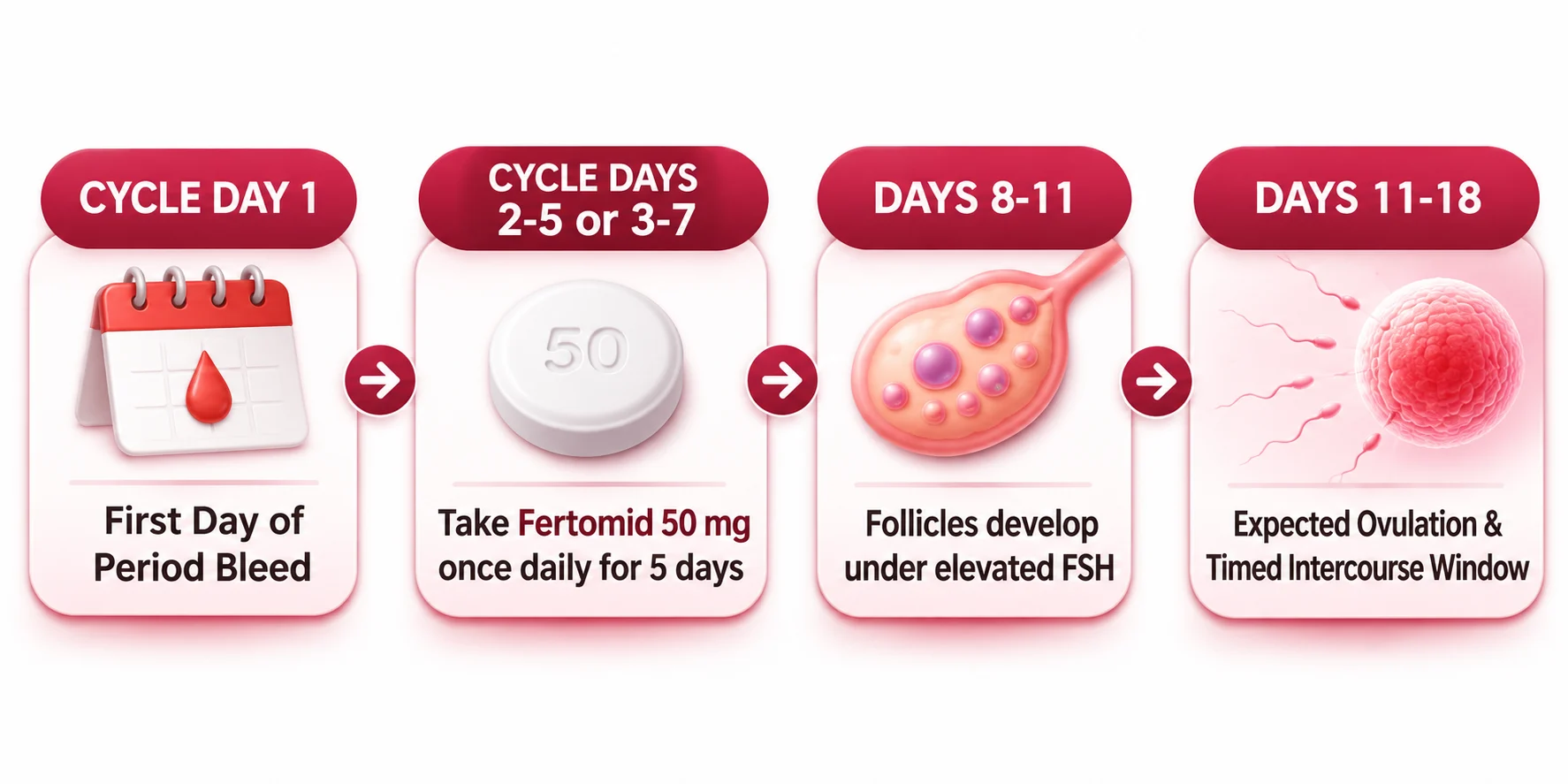
- Pinpointing Cycle Day 1
The first day of full, red menstrual bleeding is designated as Cycle Day 1. If you do not have regular periods, your doctor may prescribe a short course of an oral progestin (e.g., medroxyprogesterone) to induce a withdrawal bleed.
- The 5-Day Administration Window
Under clinical guidance, initiate your course on Cycle Day 2, Day 3, or Day 5:
- Take one 50 mg tablet daily for 5 consecutive days.
- Swallow the tablet whole with a full glass of water. It may be taken with or without food.
- Clinical Tip: Taking your dose in the evening with dinner or at bedtime can help reduce the awareness of mild side effects, such as daytime hot flushes or nausea.
- Pinpointing Ovulation & Planning Intercourse
- The Ovulatory Window: Ovulation most frequently occurs between 5 and 10 days after you take the fifth and final tablet.
- If taken on Cycle Days 3 to 7: Ovulation is typically expected between Cycle Days 12 and 17.
- If taken on Cycle Days 5 to 9: Ovulation is typically expected between Cycle Days 14 and 19.
- Timed Intercourse: Have intercourse every other day starting from Cycle Day 10 through Day 18. This schedule ensures viable sperm are already present in the fallopian tubes when the egg is released.
- Tracking Your Surge: You can identify your LH surge at home using urinary ovulation predictor kits (OPKs), tracking basal body temperature shifts, or through transvaginal ultrasound monitoring.
- The 3 to 6 Cycle Limit
If diagnostic evaluation confirms that you are ovulating on Fertomid 50, but pregnancy has not occurred after 3 to 6 completed ovulatory cycles, treatment should stop. Continuing clomiphene beyond this point rarely increases success and warrants reassessment of other fertility factors, such as tubal health, uterine cavity shape, or sperm parameters.
Other strength
Safety Profile, Side Effects & Important Precautions
While Fertomid 50 is generally well tolerated, temporary side effects can occur due to changes in estrogen signaling.
Common, Self-Limiting Side Effects
- Vasomotor Hot Flushes (~10%): Sudden sensations of heat across the face, neck, and chest, similar to menopausal symptoms. These resolve after the 5-day dosing window finishes.
- Abdominal Bloating & Pelvic Discomfort (~5.5%): A feeling of heaviness or mild cramping as developing follicles enlarge the ovaries.
- Breast Tenderness & Mild Nausea (~2%): Temporary shifts in natural hormone levels.
- Headaches & Mood Swings: Mild irritability or emotional sensitivity during active treatment days.
Critical Warnings Requiring Immediate Medical Attention
- Visual Disturbances (~1.5%): Experiencing blurred vision, seeing light flashes, floaters, or after-images (scotomata) requires stopping Fertomid 50 immediately and contacting your doctor. While visual symptoms typically resolve after discontinuation, continuing the medication could risk prolonged effects.
- Ovarian Hyperstimulation Syndrome (OHSS): Severe pelvic pain, rapid abdominal distention, sudden weight gain (e.g., in a few days), and shortness of breath can indicate exaggerated ovarian enlargement. Contact your healthcare provider promptly if these symptoms emerge.
Contraindications: Who Must NOT Take Fertomid 50
Fertomid 50 is strictly contraindicated in the presence of:
- Confirmed or Suspected Pregnancy (Category X): Clomiphene must never be taken while pregnant, as it carries risks to fetal development. Always confirm a negative pregnancy test before starting a new cycle.
- Undiagnosed Abnormal Vaginal Bleeding: Any irregular, unexplained uterine bleeding must be thoroughly evaluated before starting ovulation induction.
- Active Liver Disease or Hepatic Impairment: Clomiphene is metabolized by the liver; impaired hepatic clearance leads to drug accumulation and toxicity.
- Ovarian Cysts (Unrelated to PCOS): Pre-existing ovarian cysts or ovarian enlargement must be evaluated to prevent cyst rupture or ovarian torsion.
- Hormone-Dependent Neoplasms: Any active estrogen-dependent malignancy, such as endometrial cancer.
FAQs
What is Fertomid 50 used for in females?
Fertomid 50 is an oral fertility medication prescribed to women who have difficulty conceiving due to ovulatory disorders, such as anovulation, irregular cycles, or Polycystic Ovary Syndrome (PCOS). It encourages the pituitary gland to release FSH and LH, stimulating dominant follicle growth and natural ovulation.
What are the chances of having twins with Fertomid 50?
Clinical studies show that the twin pregnancy rate with clomiphene citrate (Fertomid 50) is approximately 5% to 8%. This occurs when two follicles mature and release eggs during the same cycle. Over 90% of clomiphene-assisted pregnancies are singletons, and triplets or higher multiples occur in less than 1% of cases.
How long after taking Fertomid 50 will I ovulate?
Ovulation typically occurs 5 to 10 days after taking the fifth (last) tablet of your 5-day course. For example, if you take tablets on Cycle Days 3 to 7, ovulation is most commonly expected between Cycle Days 12 and 17.
Which is better: Fertomid 50 or Letrozole?
Both medications are effective first-line treatments for ovulation induction. Clomiphene (Fertomid) has decades of established safety for general anovulatory subfertility. However, clinical studies show that letrozole may achieve slightly higher live-birth rates in women with PCOS who have an elevated BMI, and it is less likely to cause thinning of the endometrial lining.
What should I do if Fertomid 50 does not cause ovulation?
If a mid-luteal progesterone test or ultrasound reveals that you did not ovulate on 50 mg, your specialist may increase your dose in the following cycle to 100 mg daily for 5 days. Do not adjust your dose without medical direction. If ovulation is still not achieved at higher doses (clomiphene resistance), alternative strategies like adding metformin, switching to letrozole, or gonadotropin injections are evaluated.
Does Fertomid 50 thin the uterine lining?
In a minority of women, clomiphene’s anti-estrogen properties can temporarily reduce cervical mucus production or lead to a thinner endometrial lining (e.g., $<7\text{ mm}$). Your doctor can monitor your endometrial thickness with a mid-cycle ultrasound scan to ensure it remains receptive for embryo implantation.