

Female Sexual Arousal: Signs, Stages and Body Changes
By Erica Wilson, Oct-06-2026


 Dr. Arjun Srivastav Medical Reviewer (Pharm D)
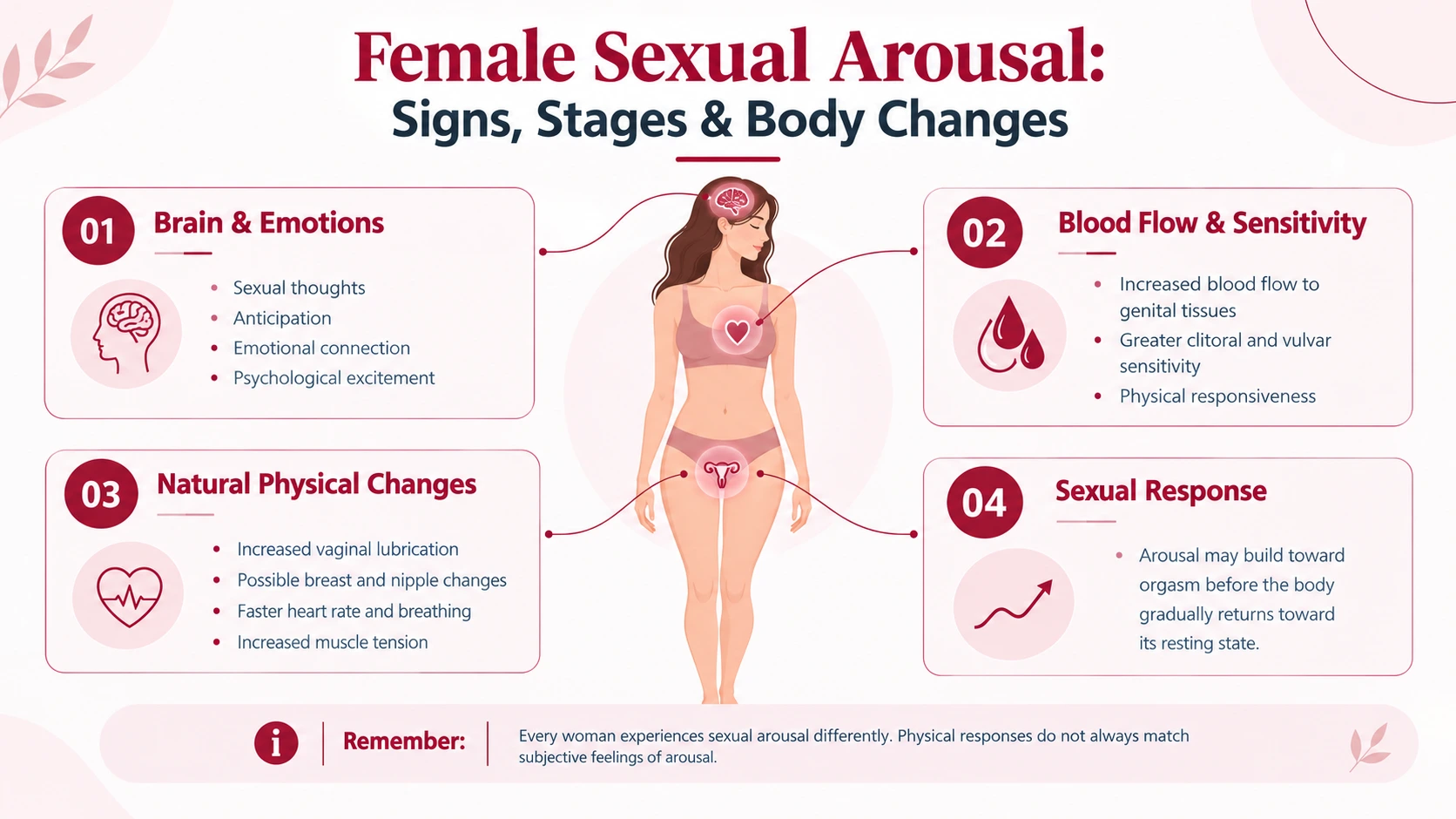
 Female sexual arousal is the mental and physical response the body can produce when a woman feels drawn toward sexual activity. It weaves together what happens in the mind with what happens in the body.
So a woman might notice warmth, interest or excitement in her thoughts while her circulation, breathing and sensitivity shift at the same time. Some of the more familiar changes include increased genital blood flow, vaginal lubrication, heightened sensitivity, a quicker heart rate and faster breathing.
Not every woman moves through these shifts in the same order or notices them with the same strength, which is completely normal. This guide walks through the signs, the body changes, the stages, the triggers, the hormones, the difference between desire and arousal, the factors that shape the experience and the moments when it makes sense to speak with a healthcare professional.
One point deserves emphasis early on. A physical response in the genitals does not automatically mean someone feels sexually aroused in her mind. Physical genital response and subjective arousal can show up independently, and treating lubrication or swelling as proof of someone’s feelings would be misleading.
💡 Quick Answer
Female sexual arousal is a physical and emotional response to sexual stimulation. It may involve increased genital blood flow, vaginal lubrication, greater sensitivity, faster heart rate and breathing, and increased muscle tension. These responses vary between women, and physical changes do not always reflect how someone feels emotionally.
What Is Female Sexual Arousal?
Sexual arousal is the state of being turned on, sexually speaking. It shows up in two connected but distinct ways.
Subjective arousal is the felt experience, the awareness of excitement, interest or pleasure in the mind. Physical or genital arousal is the body’s response, the changes in blood flow, lubrication and sensitivity that often accompany that felt experience. The two usually travel together, but not always.
Understanding the difference helps explain why someone can have a physical response without feeling mentally engaged, or feel mentally engaged without a strong physical response.
Several systems work together to create the female sexual response. The brain processes thoughts, memories and cues. The nervous system carries signals between the mind and the body. Blood circulation shifts toward the genitals as arousal builds.
Sexual stimulation can come from touch, thoughts, emotional intimacy, visual cues or verbal cues, yet triggers vary considerably from one woman to the next. Arousal also is not the same thing as wanting intercourse or reaching orgasm. A woman can feel aroused without those outcomes, and the absence of them does not erase the arousal itself.
Mental and Emotional Arousal
The mental side of arousal often begins before anything physical happens. A woman might notice sexual thoughts drifting in, a sense of excitement building, or anticipation about what is to come.
Pleasure and emotional connection play a large role here, especially when she feels comfortable, safe and genuinely engaged with what is happening around her and within her.
Physical Arousal
The physical side is what most people picture when they hear the word arousal. The common changes include:
- Increased genital blood flow that brings warmth and fullness
- Vaginal lubrication that increases to ease friction
- Clitoral swelling and greater sensitivity
- Tissues around the vulva becoming more responsive to touch
Together these changes form the visible, felt side of the female sexual response.
What Are the Signs of Female Sexual Arousal?
The signs of arousal differ from woman to woman, and they are not a reliable indicator of someone’s feelings or consent. This point matters enough to repeat. A body can respond even when the mind is not on board, so physical signs should never be read as proof of interest.
With that said, the sexual arousal symptoms in female experience often fall into two groups, physical and emotional, and many women notice a mix of both.
Physical Signs of Arousal
Physical signs can appear in different combinations, and their intensity changes from one experience to the next. The more common ones include:
- Increased vaginal lubrication
- Greater blood flow around the genitals
- Clitoral swelling and sensitivity
- Changes around the vulva such as warmth or fullness
- Breast or nipple changes
- A faster heart rate and quicker breathing
- Increased muscle tension
- Heightened physical sensitivity to touch
- Skin flushing in some people
Emotional and Mental Signs
On the emotional side, a woman might feel sexually excited, more interested in sexual activity, or filled with sexual thoughts or fantasies. Anticipation can grow, and she may become more aware of pleasurable sensations she might otherwise overlook.
Again, lubrication, genital swelling or any other physical response should not be treated as a definitive indicator of subjective sexual interest. Clinical sources specifically separate physical genital response from subjective arousal, and that separation matters.
🌸 Female Sexual Arousal at a Glance
Sexual arousal can involve changes in the mind, emotions and body. The experience is different for every woman.
1. Desire
Sexual interest or thoughts may develop because of physical, emotional or psychological factors.
2. Arousal
Blood flow, sensitivity, lubrication, heart rate and breathing may change.
3. Orgasm
Some people experience orgasm as part of the sexual response, while others may not.
4. Resolution
Heart rate, breathing, muscle tension and other physical responses gradually return toward baseline.
Remember:
Sexual response is not always linear. Desire, arousal and orgasm can occur in different patterns and may vary from one experience to another.
What Happens to the Female Body During Sexual Arousal?
When arousal builds, the body goes through a series of connected changes. Blood flow, lubrication, sensitivity, heart rate, breathing and muscle tension can all shift, and each change supports the next.
Understanding what happens under the surface can take some of the mystery out of the experience and help a woman recognize her own patterns.
Increased Blood Flow to the Genitals
Greater circulation to the pelvic region is one of the most consistent parts of arousal. As blood flow increases, the tissues of the vulva and clitoris fill and swell.
That swelling tends to bring greater sensitivity, which is why touch can feel more intense and more pleasurable as arousal deepens.
Vaginal Lubrication
Lubrication often increases during arousal as fluid moves through the vaginal walls. Its main role is reducing friction during sexual activity.
The amount varies from woman to woman and from one experience to the next, and it is not a perfect measure of sexual excitement. A woman can feel highly aroused with little lubrication, or notice lubrication without feeling mentally engaged, so it should be read as one signal among many rather than a verdict on desire.
Clitoral and Vulvar Changes
The clitoris and vulva respond strongly to increased blood flow. Swelling can make the clitoris more prominent and more sensitive, and the tissues around the vulva may feel fuller and more responsive.
These changes are part of what makes physical stimulation feel more intense as arousal progresses.
Changes in Heart Rate and Breathing
As arousal intensifies, cardiovascular and respiratory activity often increase. The heart beats faster, breathing quickens, and the body prepares for the physical engagement that may follow.
These shifts usually feel natural rather than alarming, and they settle once arousal passes.
Muscle Tension and Sensitivity
Muscle tension can rise throughout the body during arousal, and sensory awareness often becomes sharper at the same time. A woman might notice that her skin feels more responsive, that certain touches carry more weight, or that her body feels more attuned to stimulation than usual.
What Are the Stages of Female Sexual Arousal?
The traditional model of the female sexual response describes four stages, desire, arousal, orgasm and resolution. Cleveland Clinic outlines these four phases while also noting that people do not necessarily experience them in the same order or at the same intensity.
Some women skip a stage entirely, and the sequence can shift from one encounter to the next.
Stage 1: Desire
Desire is the interest in sexual activity. It can show up as sexual thoughts or a pull toward intimacy, and it often appears before physical arousal begins.
For some women, though, desire develops after stimulation or arousal has already started, which is a pattern clinical sources recognize as normal.
Stage 2: Arousal
During arousal itself, the physical changes described earlier come together and intensify:
- Blood flow increases
- Lubrication builds
- Sensitivity grows
- Heart rate and breathing pick up
- Muscle tension rises as the body becomes more engaged
Stage 3: Orgasm
Orgasm is often described as the peak of sexual pleasure. Rhythmic involuntary muscle contractions can occur, and the whole body may feel a sudden release of built up tension.
It is usually the shortest of the four stages, and not every sexual experience includes it.
Stage 4: Resolution
In resolution, the body gradually returns toward its resting state. Genital swelling decreases, muscle tension eases, and heart rate and breathing settle back down.
The sequence and intensity can vary widely. Not every sexual experience moves neatly through all four stages, and a satisfying experience does not require reaching each one in order.
What Triggers Female Sexual Arousal?
There is no single universal answer to what triggers female sexual arousal. Triggers vary from person to person, and many women respond to a blend of physical, psychological, emotional and contextual cues rather than one clear switch.
Physical Stimulation
Touch, kissing and other forms of sexual stimulation can spark arousal. The body responds to sensation, and different women are sensitive to different kinds of touch and different areas of the body.
Psychological Stimulation
Sexual thoughts, fantasies and anticipation can begin arousal without any physical contact at all. Visual or verbal stimulation also plays a role for many women, and the mind can be just as powerful a trigger as the body.
Emotional and Relationship Factors
Emotional intimacy, trust, feeling comfortable and open communication often shape how easily arousal develops. Relationship satisfaction can matter as much as physical stimulation, because a woman who feels safe and connected is often more responsive than one who feels distant or uneasy.
Environment and Context
Privacy, reduced distractions and a sense of safety can make a real difference. Feeling relaxed and unhurried gives arousal room to build, which is why context can matter as much as the stimulation itself.
Hormonal fluctuations throughout the menstrual cycle can also coincide with changes in sexual interest and physical responsiveness.
💡 Tip
Female Sexual Desire vs Sexual Arousal: What Is the Difference?
Sexual desire refers more to the interest or motivation for sexual activity, while sexual arousal describes the physical and emotional response that can occur during sexual stimulation. A person may have sexual desire without strong physical arousal, or physical arousal without feeling mentally interested. Understanding libido can also help clarify the difference between sexual desire and arousal.
Understanding the difference helps explain why a woman might feel desire without a strong physical response, or notice physical arousal without a clear sense of wanting.
| Sexual Desire | Sexual Arousal |
|---|---|
| Interest or motivation for sexual activity | Mental or physical response to stimulation |
| Can occur before stimulation | Can develop after stimulation begins |
| May fluctuate with circumstances | Can involve physical body changes |
| Does not necessarily produce physical changes | May occur physically without strong subjective desire |
Merck notes that for women, desire can sometimes develop after stimulation has already triggered excitement and pleasure, rather than always appearing first. This responsive pattern is one reason desire and arousal can feel tangled together, even though they describe different parts of the experience.
Sexual response can also vary between individuals, and broad differences between male and female sexuality do not describe every person’s experience. Sexuality can involve different patterns of desire, arousal and response.
🔔 Reminder
What Hormones Are Involved in Female Sexual Arousal?
Hormones influence sexual function, but no single hormone controls female sexual arousal on its own. Estrogen and testosterone both play a role, and other hormonal influences contribute as well.
Levels shift across the menstrual cycle, during pregnancy and the postpartum period, and around menopause, and those shifts can affect both sexual interest and arousal.
It helps to think of arousal as a multifactorial process. Psychological, neurological, physical and relationship factors all interact, and hormones are one thread among many. Hormonal changes around menopause, pregnancy and the menstrual cycle can affect sexual interest and arousal, but the experience never comes down to one chemical alone.
How to Increase Female Sexual Arousal Naturally
Many women look for ways to support arousal, and there are practical, non prescriptive factors that can help. None of these guarantee a particular outcome, since arousal depends on so many variables, but they create conditions where arousal is more likely to develop.
- Reduce stress and limit distractions to free up the mental space arousal needs
- Allow enough time for arousal to build, since rushing can interrupt the natural progression
- Communicate preferences with a partner and address relationship difficulties that quietly interfere
- Prioritise sleep and general wellbeing to support the body’s capacity to respond
- Address discomfort or vaginal dryness to make physical experiences more comfortable
If sexual changes began after starting a medicine, reviewing that medication with a professional is worth considering. Hormonal or medical factors may be involved, and persistent changes that cause concern are a good reason to seek professional advice.
Merck identifies psychological factors, relationship issues, medications, fatigue, hormonal changes and certain medical conditions among the factors that can affect sexual interest and arousal.
Female Sexual Arousal Pills and Medications: What to Know
When people search for female sexual arousal pills, drugs for sexual arousal in female use, or what medication is used for female sexual arousal, they often hope for a single tablet that solves the problem. In practice there is no universal female arousal pill.
Treatment depends on the underlying reason for reduced desire or arousal, and that reason varies from woman to woman.
Some women benefit from treatment for an underlying medical or hormonal issue, while others find psychological therapies helpful. Hormonal treatment may be appropriate in selected cases, and medication can play a role depending on the cause.
Some products are marketed as Female Viagra, but this term can refer to different medicines or products and should not be treated as a general medical category for female sexual arousal. The appropriate treatment depends on the underlying cause of reduced desire or arousal and should be discussed with a healthcare professional.
Existing medicines can sometimes contribute to sexual difficulties, which is why a careful review matters. Medication decisions should always be made with a healthcare professional, not guessed at or borrowed from someone else’s prescription. When reduced arousal continues and causes personal distress, it may be part of female sexual dysfunction rather than a temporary change.
⚠️ Warning
When Does Female Sexual Arousal Become a Problem?
Occasional changes in desire or arousal are common, and a temporary dip does not automatically mean something is wrong. Reduced arousal becomes a concern when it is persistent and causes significant personal distress, not when it shows up now and then.
The causes can include psychological, relationship, hormonal, medication related and physical factors, so the picture is rarely simple.
The clinical term female sexual arousal disorder, now grouped within female sexual interest and arousal disorder, describes a specific pattern rather than any instance of low arousal. Clinical criteria consider persistent symptoms and significant distress.
Merck notes that symptoms generally need to persist for at least six months for the diagnosis, and they must cause clinically meaningful distress. A few difficult weeks do not equal a disorder, but ongoing difficulty that weighs on a woman’s wellbeing is worth discussing with a professional.
❗ Important
Can a Woman Be Physically Aroused Without Feeling Sexually Aroused?
Yes, and this distinction is one reason clinical sources separate physical genital response from subjective arousal. Increased blood flow or lubrication can occur without a woman consciously feeling sexually excited, and the body can respond to stimulation even when the mind is elsewhere.
The reverse is also possible. Someone may feel mentally aroused without experiencing strong physical lubrication. Physical signs, in other words, should not be treated as a definitive measure of someone’s feelings.
When Should You Talk to a Healthcare Professional?
It makes sense to reach out to a healthcare professional in situations such as these:
- A persistent change in sexual desire or arousal
- Arousal difficulties that cause personal distress
- Pain during sexual activity
- Persistent vaginal dryness or discomfort
- Symptoms that began after starting or changing a medication
- Concerns about hormonal or medical causes
- Sexual difficulties that affect quality of life or relationships
The tone here is reassuring rather than alarming. These conversations are common, and professionals are used to having them.
Conclusion
Female sexual arousal is a layered experience that blends the mind and the body in ways that vary from woman to woman. The signs, the stages and the triggers all shift with context, hormones, relationships and wellbeing, so there is no single normal pattern to measure yourself against.
The most useful takeaway is that physical response and subjective arousal are not always the same thing. Lubrication, swelling or sensitivity can appear without real interest, and real interest can exist without obvious physical signs. Understanding that difference takes the pressure off and makes the experience easier to talk about honestly.
If changes in desire or arousal become persistent and start to cause distress, speaking with a healthcare professional is a reasonable, reassuring next step. These conversations are common, and help is available.
What Happens If Women Take Kamagra Oral Jelly?
Understand the potential effects and safety considerations before using a medicine intended for another purpose.
FAQ
What are the first signs of female sexual arousal?
The earliest signs often include sexual thoughts or interest, a sense of anticipation, and physical changes like increased genital blood flow, warmth and the start of vaginal lubrication. The exact first sign varies from woman to woman.
What are the symptoms of sexual arousal in females?
Common symptoms include vaginal lubrication, clitoral swelling and sensitivity, increased heart rate and breathing, muscle tension, heightened sensitivity to touch and emotional signs like excitement and sexual thoughts. Not every woman notices every symptom.
What triggers female sexual arousal?
Triggers vary widely and can include physical touch, sexual thoughts, fantasies, emotional intimacy, visual or verbal cues, and a safe, relaxed environment. Many women respond to a combination of these rather than one single trigger.
How can female sexual arousal be increased?
Reducing stress, allowing time for arousal to build, communicating with a partner, addressing relationship issues, prioritising sleep and wellbeing, and addressing discomfort or dryness can all support arousal. Persistent concerns are worth discussing with a professional.
Is female sexual desire the same as arousal?
No. Desire is the interest or motivation for sexual activity, while arousal is the mental or physical response to stimulation. They often overlap, but they are not identical, and one can appear without the other.
What hormones are involved in female sexual arousal?
Estrogen and testosterone are among the hormones that influence sexual function, along with other hormonal factors. Levels shift across the menstrual cycle, pregnancy, postpartum and menopause, but arousal depends on more than hormones alone.
When is low female sexual arousal considered a disorder?
Low arousal is considered a disorder when it is persistent, lasts generally at least six months, and causes significant personal distress. Occasional changes are common and do not by themselves indicate a disorder.

Years of Experience: 10+ years Education: B.Sc. in Biomedical Science (Monash University, Melbourne, Australia) PG Diploma in Health & Medical Communication (University of Sydney, Australia) Experience: Erica Wilson is an…

