


Description
 Dr. Arjun Srivastav
Enclomiphene Citrate is an oral medicine belonging to the selective estrogen receptor modulator (SERM) class. Each Enclomisign tablet contains 50 mg of enclomiphene citrate. It has been clinically studied in men with secondary hypogonadism — a condition where the testes produce low testosterone because of signalling problems in the hypothalamus or pituitary, not because of testicular failure. Enclomiphene works by modulating estrogen receptors to stimulate the body’s natural testosterone production pathway. Availability and prescription requirements in Australia depend on the applicable regulatory framework.
Enclomiphene Citrate at a Glance
| Product Detail | Information |
|---|---|
| Product name | Enclomisign 50 mg |
| Active ingredient | Enclomiphene Citrate |
| Strength | 50 mg |
| Drug class | Selective Estrogen Receptor Modulator (SERM) |
| Dosage form | Tablet |
| Main clinical research area | Secondary hypogonadism |
| Route | Oral |
| Prescription status | Verify according to applicable Australian requirements |
What Is Enclomiphene Citrate?
Enclomiphene citrate is the trans-isomer of clomiphene citrate. To understand what that means, it helps to know that clomiphene citrate is a mixture of two stereo-isomers — enclomiphene (the trans-isomer) and zuclomiphene (the cis-isomer). The commercial clomiphene preparation contains roughly 60% enclomiphene and 38–40% zuclomiphene.
The two isomers behave differently in the body. Enclomiphene acts primarily as an estrogen receptor antagonist — it blocks estrogen’s feedback signals. Zuclomiphene, by contrast, has estrogen-agonist (estrogen-like) activity. This difference matters because it is the estrogen-antagonist action of enclomiphene that drives the testosterone-stimulating effect studied in clinical research.
Enclomiphene citrate is classified as a selective estrogen receptor modulator (SERM). It has been studied specifically in men with secondary hypogonadism, where the problem lies in the hormonal signalling from the brain to the testes rather than in the testes themselves. read our comprehensive guide on What Is Enclomiphene Citrate?
What Is Enclomiphene Used For?
Enclomiphene for Secondary Hypogonadism
Clinical research has focused on enclomiphene citrate in men with secondary hypogonadism — a form of low testosterone where the testes are structurally capable of producing testosterone but are not receiving adequate signalling from the hypothalamus and pituitary gland.
Enclomiphene for Low Testosterone
Enclomiphene has been studied as a way to raise testosterone levels by stimulating the body’s own production pathway rather than supplying testosterone externally. It is not appropriate for every type of low testosterone — the research specifically involves men whose low testosterone is driven by signalling issues, not by primary testicular failure.
Enclomiphene and Male Reproductive Function
A key reason enclomiphene has attracted research interest is its potential relationship to male reproductive function. Unlike external testosterone replacement, which can suppress sperm production, enclomiphene has been studied for its ability to raise testosterone while preserving sperm production in selected men with secondary hypogonadism.
How Does Enclomiphene Citrate Work?
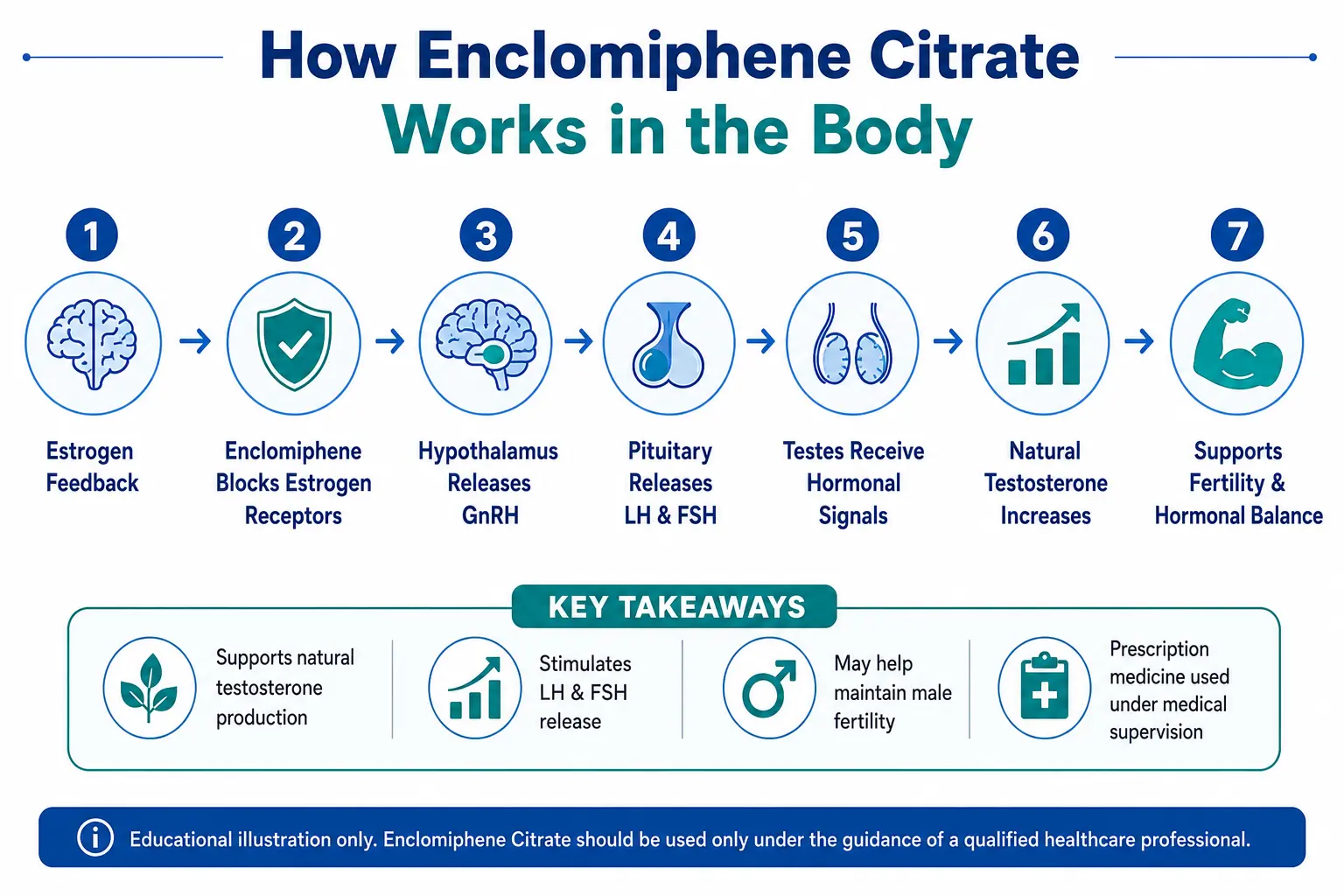
The mechanism can be understood as a chain of hormonal signals:
Enclomiphene ↓ Estrogen receptor modulation ↓ Reduced negative feedback ↓ Increased GnRH signalling ↓ Increased LH and FSH ↓ Testicular testosterone production
In plain language: the hypothalamus and pituitary gland in the brain control testosterone production through a signalling system called the hypothalamic-pituitary-gonadal (HPG) axis. Estrogen provides negative feedback that slows this system down. Enclomiphene blocks estrogen’s feedback at the receptor level, which tells the hypothalamus to send more gonadotropin-releasing hormone (GnRH). That signals the pituitary to release more luteinizing hormone (LH) and follicle-stimulating hormone (FSH). LH then stimulates the testes to produce more testosterone.
The result is that enclomiphene works with the body’s natural pathway rather than replacing it — it stimulates endogenous (self-produced) testosterone rather than supplying it from outside.
How Does Enclomiphene Affect Testosterone?
Clinical trials have reported that enclomiphene citrate increases serum testosterone levels in men with secondary hypogonadism. The same studies reported increases in LH and FSH — the pituitary hormones that drive testicular testosterone production.
This is a fundamentally different approach from externally administered testosterone (testosterone replacement therapy, or TRT). TRT supplies testosterone from outside the body, which can suppress the HPG axis and reduce the body’s own production. Enclomiphene, by contrast, stimulates the body’s own signalling pathway, so testosterone is produced endogenously.
The distinction matters both for testosterone levels and for fertility, as explained in the sections below.
💡 Tip
For the best treatment results, take Enclomiphene at the same time each day and attend regular follow-up appointments to monitor your hormone levels and overall response to therapy.
Enclomiphene for Secondary Hypogonadism
Secondary hypogonadism is the condition for which enclomiphene has been most directly studied. It is distinct from primary hypogonadism, and that distinction determines whether enclomiphene is scientifically relevant.
Primary vs Secondary Hypogonadism
| Primary | Secondary | |
|---|---|---|
| Main problem | Testicular dysfunction | Hypothalamus / pituitary signalling |
| LH / FSH | Often elevated | Low or inappropriately normal |
| Enclomiphene research relevance | Limited | Stronger |
In primary hypogonadism, the testes themselves are not functioning properly, so stimulating the signalling pathway has limited value. In secondary hypogonadism, the testes can produce testosterone but are not being told to — which is exactly the situation where enclomiphene’s mechanism is relevant.
Enclomiphene and Male Fertility
This is one of the most important differentiators between enclomiphene and other testosterone-restoration approaches.
External testosterone treatment (TRT) can suppress the HPG axis, which in turn can reduce or stop sperm production. This is a well-recognised concern for men who want to preserve fertility.
Enclomiphene has attracted research interest precisely because it works through the body’s own LH and FSH pathway — the same hormones that drive both testosterone production and sperm production. A randomised phase II trial reported that enclomiphene citrate increased testosterone and gonadotropins while sperm counts were conserved in the enclomiphene group. A later phase III program also reported maintenance of sperm concentration compared with testosterone gel.
By stimulating LH and FSH production, Enclomiphene helps the body produce testosterone naturally instead of replacing it with an external hormone source. Along with Enclomiphene, other men’s health medications may be recommended depending on your diagnosis and treatment goals.
Enclomiphene for Women (Fertility & Hormonal Health)
Although Enclomiphene is primarily associated with men’s hormonal health, researchers have also studied its effects on female reproductive hormones.
Because Enclomiphene influences estrogen receptors and hormone signalling, it may affect ovulation-related pathways. However, clomiphene citrate remains the more commonly prescribed medication for ovulation induction and female fertility treatment.
Women experiencing infertility, irregular ovulation, or conditions such as PCOS should consult a fertility specialist to determine the most appropriate treatment. Enclomiphene should only be used when recommended by a qualified healthcare professional.
Possible Areas of Research in Women
- Hormonal regulation
- Ovulation-related hormone pathways
- Reproductive hormone signalling
- Fertility research in selected clinical settings
Enclomiphene Benefits
The potential benefits of enclomiphene relate to its mechanism and the clinical evidence studied so far.
Supports Endogenous Testosterone Production
Rather than supplying testosterone from outside, enclomiphene stimulates the body’s own production pathway — raising testosterone through the natural HPG axis.
Increases LH and FSH Signalling
Clinical trials reported increases in LH and FSH in men with secondary hypogonadism, which is the mechanism that drives the testosterone increase.
May Be Relevant to Men Concerned About Fertility
Because enclomiphene works through the LH/FSH pathway, it has been studied for its potential to raise testosterone while preserving sperm production — a consideration that distinguishes it from external testosterone.
Alternative Approach to Direct Testosterone Replacement
For men in whom external testosterone is not suitable — particularly those concerned about fertility — enclomiphene represents a different pharmacological approach that has been studied in clinical trials.
Clinical Evidence Summary
- Studies reported increased serum testosterone in men with secondary hypogonadism
- Enclomiphene increased gonadotropin (LH and FSH) levels in studied men
- Sperm concentration was preserved compared with testosterone gel in the studied trials
Who May Be Considered for Enclomiphene?
Enclomiphene is not appropriate for every man with low testosterone. The clinical research has focused on specific characteristics:
- Confirmed low testosterone — diagnosed through proper blood testing
- Secondary rather than primary hypogonadism — the issue is signalling, not testicular failure
- Appropriate hormonal profile — low or inappropriately normal LH/FSH levels
- Fertility considerations — men who want to preserve sperm production
- Medical assessment — a healthcare provider must determine whether enclomiphene is appropriate.
Enclomiphene Citrate Dosage
How Is the Dose Determined?
The dose of enclomiphene is determined by a healthcare provider based on the individual’s hormone levels, clinical situation, and response to treatment. A 50 mg tablet does not, by itself, establish a universal dose.
What Factors Affect Dosage?
- Baseline testosterone levels
- Whether the hypogonadism is secondary
- LH and FSH levels
- Age and overall health
- Other medicines being taken
- Response to treatment
How Long Is Treatment Studied?
Clinical research has investigated enclomiphene over periods of several weeks to months. The appropriate duration for any individual depends on the clinical situation and the prescriber’s guidance.
What Monitoring Is Required?
Treatment with enclomiphene typically requires monitoring of testosterone levels, LH, FSH, and — where relevant — semen parameters. A healthcare provider determines the monitoring schedule.
Clinical research has investigated several doses, including 6.25 mg, 12.5 mg, and 25 mg,50 mg daily in men with secondary hypogonadism. These are research doses, not a universal recommendation for this product. Follow the actual product documentation and prescriber instructions.
How to Take Enclomiphene Citrate
- Prescribed schedule — take enclomiphene exactly as prescribed by your healthcare provider
- Same-time dosing — take the tablet at the same time each day to maintain consistent levels
- With or without food — follow the product information regarding whether to take with food
- Missed dose — if you miss a dose, take it when you remember unless it is close to the next scheduled dose
- Do not double dose — never take two doses at once to make up for a missed one
- Do not change dose independently — do not adjust the dose or stop treatment without consulting your provider
Enclomiphene Side Effects
Commonly Reported or Potential Effects
Possible side effects may include headache, nausea, hot flashes, and mood changes. The exact profile depends on the individual and the dose.
Vision-Related Symptoms
Because enclomiphene modulates estrogen receptors, visual symptoms have been reported with clomiphene-class medicines. Any visual changes — such as blurred vision, spots, or light sensitivity — should be reported to a healthcare provider promptly.
Hormonal and Mood Effects
Changes in hormone levels can affect mood, energy, and libido. Some men may experience irritability, mood swings, or changes in emotional state.
When to Seek Medical Attention
Seek immediate medical attention for visual disturbances, severe headache, chest pain, signs of an allergic reaction, or any severe or unusual symptom.
Enclomiphene Safety, Precautions & Warnings
- Medical evaluation — enclomiphene should only be used under medical supervision after proper diagnosis
- Existing conditions — inform your provider of any existing health conditions, especially liver, cardiovascular, or hormonal disorders
- Medicines and supplements — share your full medicine and supplement list with your provider
- Liver considerations — liver function may affect how the medicine is processed
- Visual symptoms — report any visual changes to your provider immediately
- Pregnancy / contraindicated populations — enclomiphene is studied in men; it is not intended for use in women who are or may become pregnant
- Monitoring — regular blood tests and clinical follow-up are required during treatment
Enclomiphene vs Clomiphene: What's the Difference?
| Feature | Enclomiphene Citrate | Clomiphene Citrate (Clomid) |
|---|---|---|
| Composition | Contains the enclomiphene isomer | Contains enclomiphene and zuclomiphene isomers |
| Main research focus | Male hormonal health and testosterone support | Fertility treatment applications |
| Hormonal effect | Supports LH and FSH stimulation | Influences estrogen receptors and reproductive hormones |
| Common discussion topic | Low testosterone and male fertility | Female ovulation and fertility |
Enclomiphene and clomiphene are closely related but not identical. The difference lies in stereochemistry — the three-dimensional arrangement of the same molecule.
- Clomiphene citrate is a mixture of two isomers: enclomiphene (trans) and zuclomiphene (cis)
- Enclomiphene citrate is the isolated trans-isomer
- Zuclomiphene is the cis-isomer, which has estrogen-agonist activity
The two isomers have different properties. Enclomiphene acts primarily as an estrogen antagonist, which is the action that drives testosterone stimulation. Zuclomiphene has estrogen-agonist effects, which can contribute to side effects such as raised estradiol levels.
A study of men on long-term clomiphene therapy found that zuclomiphene became the predominant isomer in the blood over time, which the authors noted supports the development of a pure estrogen-receptor antagonist (i.e., enclomiphene) for treating men with hypogonadism.
Enclomiphene vs Testosterone Replacement Therapy
| Feature | Enclomiphene | TRT |
|---|---|---|
| Basic approach | Stimulates endogenous signalling | Provides testosterone externally |
| LH / FSH | May increase | Can be suppressed |
| Testosterone | Endogenous production | Exogenous supply |
| Sperm production | Maintained in studied enclomiphene trials | Can be suppressed |
| Fertility consideration | Important potential consideration | Important potential concern |
| Monitoring | Required | Required |
The fundamental difference is the approach. Enclomiphene works with the body’s own production pathway; TRT replaces testosterone from outside. The clinical implication is that enclomiphene may preserve sperm production while raising testosterone, whereas TRT can suppress it. Which approach is appropriate depends on the individual, their fertility goals, and their clinical situation — this is a decision for a healthcare provider.
Enclomiphene vs Other Testosterone-Restoration Approaches
Beyond enclomiphene and TRT, other approaches exist:
- Testosterone replacement — supplies testosterone externally; effective for raising levels but can suppress fertility
- hCG (human chorionic gonadotropin) — mimics LH to stimulate testicular testosterone production; can be combined with other approaches
- Clomiphene — the mixed-isomer version; has been used off-label for years in male hypogonadism
- Observation and lifestyle — in some cases, addressing weight, sleep, stress, and underlying health factors may be clinically appropriate
Enclomiphene Citrate Australia
What Australians Are Looking For
Australians searching for enclomiphene citrate are typically looking for:
- Product availability and formulation
- Strength (50 mg)
- Prescription requirements
- Legitimate supply pathways
- Regulatory status
Australian Regulatory Status
In Australia, the supply of medicines is regulated through the Therapeutic Goods Administration (TGA). The TGA maintains the Australian Register of Therapeutic Goods (ARTG), which contains information about products that can be legally supplied in Australia, including product name, formulation, sponsor, and manufacturer.
The regulatory status of any specific enclomiphene product must be checked through the ARTG.
Product-Specific Regulatory Information
Australian Regulatory Check
Product: Enclomisign 50 mg Active ingredient: Enclomiphene citrate Sponsor: Verify Manufacturer: Verify ARTG number: Verify Status: Verify Last checked: Verify
Enclomiphene Availability in Australia
Availability in Enclomiphene Australia depends on the legitimate supply pathway that applies to this specific product.
Enclomiphene Australia: What Patients Should Know
- Australia-specific terminology — prescription-only medicines are regulated through the TGA/ARTG framework
- Prescription pathway — enclomiphene requires a prescription and medical supervision
- Regulatory status — check the ARTG for product-specific status
- Product verification — verify the product name, strength, manufacturer, and batch
- Professional consultation — consult a healthcare provider before use
- Storage and handling — follow the manufacturer’s storage instructions
- Purchasing considerations — buy only from a legitimate, regulated source
What to Check Before Buying Enclomiphene
- ☑ Exact product name (Enclomisign 50 mg)
- ☑ Correct strength (50 mg)
- ☑ Active ingredient (enclomiphene citrate)
- ☑ Manufacturer
- ☑ Pack size
- ☑ Regulatory information
- ☑ Prescription requirements
- ☑ Batch and expiry information
- ☑ Secure packaging
- ☑ Supplier and customer support
Enclomiphene Ordering & Delivery Information
- Ordering process — select the product and quantity
- Prescription process — provide a valid prescription
- Dispatch timeframe — confirmed by the seller
- Australia delivery — confirmed at checkout
- Tracking — provided where available
- Packaging and privacy — check the seller’s packaging policy
- Customer support — check the seller’s support options
- Cancellation — check the seller’s cancellation policy
- Returns and refunds — check the seller’s refund policy
How to Store Enclomiphene Citrate
- Store at the temperature stated on the product packaging
- Protect from moisture
- Protect from light
- Keep in the original packaging
- Keep out of reach of children
Follow the manufacturer’s exact storage instructions as printed on the label.
What If You Miss an Enclomiphene Dose?
If you miss a dose, take it as soon as you remember — unless it is nearly time for the next scheduled dose. Do not take two doses at once to make up for a missed one. If you are unsure, contact your healthcare provider or pharmacist.
What If You Take Too Much Enclomiphene?
Taking more than the prescribed dose can increase the risk of side effects. If an overdose is suspected, seek medical attention immediately or contact a poison information centre.
What Does the Research Say About Enclomiphene?
Testosterone Evidence
Clinical studies reported that enclomiphene citrate increased serum total testosterone levels in men with secondary hypogonadism. In one phase II study, total testosterone levels rose to the normal range and were sustained over the treatment period.
LH and FSH Evidence
Enclomiphene increased gonadotropin levels — both LH and FSH — in studied men. This is the mechanism that drives the testosterone increase and distinguishes enclomiphene from external testosterone, which can suppress these hormones.
Sperm and Fertility Evidence
Studies reported preservation of sperm concentration in the enclomiphene groups compared with testosterone gel. In one trial, all enclomiphene-treated men had sperm counts above 75 million/mL. A phase III program also reported maintenance of sperm concentration compared with topical testosterone.
Limitations of Current Evidence
The evidence is strongest for men with secondary hypogonadism. Individual results depend on the diagnosis, dose, duration, and clinical factors specific to each person.
Enclomiphene Citrate: Key Takeaways
- What it is: The trans-isomer of clomiphene citrate, a SERM supplied as an oral tablet (Enclomisign 50 mg)
- What it has been studied for: Secondary hypogonadism in men — low testosterone driven by signalling problems, not testicular failure
- How it works: Blocks estrogen feedback to stimulate the body’s natural LH/FSH/testosterone pathway
- Testosterone relationship: Clinical trials reported increased serum testosterone in studied men
- Fertility relationship: Studies reported preservation of sperm concentration compared with testosterone gel
- Safety: Requires medical supervision, monitoring, and a prescription; visual symptoms should be reported promptly
- Australia / regulatory point: Check the ARTG for product-specific status and confirm legitimate supply pathways
Enclomiphene citrate is a prescription medicine that should only be used under medical supervision after proper diagnosis. Check the current product listing for price, pack size, and availability.
Conclusion
Enclomiphene Citrate is a prescription medicine primarily used to support natural testosterone production in men with secondary hypogonadism. By stimulating the body’s own hormone signalling pathway, it offers a different approach from traditional testosterone replacement therapy and may help maintain fertility in appropriate patients.
While research has also explored its effects on female reproductive hormones, its primary clinical application remains focused on men’s hormonal health. Because treatment needs vary from person to person, Enclomiphene should always be used under the guidance of a qualified healthcare professional.
If you plan to buy Enclomiphene in Australia, purchase only from a trusted pharmacy that supplies genuine medication and follows Australian prescribing requirements. AustraliaRxMeds offers a wide range of prescription medicines and healthcare products to support your treatment needs.
FAQs
What is Enclomiphene Citrate?
It is the trans-isomer of clomiphene citrate, classified as a selective estrogen receptor modulator (SERM). It is supplied as an oral tablet, in this case as Enclomisign 50 mg.
What is Enclomiphene used for?
It has been studied in men with secondary hypogonadism to stimulate the body's natural testosterone production. It is not appropriate for every type of low testosterone.
How does Enclomiphene work?
It blocks estrogen's negative feedback at the receptor level, which increases GnRH, LH, and FSH signalling, which in turn stimulates the testes to produce more testosterone.
Does Enclomiphene increase testosterone?
Yes — clinical trials reported increased serum testosterone in men with secondary hypogonadism.
Does Enclomiphene affect sperm production?
Studies reported that sperm concentration was preserved in enclomiphene-treated men, unlike external testosterone which can suppress sperm production.
What is the difference between Enclomiphene and Clomiphene?
Enclomiphene is the isolated trans-isomer of clomiphene. Clomiphene is a mixture of enclomiphene and zuclomiphene. The two isomers have different estrogen-receptor activity.
Is Enclomiphene the same as TRT?
No. Enclomiphene stimulates the body's own testosterone production; TRT supplies testosterone externally. The two have different effects on LH, FSH, and sperm production.
What are the side effects of Enclomiphene?
Possible side effects include headache, nausea, hot flashes, mood changes, and visual symptoms. Seek medical attention for severe or unusual symptoms.
What is the usual Enclomiphene dosage?
The dose depends on the individual and is determined by a healthcare provider. Research has studied doses of 6.25 mg, 12.5 mg, and 25 mg, 50 mgdaily.
Is Enclomiphene available in Australia?
Availability depends on the regulatory status of the specific product. Check the ARTG and confirm prescription requirements and legitimate supply pathways.
What should I know about Enclomiphene Australia?
In Australia, enclomiphene is a prescription medicine regulated through the TGA/ARTG framework.
How should Enclomiphene be stored?
Store at the temperature on the product packaging, protected from moisture and light, in the original packaging, and out of reach of children.


Oscar McLeod –
Chester Bejalanes –
Callum Westbrook –
Otto Seldial –
Samuel Parker –
Rosan K. Marquez –
Ratt Idraw –
duncan markd –
jakes parosam –
Alex Bennett –
Ryan Davidson –
Cruz Nancy –
realpalomakoch –
williecchavis –
Marie Fairbairn –
Lope Whitfield –
malia glass –
Hayden Russell –
Marlow Bennett –
zimerovertover –
rosaliabarret –
Noah Sinclair –
Sam Douglas –
Joella Calloway –
Joel Richardson –
Celia Morgan –
Beau Matthews –
Hugo Calloway –
Weston Hale –
Alexander Grant –
Hudson Vale –
Matthew Reynolds –
Indigo Fletcher –
Soren McAllister –
Freya Sullivan –
Eamon Rutherford –
Amelia Collins –
Jonty Caldwell –
vorbelutrioperbir –
Alistair Beaumont –
Beau Whitlam –
Xavier Langford –
Jasper Ellington –
Mason Clarke –
Sophie Williams –
Mason Foster –
Liam Hartwell –
Andrew Cooper –
Xalib Hughes –
Rhodes –
Deron Schamberger –
Arlo Schaden –
akash.priyam –
Denish L. Mariya –
westin.zed –
Myron Yundt –
Lucy O. Smith –
Belly James –
Silas Watsica –
avyay.kirin –
Willy Gleason –
Jamie Leah –
daman.devonte –
Arnulfo Turner –
James Wilson –
Jerrold Rohan –
Martin Roy –
Petter Norh –
Zork Burnat –
Molly Jemas –
Kottel Smith –
symir.kamarri –
Salvador Macejkovic –
Smith Willson –
Jassica Roy –
Chloe Alex –
Natalie Jim –
John Peter –
Saniya R. Kett –
Lucy O. Smith –
Rhys. cochran –
ryuu.prabhjot –