
Do You Know How To Treat ED In Men?
By Erica Wilson, May-11-2023

 Dr. Arjun Srivastav Medical Reviewer (Pharm D)
Yes, erectile dysfunction (ED) is treatable in many men. That is the short answer. The longer, more honest answer is that treatment depends on three things: the underlying cause, your overall health, and how you respond to a given treatment. There is no single treatment that works for every man, because ED can have different physical, psychological and medication-related causes.
This article is built around one question: what do you actually do about ED? It walks through how ED is treated in men, from finding and fixing the root cause, to lifestyle changes, to the main ED medicines and why they sometimes do not work, to non-oral options when pills are not suitable, to the emerging treatments you have probably heard marketed online. It also covers the questions most articles skip: whether a medication you already take could be causing your erectile dysfunction, how sleep and pelvic floor training fit in, and why ED is often an early warning sign of heart disease that you should not ignore.
The goal is practical. By the end, you should know the realistic treatment options, the order in which they are usually considered, and what to ask a doctor to get the right one for your situation.
TL;DR: Quick Answer
How do you treat ED in men? Treatment usually starts by identifying the cause and improving factors such as lifestyle, stress, sleep, or medicines that may affect sexual function. When appropriate, prescription ED medicines such as sildenafil, tadalafil, vardenafil, or avanafil may be considered. If tablets are not effective or suitable, options such as vacuum erection devices, injections, local treatments, or penile implants may be considered. The right approach depends on your health, the cause of ED, and how you respond to treatment.
Can Erectile Dysfunction Be Treated?
Yes. ED can be treated, and In some men, addressing the underlying cause can substantially improve erectile function, while others may need ongoing treatment to manage ED. But the treatment that works for one man may do nothing for another, and understanding why is the most important first step.
Why Erectile Dysfunction Treatment Is Different for Each Man
An erection is a chain of events: the brain sends a signal, nerves carry it, blood vessels open, and smooth muscle traps the blood to create rigidity. ED happens when one of those links breaks. Because different men break different links, the treatment has to match the break:
- A man whose ED comes from blocked arteries needs a different approach than a man whose ED comes from anxiety
- A man whose ED started after starting a new blood pressure medication needs a medication review, not necessarily a pill for ED
- A man with low testosterone may need hormone correction before anything else works
- A man whose ED follows prostate surgery may need specialist rehabilitation, not a standard prescription
This is why a one pill fits all approach fails so many men. The treatment only works well when it is matched to the actual cause.
How Do You Treat Erectile Dysfunctionin Men?
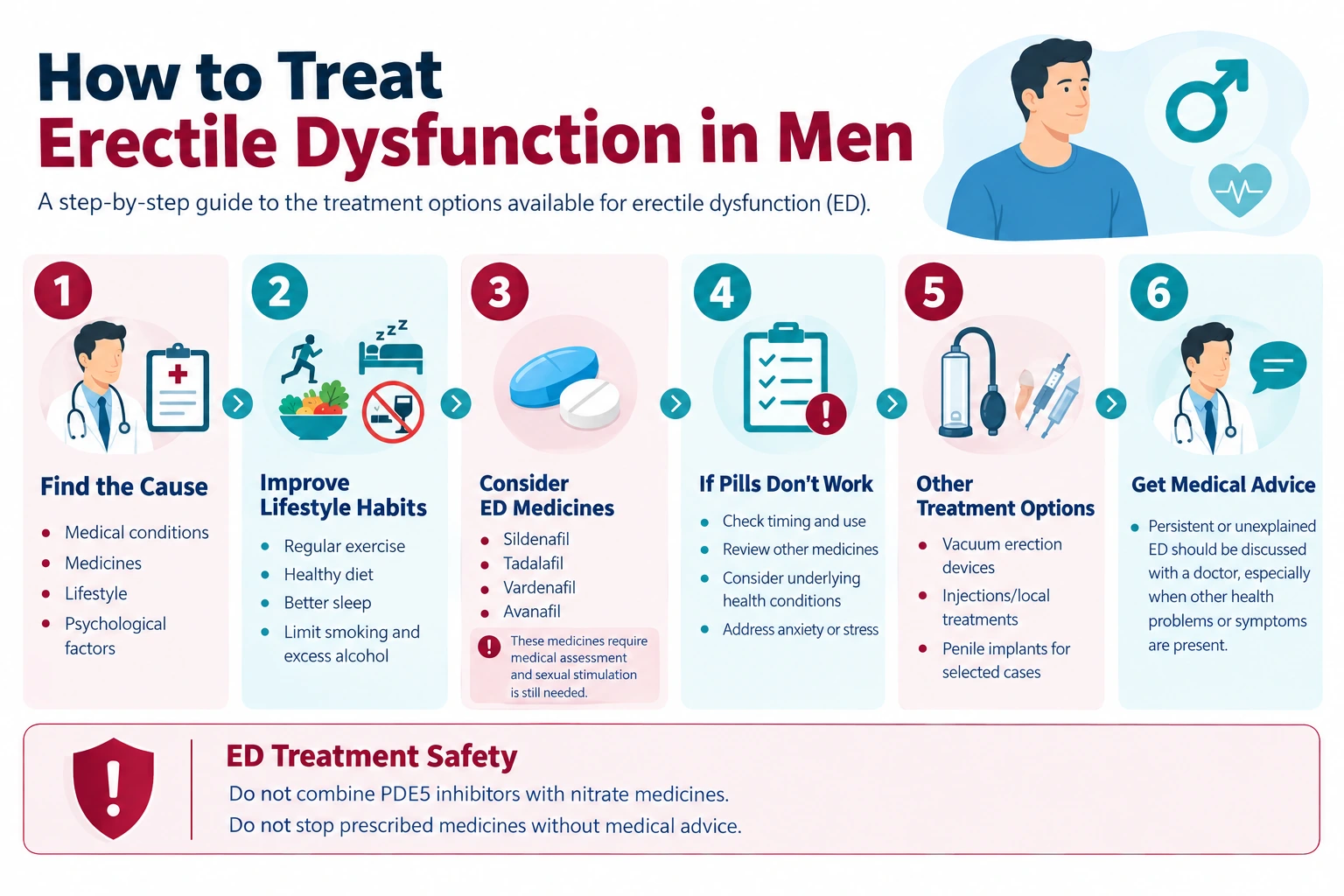
This is the heart of the article. Treating erectile dysfunction in men follows a logical, step-by-step approach. You do not start with a pill; you start with the cause.
1. Find and Treat the Underlying Cause
Before any ED-specific treatment, the question is: why is this happening? The most common underlying causes and how they are addressed:
- Diabetes: tight blood sugar control protects nerves and blood vessels. Poorly controlled diabetes is one of the strongest drivers of ED, and improving control can slow or stabilise the progression.
- High blood pressure and cholesterol: these damage the lining of blood vessels over time. Treating them protects vascular health, which is the foundation of erectile function. Note: some blood pressure medications themselves can contribute to ED, so a review of the specific drug matters.
- Hormonal issues: low testosterone, high prolactin, or thyroid disorders can cause or worsen ED. Testosterone replacement helps only when blood tests confirm a deficiency; giving testosterone to men with normal levels does not improve ED and can cause harm.
- Cardiovascular health: ED is now recognised as an early warning sign of cardiovascular disease, often appearing 2 to 5 years before a heart event. This means cardiovascular risk should be assessed, not just ED treated. Improving heart health often improves erectile function as a side effect.
- Medication-related ED: some medicines you already take may be contributing (covered in its own section below). A medication review is one of the highest-value, lowest-effort steps in ED care.
- Psychological factors: stress, anxiety, depression, and relationship difficulties can cause or worsen ED. When psychological factors are primary, no pill fixes the root cause; therapy does.
The principle: treat the cause first, and the ED often improves as a result. If it does not, then move to ED-specific treatments.
2. Make Lifestyle Changes
For many men, lifestyle change is the single most effective treatment available, and it has the advantage of improving overall health at the same time. The evidence is strong enough that it should be considered a treatment, not just a suggestion.
- Exercise: aerobic exercise improves endothelial function (the ability of blood vessels to open) and blood flow. A meta-analysis of exercise interventions found a statistically significant improvement in erectile function across aerobic, pelvic, and combined programs, with aerobic training showing the strongest effect. Aim for regular moderate aerobic activity.
- Weight management: weight loss raises testosterone, improves vascular function, and reduces inflammation. For overweight men, losing weight can meaningfully improve ED.
- Smoking: smoking accelerates arterial damage. Stopping smoking slows further vascular damage and can improve erectile function over time.
- Alcohol: alcohol is a central nervous system depressant that suppresses arousal and impairs performance. Reducing intake, especially before sex, can help.
- Sleep: poor sleep disrupts testosterone production and vascular recovery (covered in detail in the sleep section).
- Managing stress: chronic stress elevates cortisol and constricts blood vessels. Stress management, whether through exercise, mindfulness, or therapy, can directly improve erectile function.
3. Address Anxiety and Psychological Factors
When the brain is not sending the arousal signal, no amount of medication will produce an erection. Psychological erectile dysfunction is real, common, and treatable, but it requires a different approach than physical erectile dysfunction.
- Performance anxiety: this creates a self-reinforcing loop. A man worries about losing his erection, the worry itself prevents the erection, which confirms the worry, which makes the next attempt harder. Breaking this loop is often the key to recovery.
- Stress: work, financial, or life stress elevates cortisol and suppresses the arousal response.
- Depression and anxiety: both conditions and some of their treatments (SSRIs in particular) can contribute to ED. Treating the underlying condition is the priority.
- Relationship or sexual concerns: communication problems, unresolved conflict, or sexual mismatches can drive ED. Couples counselling or sex therapy addresses the relationship context, not just the individual.
- Counselling and sex therapy: cognitive behavioural therapy (CBT) and sex therapy are evidence-based for psychological ED. They address the thought patterns and behaviours that maintain the problem.
A useful diagnostic clue: if you still get morning erections or erections during masturbation but struggle with a partner, psychological factors are likely playing a significant role.
Which Medicines Are Used to Treat Erectile Dysfunction?
The main ED medicines are all in the same class: PDE5 inhibitors. The four available options are:
- Sildenafil (Viagra)
- Tadalafil (Cialis)
- Vardenafil (Levitra)
- Avanafil (Stendra)
How These Medicines Work
PDE5 inhibitors work by blocking an enzyme called PDE5, which breaks down cGMP, the chemical that keeps the blood vessels in the penis open during an erection. By blocking PDE5, the medicine allows cGMP to persist, which improves blood flow and makes it easier to get and maintain an erection.
Why Sexual Stimulation Is Still Needed
This is the part many men misunderstand. A PDE5 inhibitor does not produce an erection on its own. It requires sexual stimulation to release nitric oxide, which is what starts the chain reaction the medicine then amplifies. Without stimulation, the medicine has nothing to amplify. Taking a pill and waiting for an erection to appear on its own does not work; the brain and body still need to be engaged.
Why a Doctor Should Determine Whether They Are Appropriate
PDE5 inhibitors are prescription medicines for good reason. They interact with other medications, they are dangerous for men with certain heart conditions, and the correct dose varies by individual. A doctor determines whether you are medically suitable, which specific medicine and dose is right for you, and whether your ED needs further investigation before medication is tried.
Common Side Effects
Common side effects include headache, facial flushing, indigestion, nasal congestion, and back pain (more common with tadalafil). Vision changes (a blue tint) can occur with sildenafil. These are usually mild and temporary.
Important Contraindications and Interactions
- Nitrates are an absolute contraindication. Combining a PDE5 inhibitor with nitrate medication (nitroglycerin, isosorbide) can cause a dangerous, potentially life-threatening drop in blood pressure. This is the single most important safety rule with ED medicines.
- Alpha-blockers (used for prostate or blood pressure) can interact and need dose adjustment.
- Certain heart conditions (recent heart attack, unstable angina, severe heart failure) require professional assessment before any Erectile dysfunction medicine is considered.
- Some HIV protease inhibitors and certain antibiotics can interact and affect blood levels.
This is why these medicines are not a self-serve purchase. The safety depends on the individual’s full medical picture.
Why Don’t Erectile Dysfunction Pills Always Work?
This is one of the most important sections in this article, because it addresses the single most common real-world problem men face with ED treatment. If a PDE5 inhibitor isn’t working, the drug has almost never actually failed. Here is what is really going on:
The most common reason is incorrect use. In a study of 100 consecutive sildenafil non-responders, 56 were using it incorrectly: 45 had never tried the highest recommended dose, 32 took it on a full stomach, 22 took it immediately before sex, and 12 did not know sexual stimulation was required. Correcting administration alone restores response in many men.
The real reasons pills appear to fail:
- Incorrect timing: sildenafil should be taken 30 to 60 minutes before sex. Taking it right before or too early reduces effectiveness.
- Not allowing enough time: many men need 4 to 8 attempts at the correct dose before concluding it does not work. One or two tries is not an adequate trial.
- Lack of sexual stimulation: the medicine amplifies an erection; it does not create one from nothing. Without adequate stimulation, nothing happens.
- Food and alcohol considerations: a heavy, fatty meal can delay sildenafil absorption by over an hour and cut peak blood levels by up to 29%. Tadalafil is less affected by food, but excessive alcohol reduces effectiveness and increases side effects.
- Incorrect use: not taking the full recommended dose, or taking it inconsistently.
- Underlying health conditions progressing: worsening vascular disease, declining testosterone, new medications, or advancing diabetes reduce the response the drug can amplify. The drug itself does not cause tolerance at therapeutic doses; what changes is the underlying condition.
- Medication interactions: hidden interactions with other drugs you take can reduce effectiveness.
- Anxiety or performance pressure: if the brain is not sending the arousal signal, no amount of the medicine will produce an erection. This is one of the most overlooked reasons.
- Insufficient treatment trial: giving up after one or two attempts instead of working through correct use at adequate dose over enough tries.
The key insight: when men say the pill stopped working, they are usually describing an upstream change (damaged blood vessels, falling testosterone, or anxiety taking over), not a failure of the pill itself. If correct use at full dose over adequate attempts still fails, it is time to review the cause and consider non-oral options.
What If ED Medicines Don’t Work or Aren’t Suitable?
Roughly 30 to 40% of men do not respond adequately to PDE5 inhibitors, and some cannot take them at all (men on nitrates, with certain heart conditions). When pills are not an option or do not work, there are well-established alternatives. The focus here is on when each may be considered.
Vacuum Erection Devices
A vacuum erection device (penis pump) creates an erection by drawing blood into the penis using a vacuum, then a constriction ring holds the blood in place. It works almost immediately and is non-invasive and reusable. It may be considered for men who cannot use medication, who prefer a drug-free option, or as a bridge while other treatments are being adjusted. It does not affect sensation, urination, or orgasm.
Injectable Erectile DysfunctionTreatments
Alprostadil (Caverject, Edex) is injected into the side or base of the penis with a fine needle. It produces an erection within about 10 minutes, lasting roughly an hour. It is highly effective for men who fail or cannot take PDE5 inhibitors. It requires specialist guidance and carries risks including penile pain and, rarely, priapism (prolonged erection). It may be considered when oral medicines have failed or are unsuitable.
Local/Intraurethral Treatments
A small alprostadil pellet (MUSE) is inserted into the urethra. It is less effective than injection but avoids needles. It may be considered for men who cannot or will not use injections and for whom oral medicines are not suitable.
Penile Implants
A penile implant is a surgical device, either inflatable or semirigid, placed inside the penis. It is generally considered for persistent ED when other options are not suitable or effective. Implant users report satisfaction rates over 95%, and devices often work for up to 20 years. Once implanted, natural erections are no longer possible, so it is a considered, last-resort option for men whose erectile dysfunction has not responded to other treatments and who want a reliable, permanent solution.
Which ED Treatment May Be Right for You?
This decision table shows which treatment approach may be considered for different situations. It is not a substitute for a doctor’s assessment, but it gives you a realistic map of how treatment is matched to circumstances.
| Situation | Treatment approach that may be considered |
|---|---|
| Lifestyle-related risk factors | Lifestyle and health changes (exercise, weight, smoking, alcohol, sleep) |
| Psychological factors | Counselling/sex therapy, with or without medical treatment |
| Suitable for oral medication | PDE5 inhibitor (correct use, adequate dose, enough attempts) |
| Oral medicines unsuitable or ineffective | Other treatment options: vacuum device, injection, MUSE, or implant |
| Medication-related ED | Medical review with prescriber; consider alternative medications |
| Persistent ED despite treatment | Further assessment and specialist options |
| Confirmed low testosterone | Address testosterone deficiency; may combine with PDE5 inhibitor |
| ED after prostate treatment | Specialist assessment and penile rehabilitation |
| Sleep apnoea or poor sleep | Sleep evaluation; CPAP if OSA confirmed |
Is Erectile Dysfunction a Sign of Another Health Problem?
Yes, and this is one of the most important medical insights in this guide. Erectile dysfunction is now recognised as a sentinel marker of cardiovascular disease.
Here is why: the arteries in the penis are much narrower than the coronary arteries. The same endothelial dysfunction and plaque buildup that eventually causes heart disease shows up in the penis first, because the smaller arteries clog sooner. This is why erectile dysfunction frequently precedes a cardiovascular event by 2 to 5 years, offering a window for early detection and prevention.
The numbers are sobering:
- Erectile dysfunction affects over 70% of men with known cardiovascular disease.
- Men in their 40s with erection problems but no other risk factors run roughly an 80% risk of developing heart problems within 10 years.
- ED is an independent marker of increased all-cause and cardiovascular mortality, particularly in men aged 30 to 60.
- The 2024 Princeton IV Consensus formally designated erectile dysfunction a risk-enhancing factor in cardiovascular risk stratification.
Beyond the heart, erectile dysfunction can also signal:
- Diabetes: ED is a common early sign of undiagnosed or poorly controlled diabetes.
- High blood pressure: vascular damage from longstanding hypertension.
- Cholesterol problems: metabolic and lipid disorders.
- Hormonal problems: low testosterone or other endocrine issues.
The practical point: persistent erectile dysfunction should not be dismissed as just ageing. Treating it as only a quality-of-life issue means missing a 2 to 5 year window to detect and treat vascular disease before it becomes a heart attack or stroke. An erectile dysfunction workup should include cardiovascular risk assessment.
When Should You See a Doctor About Erectile Dysfunction?
See a doctor when:
- ED is persistent: occasional difficulty is normal; Erectile dysfunction that happens repeatedly over weeks or months is a signal worth investigating.
- There are sudden changes: ED that starts suddenly may indicate a psychological cause or, less commonly, an acute vascular event.
- There are other concerning symptoms: chest pain, breathlessness, or pain in the legs when walking could indicate cardiovascular disease, and ED may be the first visible sign.
- ED appears alongside cardiovascular or metabolic risk factors: if you have diabetes, high blood pressure, or cholesterol problems, Erectile dysfunction may indicate these are progressing and need attention.
- Treatment isn’t working: if your current ED treatment is not working, the answer is usually to review why (incorrect use, progressing disease, wrong cause), not simply to give up or keep switching pills.
The earlier you seek assessment, the more treatment options remain available and the more likely it is that an underlying cause can be addressed before it causes more serious problems.
ED Treatment Safety: What Should You Know?
- Do not combine ED medicines without medical advice. Taking multiple PDE5 inhibitors together, or combining them with other Erectile dysfunction treatments, increases risk without increasing benefit.
- Nitrates and PDE5 inhibitors are a dangerous combination. This is the single most important safety rule: never take a PDE5 inhibitor if you are on any form of nitrate medication, as the combination can cause a life-threatening drop in blood pressure.
- Medication interactions matter. ED medicines interact with alpha-blockers, certain antibiotics, HIV protease inhibitors, and other drugs. A full medication list should be reviewed before starting any ED medicine.
- Seek urgent care for a prolonged or painful erection. An erection lasting more than 4 hours (priapism) can cause permanent tissue damage and needs immediate medical attention. Sudden vision loss, sudden hearing loss, or a severe allergic reaction also need urgent care.
FAQ
What are the common treatments for ED?
Treatment options include lifestyle changes, counseling, oral medications, vacuum devices, and other doctor-recommended therapies.
Do ED medications work immediately?
Most ED medications start working within 30 to 60 minutes, but sexual stimulation is usually required for them to be effective.
When should I see a doctor for ED?
Consult a healthcare professional if ED occurs frequently, affects your quality of life, or may be linked to an underlying health condition.
Is ED a normal part of aging?
While ED becomes more common with age, it is not considered a normal or unavoidable part of aging.
Can Erectile Dysfunction (ED) be prevented?
Maintaining a healthy lifestyle, managing chronic conditions, and attending regular medical checkups may reduce the risk of ED.
Can stress and anxiety cause ED?
Yes. Psychological factors such as stress, anxiety, and depression can contribute to erectile dysfunction.

Years of Experience: 10+ years Education: B.Sc. in Biomedical Science (Monash University, Melbourne, Australia) PG Diploma in Health & Medical Communication (University of Sydney, Australia) Experience: Erica Wilson is an…