

Manage ED with Cutting-Edge Science: New Therapy Approach
By Ezra Allen, May-10-2025


 Dr. Arjun Srivastav Medical Reviewer (Pharm D)
 Erectile dysfunction (ED) treatment is entering a more research-driven phase. Alongside established medicines, scientists are studying approaches that could influence blood vessels, penile tissue, nerve signalling and other biological pathways involved in erection. For men looking to manage ED, these developments provide a broader view of how treatment may evolve.
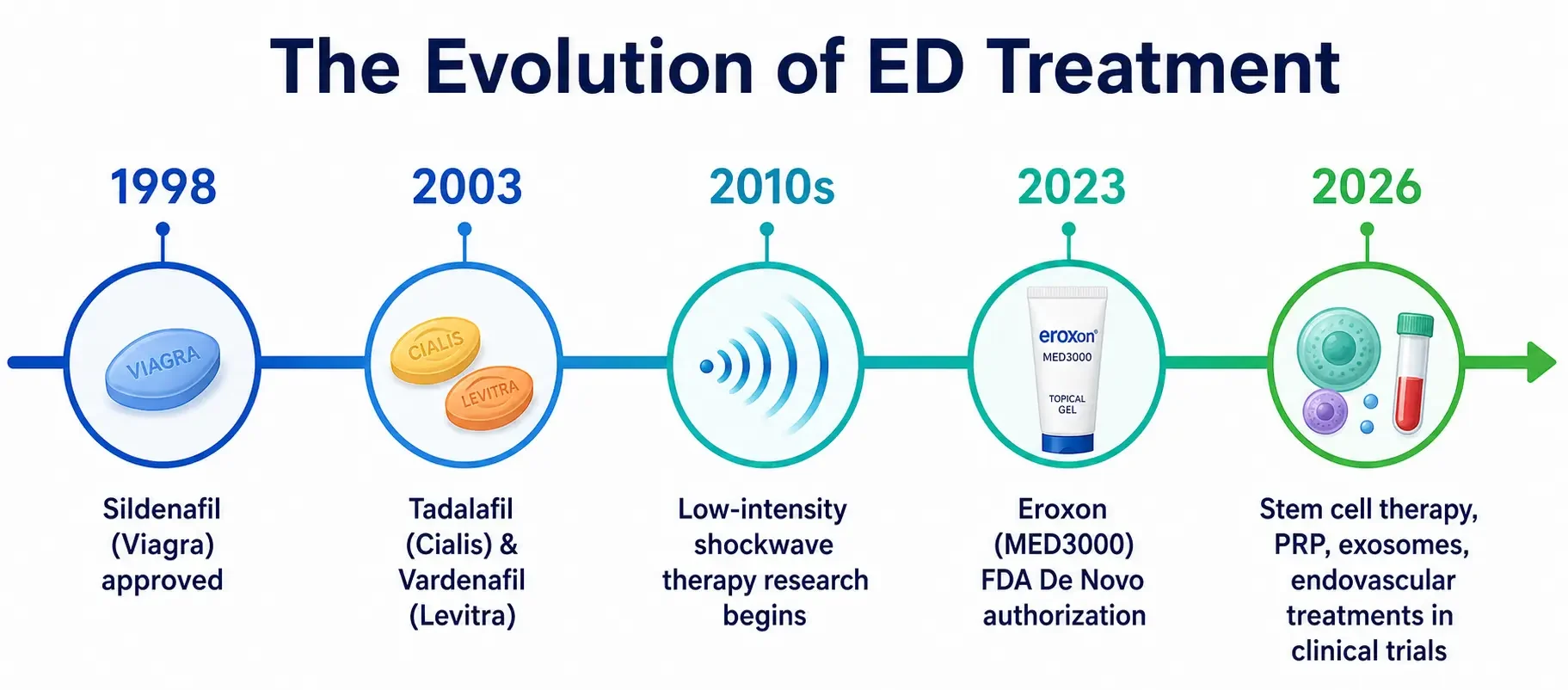
Low-intensity shockwave therapy, platelet-rich plasma (PRP), cell-based treatments, extracellular vesicles and endovascular procedures are among the areas receiving attention. A newer topical technology, MED3000 (Eroxon), has also reached the US market through an FDA De Novo authorization.
However, these therapies are not at the same stage of development. Some have regulatory authorisation for specific uses, some have encouraging clinical data, and others remain experimental. Understanding that difference is essential when evaluating the future of erectile dysfunction treatment and deciding how to manage ED based on the available evidence.
TL;DR: Quick Answer
What is the newest way to manage ED? Beyond conventional PDE5 inhibitors, research is exploring topical devices, shockwave therapy, PRP, cell-based treatments, extracellular vesicles and targeted vascular procedures. Some approaches have reached clinical use, while others remain investigational. The strongest evidence still supports established treatments, so emerging options should be assessed according to the cause of ED and the quality of available evidence.
At a Glance
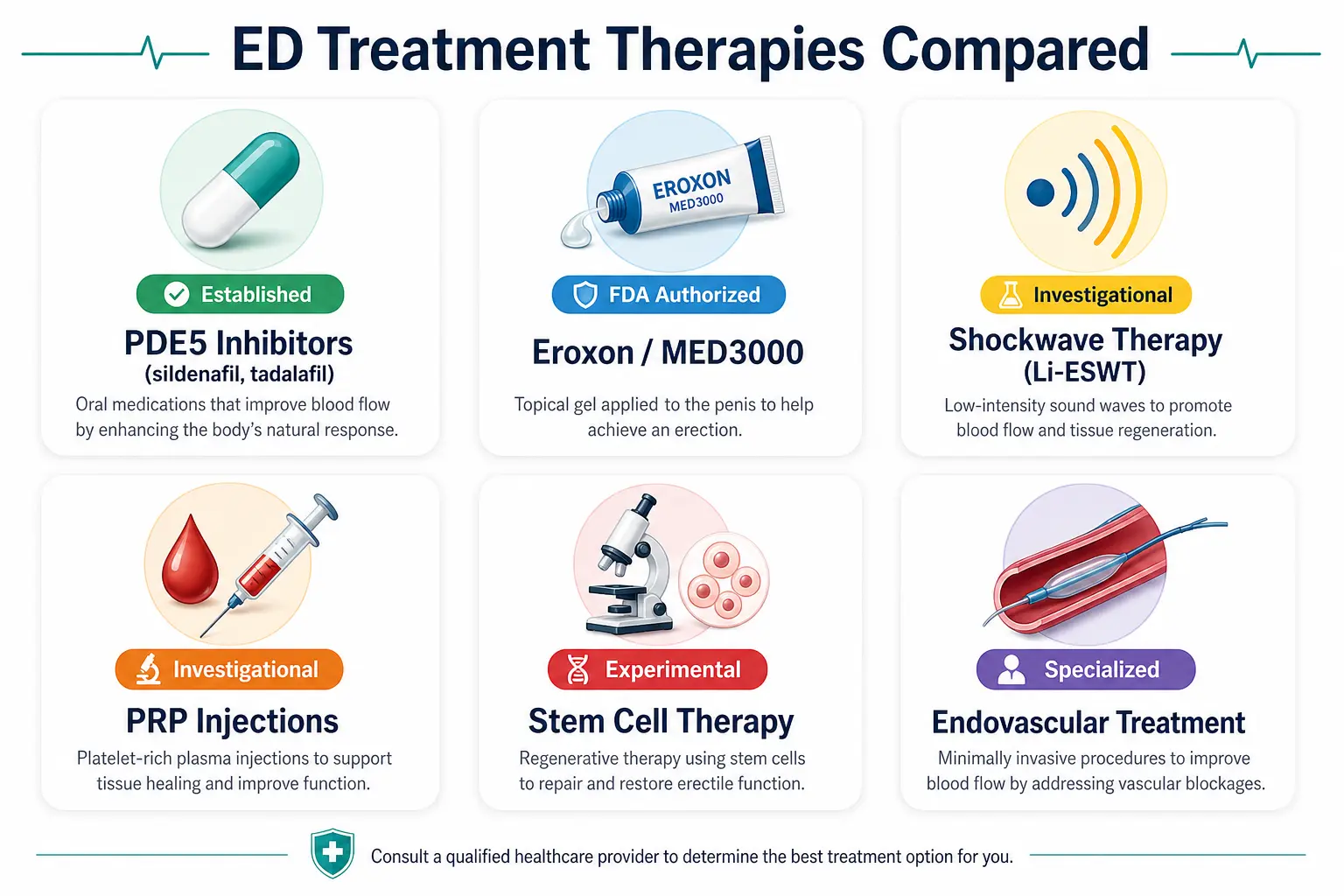
| Therapy | Main Scientific Approach | Current Evidence Position |
| PDE5 inhibitors | Supports nitric-oxide signalling | Established treatment |
| MED3000/Eroxon | Local sensory stimulation using a topical gel | FDA-authorized device in the US |
| Li-ESWT | Mechanical stimulation of penile tissue | Investigational; evidence remains inconsistent |
| PRP | Autologous platelet-derived growth factors | Investigational |
| Stem-cell therapy | Cell-based regenerative signalling | Experimental; clinical research ongoing |
| Exosomes/EVs | Cell-free biological signalling | Early-stage research |
| Endovascular treatment | Arterial revascularization or venous embolization | Specialized treatment for selected vascular cases |
Why Pills Are Not the Whole Story
PDE5 inhibitors such as sildenafil, tadalafil, vardenafil and avanafil remain an important part of manage ED. They work through the nitric oxide–cGMP pathway, helping relax penile smooth muscle and increase blood flow when sexual stimulation is present.
Their role is well established, but researchers are also investigating whether some forms of ED could eventually be addressed more directly. This may expand the options available to men trying to manage ED when conventional approaches are not suitable or do not provide the desired response.
That question is particularly relevant when vascular disease, diabetes, nerve injury, fibrosis or surgery contributes to erectile dysfunction. Instead of focusing only on the erection itself, regenerative research asks whether damaged biological pathways can be influenced.
This does not mean conventional medicines have become outdated. Rather, they provide the established benchmark against which newer approaches must be evaluated.
1. Low-Intensity Shockwave Therapy
Low-intensity extracorporeal shockwave therapy (Li-ESWT) uses acoustic pulses directed at penile tissue. Researchers have proposed several mechanisms, including changes in vascular signalling, angiogenesis and tissue-level regenerative responses.
Early studies generated considerable interest, particularly among men with vasculogenic ED who were exploring alternatives to manage ED.
What Does Current Research Show?
The picture in 2026 is more cautious than early promotional material suggests.
The 2026 SMSNA position statement reviewed randomized controlled evidence and highlighted major differences between devices, energy levels, treatment schedules and study designs. The organization concluded that current trials have not consistently demonstrated a clinically meaningful benefit and recommends against routine use of energy-based therapy outside appropriately designed research settings.
That makes Li-ESWT an important research area, but not an established replacement for standard ED treatment.
2. Platelet-Rich Plasma (PRP)
Platelet-Rich Plasma (PRP) is produced by processing a person’s own blood to concentrate platelets and associated biological factors. Researchers are investigating whether these components could influence tissue repair, vascular signalling and cellular responses in penile tissue.
Small clinical studies have reported improvements in erectile-function measures, which has helped drive further research. This has also made PRP a topic of interest among men researching newer ways to manage ED.
However, PRP protocols are not standardized. Preparation methods, platelet concentrations, injection schedules and patient selection can differ considerably between studies.
The 2026 SMSNA position statement concluded that current evidence does not establish PRP as a routine ED treatment and recommends its use only within appropriately governed clinical research.
For readers, the important point is simple: promising biological theory and early clinical findings do not yet equal established therapy.
3. Stem-Cell Therapy
Stem-cell research takes regenerative ED treatment a step further.
Mesenchymal stem cells and related cell populations are being investigated because of their potential effects on vascular signalling, inflammation, fibrosis and tissue repair. Researchers are particularly interested in whether these mechanisms could help men whose ED is associated with diabetes, vascular damage or treatment-related tissue injury.
Human clinical studies are underway, but the field remains experimental.
A 2026 systematic review and meta-analysis examined clinical research on stem-cell therapy for ED and highlighted the growing evidence base while also reflecting the limitations of the available studies.
The 2026 SMSNA position statement remains more conservative: it concluded that evidence for stem-cell therapy is extremely limited and that these treatments should be administered within clinical-trial settings rather than routine practice.
That distinction should remain clear when discussing regenerative medicine online or researching ways to manage ED.
4. Cell-Free Therapy: Exosomes and Extracellular Vesicles
Exosomes and other extracellular vesicles are attracting attention because they may deliver biological signals without introducing live cells.
The concept is particularly interesting for regenerative medicine. Instead of relying on transplanted cells to survive and function at the treatment site, researchers are investigating whether the signalling molecules released by those cells can influence damaged tissue.
Recent laboratory research has explored extracellular vesicles delivered through engineered hydrogels for diabetic ED. These studies are useful for understanding how researchers are trying to improve local delivery and biological activity.
But this is still early-stage science. Preclinical findings cannot be treated as proof that an exosome product is an established treatment for men with ED.
5. Endovascular Treatment
Endovascular treatment is one of the more clinically developed specialized approaches in this list.
The basic idea is to address a documented vascular abnormality using catheter-based techniques. Depending on the anatomy, procedures may involve revascularization of an arterial obstruction or embolization for selected venous-leak cases.
A major 2026 SwissPower registry study reported 1,032 endovascular procedures in 776 patients. Among patients with available follow-up data, improvements in erectile-function scores were observed after arterial revascularization, venous embolization and combined procedures.
The findings are notable, but they do not mean every man with ED is a candidate.
These interventions require careful vascular assessment and specialized expertise. They are most relevant when testing has identified a specific vascular problem that can potentially be addressed by an endovascular procedure.
6. Eroxon (MED3000): A New Topical Approach
Not every new ED development is regenerative.
MED3000, marketed as Eroxon, represents a different direction. It is a non-medicated topical gel designed to produce a cooling and warming effect that stimulates sensory nerve endings in the penis.
Unlike sildenafil or tadalafil, it does not rely on a conventional PDE5-inhibitor mechanism. For some men researching alternatives to manage ED, this represents a different treatment format rather than another oral medicine.
What Is Its Regulatory Status?
The US FDA granted Eroxon a De Novo classification in June 2023. FDA records classify it as a Class II, non-medicated topical formulation for the treatment of ED.
This is an important example of how newer ED technology can reach the market through a regulatory pathway that differs from conventional pharmaceutical approval.
What About Australia?
US authorization does not automatically establish Australian availability or approval.
The TGA maintains the Australian Register of Therapeutic Goods (ARTG), which provides information on therapeutic goods that can legally be supplied in Australia. A product’s Australian regulatory position should therefore be checked against the current ARTG rather than inferred from FDA status.
At the time of this review, a verified current ARTG entry for Eroxon/MED3000 was not established, so it should not be described as TGA-approved without current confirmation.
What Other Technologies Are Being Studied?
The research pipeline extends beyond the therapies already discussed.
Gene therapy is being investigated for its potential to influence molecular pathways involved in erectile function. Tissue-engineering approaches are also being explored as scientists look at ways to restore damaged structures.
Nanotechnology and engineered delivery systems are another active research area. Recent laboratory work has examined ways of delivering extracellular vesicles or other biological signals more effectively to penile tissue.
Artificial intelligence is also being explored in medicine for patient stratification, prediction and treatment planning. However, AI-assisted ED treatment selection is not yet a standard clinical approach.
These technologies are scientifically interesting, but they should remain clearly separated from treatments that have already demonstrated established clinical utility. Anyone looking to manage ED should distinguish research-stage technology from available medical care.
How Do Doctors Decide Which Approach Fits?
There is no single advanced therapy that suits every type of ED.
The first step is identifying the likely cause. Assessment may consider cardiovascular risk, diabetes, medications, hormonal factors, neurological conditions, psychological contributors and vascular health.
Depending on the findings:
- Established ED: conventional treatments may remain the most appropriate starting point.
- Suspected vascular disease: vascular assessment can help determine whether a targeted intervention is relevant.
- Treatment-resistant ED: a specialist may discuss established second-line options or appropriate research opportunities.
- Experimental regenerative treatment: participation in a properly regulated clinical trial may be preferable to commercial treatment with uncertain evidence.
Understanding the underlying cause can make it easier to determine which approach is appropriate to manage ED rather than choosing a therapy simply because it is marketed as new.
ED can also occur alongside cardiovascular risk factors, so an assessment should not focus solely on sexual symptoms.
What Is Still Experimental?
Several technologies discussed in scientific literature are not ready for routine of manage ED:
- Stem-cell therapy: promising biological rationale, but insufficient evidence for routine treatment.
- PRP: clinical studies exist, but evidence and treatment protocols remain inconsistent.
- Exosomes and extracellular vesicles: an active research field with important preclinical findings, but limited clinical evidence.
- Gene therapy: early-stage investigation rather than routine care.
- Advanced tissue engineering: primarily a translational research field.
The 2026 evidence makes one point particularly clear: a therapy can be scientifically exciting without yet being clinically established.
Safety Considerations Before Trying a New ED Therapy
Before paying for an emerging treatment, consider:
- Evidence: Ask which human clinical studies support the exact treatment protocol being offered.
- Regulatory position: Check the relevant regulator rather than relying on overseas advertising.
- Diagnosis: Make sure the underlying cause of ED has been assessed.
- Provider qualifications: Procedures should be performed by appropriately qualified healthcare professionals.
- Clinical-trial status: Experimental therapies are generally better evaluated through properly governed research.
- Long-term data: Ask whether durability and adverse effects have been studied beyond the initial follow-up period.
These checks are particularly important when deciding how to manage ED with a therapy that has limited long-term evidence.
Be especially cautious of clinics promising permanent results, guaranteed outcomes or claiming that an experimental treatment can repair every form of ED.
The Future of ED Treatment
The next stage of ED research is likely to focus increasingly on precision treatment: matching an intervention to the biological cause rather than treating every case in the same way.
Regenerative medicine, vascular interventions, topical technologies and advanced biological delivery systems could all contribute to that future. Some may eventually move from research into routine practice if larger, well-designed studies confirm meaningful benefits.
For now, the evidence supports a more measured approach. Established treatments remain the foundation, while newer technologies should be judged by clinical trials, regulatory standards and long-term outcomes. This evidence-based approach is more useful than assuming every new technology will provide a better way to manage ED.
Conclusion
Cutting-edge ED research is no longer limited to developing another tablet. Scientists are investigating vascular interventions, tissue regeneration, biological signalling, topical technologies and cell-free therapies that could change how selected forms of erectile dysfunction are managed.
Some developments, such as Eroxon, have already achieved regulatory milestones in the US. Others, including shockwave therapy, PRP, stem-cell therapy and extracellular-vesicle approaches, remain under investigation or have important evidence gaps.
For patients, the most useful approach is to look beyond the “new” label. The cause of ED, quality of clinical evidence, regulatory position and long-term safety all matter when deciding how to manage ED. Treatment decisions should always be made with a qualified healthcare professional.
FAQ
What Is the Newest Treatment for Erectile Dysfunction?
There is no single newest treatment that is appropriate for everyone. Current developments include Eroxon/MED3000, shockwave therapy, PRP, cell-based treatments, extracellular vesicles and specialized vascular procedures, but they are at different stages of development.
Is Eroxon FDA Approved for ED?
The FDA granted Eroxon a De Novo classification in 2023 as a Class II non-medicated topical device for ED. It is regulated differently from a conventional oral ED medicine.
The FDA granted Eroxon a De Novo classification in 2023 as a Class II non-medicated topical device for ED. It is regulated differently from a conventional oral ED medicine.
A verified current ARTG entry for Eroxon/MED3000 was not established during this review. Australian regulatory status should be confirmed through the current TGA/ARTG database.
Is Shockwave Therapy Proven for ED?
Research has reported potential benefits, but current randomized evidence remains inconsistent. The 2026 SMSNA position statement does not support routine energy-based therapy outside research settings.
Does PRP Work for Erectile Dysfunction?
Some clinical studies have reported improvements, but the evidence remains insufficient to establish PRP as routine ED treatment.
Is Stem-Cell Therapy Available for ED?
Stem-cell therapy is still experimental. Human studies are being conducted, but current professional guidance supports its use within clinical research rather than routine practice.
What Is the Most Promising Future Treatment for ED?
Several areas are being investigated, including regenerative medicine, vascular interventions, biological delivery systems and topical technologies. It is too early to identify one experimental approach as the definitive future treatment.
Are New ED Treatments Better Than Viagra or Cialis?
Not automatically. Established PDE5 inhibitors have a much larger clinical evidence base. A newer treatment should be judged by its own clinical evidence rather than its novelty.

Years of Experience: 12+ Years Education: Master of Sexology - [University of Sydney] MBBS (Bachelor of Medicine, Bachelor of Surgery) - [Torrens University Australia] BSc in Medical Laboratory Technology -…

