

What is the Difference between Ivermectin and Fenbendazole
By Erica Wilson, May-14-2026

 Dr. Arjun Srivastav Medical Reviewer (Pharm D)
What Is Ivermectin?
Ivermectin is a human antiparasitic medication used to treat certain parasitic infections caused by worms and external parasites. It has been used for decades in human medicine and remains recognised in many countries for specific approved medical purposes. In Australia, medications containing ivermectin are regulated within established prescription and therapeutic frameworks.
The medication became widely known for its role in treating infections caused by parasites that affect the skin, intestines, or bloodstream. Some formulations are prescribed under medical supervision for conditions involving scabies and particular worm infections.
People researching antiparasitic medications often come across products such as Iverheal 12 mg, which are associated with ivermectin-based treatment options available through online pharmacy providers.
➤ How Ivermectin Is Commonly Used
Ivermectin is commonly associated with:
- River blindness treatment programs
- Certain intestinal worm infections
- Scabies management in selected cases
- Parasitic infections involving microscopic organisms
Its use depends on medical assessment, diagnosis, and appropriate prescribing guidance. Healthcare professionals evaluate factors such as body weight, infection type, existing medical conditions, and possible medication interactions before recommending treatment.
One reason ivermectin gained attention globally is its established role in human medicine compared with many veterinary antiparasitic compounds. That distinction is important when comparing ivermectin vs fenbendazole later in this guide.
➤ How Ivermectin Works Against Parasites
Ivermectin works by affecting the nervous system of certain parasites. It targets specific channels known as glutamate-gated chloride channels, which are important for parasite nerve and muscle activity.
Once these channels are affected, parasites can become immobilized and eventually die. This process helps the body remove the infection over time. Human cells do not rely on these channels in the same way, which is one reason ivermectin can selectively affect parasites under medically controlled use.
Researchers continue studying ivermectin in several scientific areas, including laboratory-based drug repurposing discussions. Still, approved human use remains centered on antiparasitic treatment rather than unproven oncology claims.
What Is Fenbendazole?
Fenbendazole is a benzimidazole antiparasitic medicine primarily used in veterinary medicine to treat certain parasitic worm infections in animals. It works differently from ivermectin and does not have the same established role in routine human medicine.
Fenbendazole has received increased attention because of laboratory and preclinical research, particularly research exploring its potential effects beyond parasite treatment. However, experimental findings should not be confused with established human medical uses.
How Fenbendazole Is Commonly Used
In veterinary medicine, fenbendazole may be used against susceptible gastrointestinal parasites, including:
- Roundworms
- Hookworms
- Whipworms
- Other susceptible intestinal worms
The appropriate veterinary formulation and treatment schedule depend on the animal, parasite and veterinary instructions.
How Fenbendazole Affects Parasites
Fenbendazole interferes with parasite microtubules, structures that are important for cellular processes such as division and nutrient utilisation. This mechanism differs from some other antiparasitic medications, which target parasites through different biological pathways. Disrupting these structures can impair susceptible parasites and contribute to their elimination.
Although this mechanism has generated interest in laboratory research, it does not establish fenbendazole as an appropriate or effective human treatment.
What Is the Difference Between Ivermectin and Fenbendazole?
The main difference between ivermectin and fenbendazole is their medical use, human evidence, mechanism of action and regulatory context.
Both belong to the broad category of antiparasitic medicines, but they should not be treated as interchangeable alternatives.
| Feature | Ivermectin | Fenbendazole |
|---|---|---|
| Primary use | Human antiparasitic medicine for specific infections | Primarily veterinary antiparasitic medicine |
| Drug class | Avermectin | Benzimidazole |
| Main action | Affects parasite nerve and muscle signalling | Disrupts parasite microtubules |
| Human use | Established for specific indications | Not established as routine human therapy |
| Main evidence | Established human clinical evidence for specific uses | Mainly veterinary and preclinical evidence |
| Cancer treatment | Not an established cancer treatment | Not an established cancer treatment |
| Interchangeable? | No | No |
💡 Tip
Human vs Veterinary Use
Ivermectin has established uses in human medicine for specific parasitic infections. Fenbendazole, in contrast, is primarily a veterinary medicine.
This distinction is particularly important when considering products or information found online. A medicine being effective against parasites in animals does not automatically mean that the same medicine, formulation or dose is appropriate for people.
Mechanism of Action
The medicines also affect parasites in different ways.
Ivermectin:
Ivermectin primarily affects nerve and muscle signalling in susceptible parasites. This can interfere with their movement and survival.
Fenbendazole:
Fenbendazole acts on parasite microtubules, disrupting processes required for normal cellular function.
Therefore, their mechanisms should not be considered equivalent simply because both are described as antiparasitic medicines.
Human Clinical Evidence
Ivermectin has a substantial history of human medical use for specific parasitic infections.
Fenbendazole has considerably less established human clinical evidence. Much of the interest surrounding fenbendazole comes from veterinary experience, laboratory research and preclinical studies rather than established human treatment guidelines.
Are Ivermectin and Fenbendazole Interchangeable?
No. One medicine should not automatically be substituted for the other.
The appropriate antiparasitic treatment depends on the parasite involved, the site of infection, available evidence, approved indications and individual patient factors.
🔔 Reminder
Safety and Regulatory Differences
- The safety and regulatory status of ivermectin and fenbendazole are another important difference.
- Ivermectin has established human medical indications, but it still needs to be used appropriately because its safety can depend on the dose, treatment duration, other medicines and the patient’s health.
- Fenbendazole is primarily a veterinary medicine, and evidence supporting routine human treatment is limited. Veterinary formulations should not automatically be assumed to be suitable substitutes for medicines intended for people.
- Online claims can also blur the difference between laboratory findings, animal studies and proven human treatments. A medicine should not be used for an unestablished indication simply because early research or anecdotal reports appear promising.
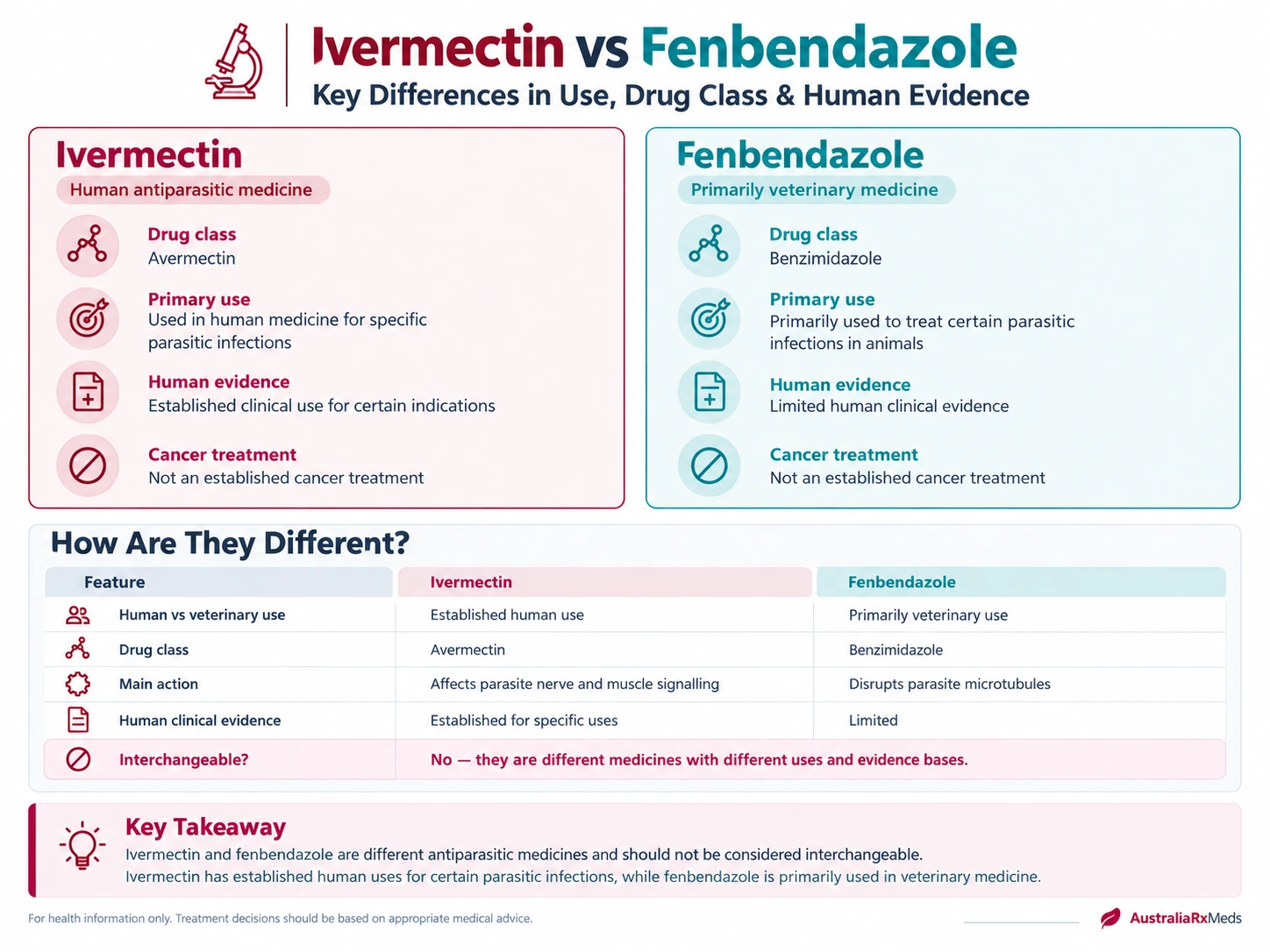
Ivermectin vs Fenbendazole for Parasites
Ivermectin and fenbendazole should not be viewed as two versions of the same antiparasitic treatment. Understanding what is a parasite infection can help clarify why treatment depends on the specific organism and site of infection.
Which Medicine Is Appropriate?
The appropriate treatment depends on the specific parasite and the person or animal being treated. Different infections may require different medicines for parasite infection, depending on the organism and clinical situation.
Factors that may influence treatment include:
- The type of parasite
- Where the infection is located
- Whether the medicine is approved or established for that infection
- The patient’s age and health
- Other medicines being used
- Previous treatment and response
For this reason, choosing between ivermectin and fenbendazole based only on which medicine appears “stronger” is not a reliable approach.
Ivermectin vs Fenbendazole for Humans
When comparing fenbendazole for human use, their differences become particularly important.
Which Medication Is Used in Human Medicine?
Ivermectin has established human medical uses for specific parasitic infections. Its use should still be based on the appropriate indication and medical guidance.
Fenbendazole is primarily a veterinary medicine. Its established veterinary use should not be confused with an established human indication.
Can Humans Take Fenbendazole?
The fact that fenbendazole has been discussed for human use does not mean that it has been established as a routine human treatment.
Human safety, dosing, formulation and effectiveness require appropriate clinical evidence. People should not assume that a veterinary medicine is suitable for self-treatment simply because it is an antiparasitic drug.
⚠️ Warning
Australian Regulatory Perspective
In Australia, ivermectin has established human medical uses for specific conditions. Fenbendazole is primarily associated with veterinary use and does not have the same established role in routine human medicine.
This distinction is important when evaluating online products and claims about using veterinary medicines in people.
Important Safety Considerations
Do not choose ivermectin or fenbendazole solely because of online testimonials, social media claims or comparisons suggesting that one is “stronger.”
The safest approach is to identify the condition being treated and use a medicine with an appropriate indication, formulation and evidence base.
Ivermectin vs Fenbendazole for Cancer: What Does the Research Say?
Drug Repurposing in Oncology
Fenbendazole attracted attention because of its effects on microtubules, while ivermectin generated scientific interest through research involving cellular signaling pathways and laboratory-based models. For more detail on the available evidence, fenbendazole and cancer research should be considered in the context of preclinical findings rather than established cancer treatment.
In oncology-related investigations, scientists have explored whether some antiparasitic compounds interact with:
- Cellular metabolism pathways
- Inflammatory signaling
- Microtubule activity
- Tumor cell growth patterns
- Immune-related biological responses
Fenbendazole attracted attention because of its effects on microtubules, while ivermectin generated scientific interest through research involving cellular signaling pathways and laboratory-based models.
Even so, preclinical research does not automatically establish safe or effective human cancer treatment.
🔴 Important
Laboratory Studies and Early Research
Several laboratory and animal studies have examined how these medications behave in controlled experimental conditions. Researchers have reported observations involving tumor cell response, metabolic stress, and altered cellular activity in some preclinical models.
These findings helped create broader scientific curiosity around repurposed antiparasitic drugs. However, laboratory evidence has important limitations.
- Cell culture studies do not fully represent the human body
- Animal models may respond differently from humans
- Experimental dosing may not reflect clinical safety standards
- Early-stage findings require further validation
At present, there is no broad clinical consensus supporting ivermectin or fenbendazole as established cancer therapies. Major healthcare organizations continue emphasizing the need for rigorous human clinical trials before therapeutic conclusions can be made.
Why Online Interest Increased
Online interest grew rapidly after anecdotal stories and social media discussions began circulating across forums, podcasts, and video platforms. Personal testimonials often spread faster than scientific clarification, especially when people are searching for alternative treatment discussions.
Searches related to:
- Fenbendazole cancer research
- Ivermectin cancer research
- Repurposed antiparasitic drugs
- Experimental therapies
became increasingly common as public curiosity expanded.
One challenge with online discussions is that laboratory findings are sometimes presented without enough medical context. Readers may encounter claims that overlook the difference between:
- Cell studies
- Animal studies
- Preclinical evidence
- Large-scale human clinical trials
This can create confusion about what current research actually proves.
Why Experts Recommend Caution
➠ Medical experts, oncology organizations, and healthcare professionals continue recommending caution when discussing these medications outside approved therapeutic contexts.
➠ Limited clinical evidence remains one of the biggest concerns. While early-stage research may identify biological activity worth studying further, that does not confirm treatment effectiveness or long-term human safety.
➠ Experts also warn that self-medication can create serious risks, particularly when individuals use veterinary products or delay evidence-based medical care.
Balanced scientific discussion means recognizing two realities at the same time:
- Researchers are interested in studying repurposed medications
- Current evidence is still incomplete and under investigation
This distinction is essential for understanding why ivermectin and fenbendazole continue appearing in research conversations without being recognized as proven oncology treatments.
Safety, Side Effects and Potential Risks
Like other medicines, ivermectin can cause side effects, and the potential risks depend on the medicine, dose, formulation and individual circumstances.
Ivermectin
Reported side effects can include:
- Dizziness
- Nausea
- Diarrhoea
- Abdominal discomfort
- Headache
- Fatigue
More serious reactions are possible, particularly when ivermectin is used inappropriately or at excessive doses. It can also interact with other medicines.
Fenbendazole
Information about fenbendazole side effects in humans is more limited because fenbendazole is primarily a veterinary medicine. Human safety cannot simply be assumed from its use in animals.
Anyone considering an unapproved or non-standard use of a medicine should discuss the potential risks with an appropriate healthcare professional.
Why Proper Medical Guidance Matters
The correct antiparasitic treatment depends on the infection, the medicine being considered, the patient’s health and other medicines being taken.
Using a medicine for an unproven condition or taking a veterinary formulation without appropriate medical advice can create unnecessary risks.
Which Medicine Is Appropriate for a Parasitic Infection?
Choosing between ivermectin and fenbendazole should begin with understanding why the medication is being considered in the first place. Although both are antiparasitic drugs, they are not interchangeable in terms of approval status, intended use, or available human clinical evidence.
Many people researching these medications are trying to compare safety, effectiveness, regulatory status, and online claims. A responsible decision process depends on evidence-based information rather than viral discussions or isolated testimonials.
Understanding Intended Usage
Ivermectin is associated with approved human antiparasitic applications in certain medical settings, while fenbendazole remains primarily connected to veterinary parasite treatment.
This distinction matters because:
- Human medications undergo different regulatory review processes
- Veterinary formulations may not match human therapeutic standards
- Safety data can vary significantly between intended species
- Clinical evidence for human use differs between medications
Understanding intended usage helps reduce confusion created by simplified online comparisons between fenbendazole vs ivermectin.
Importance of Professional Advice?
Professional medical advice remains important whenever someone is considering prescription medication, antiparasitic treatment, or information connected to experimental research discussions.
Healthcare professionals can provide guidance based on:
- Medical history
- Current health conditions
- Medication interactions
- Evidence-based treatment standards
- Regulatory safety information
This type of guidance is especially important when online information mixes laboratory findings with unverified treatment claims.
Avoiding Misinformation Online
Online health discussions can spread quickly, particularly when they involve experimental therapies or highly emotional medical topics. One challenge for readers is distinguishing balanced scientific discussion from exaggerated or unsupported claims.
Helpful ways to evaluate medical information include:
- Checking whether claims are supported by clinical trials
- Separating laboratory research from proven treatment outcomes
- Reviewing guidance from recognized healthcare organizations
- Avoiding reliance on isolated testimonials alone
For most readers, the safest approach is to treat ivermectin and fenbendazole as medically distinct medications with different regulatory backgrounds, different mechanisms, and different levels of human clinical evidence.
Conclusion
Ivermectin and fenbendazole are different antiparasitic medicines and should not be considered interchangeable. Ivermectin has established human uses for certain parasitic infections, while fenbendazole is primarily used in veterinary medicine. Always choose treatment based on the specific condition and appropriate medical advice.
For more information, visit AustraliaRxMeds.
FAQ
Is Fenbendazole Approved for Humans?
Fenbendazole is primarily known as a veterinary antiparasitic medication. Current human clinical evidence remains limited, and it is not broadly recognized as an established human cancer treatment.
What Is Ivermectin Mainly Used For?
Ivermectin is mainly used for certain parasitic infections involving worms and external parasites. Medical applications may include conditions such as scabies and specific parasitic worm infections under professional supervision.
Why Are These Drugs Discussed Online?
Online discussions increased because of drug repurposing research, laboratory studies, and anecdotal reports shared through social media, forums, and alternative health communities.
Can Ivermectin Treat Cancer?
Current evidence does not establish ivermectin as a proven cancer treatment. Existing discussions largely involve laboratory research, preclinical studies, and ongoing scientific investigation rather than confirmed clinical outcomes.
Is Fenbendazole Stronger Than Ivermectin?
These medications work differently and are designed for different treatment contexts. Comparing them as simply “stronger” can be misleading because their mechanisms, approval status, and intended use are not the same.
What Are the Main Side Effects?
Possible side effects may include nausea, dizziness, digestive discomfort, fatigue, headache, and medication interaction risks. Safety can vary depending on dosage, formulation, and individual health factors.
Are There Human Clinical Trials?
Some early-stage human investigations and experimental studies exist, but large-scale clinical evidence remains limited in several areas being discussed online.

Years of Experience: 10+ years Education: B.Sc. in Biomedical Science (Monash University, Melbourne, Australia) PG Diploma in Health & Medical Communication (University of Sydney, Australia) Experience: Erica Wilson is an…