

Intestinal Parasite Infection: Symptoms, Causes and Treatment Options
By Erica Wilson, Sep-24-2026


 Dr. Arjun Srivastav Medical Reviewer (Pharm D)
 An intestinal parasite infection happens when a living organism takes up residence inside your digestive tract and draws its nourishment from you. The word parasite describes any creature that survives this way, and the intestinal kind settles in the gut, where food is already being broken down and absorbed. People often use the phrase intestinal worms as a catchall, but worms are only one branch of the picture. Threadworms, tapeworms, hookworms, roundworms and whipworms are worm shaped and visible at certain stages, while a second, less discussed group is made up of microscopic single celled organisms such as Giardia, Blastocystis, Dientamoeba and Cyclospora. Some infections announce themselves with cramping, diarrhoea, bloating or itching, while others stay completely silent for months or even years, which is why identifying the exact organism before reaching for treatment is what separates an effective recovery from a wasted dose of medicine.
An intestinal parasite infection occurs when a parasite lives in the digestive tract and may affect the intestines. Common examples include threadworms, roundworms, hookworms, whipworms and tapeworms. Some infections cause noticeable symptoms, while others may produce few or no symptoms.
🔎 Possible Signs
🦠 Common Sources
🩺 What Matters
What Causes an Intestinal Parasite Infection?
Most people assume poor hygiene is the whole story behind an intestinal parasite infection. The reality is more interesting, because each parasite has its own preferred route into the body. To understand how these organisms enter and affect the body more broadly, it helps to first understand what a parasite infection is.
The simplest pathway is swallowing. Microscopic eggs or cysts can cling to food that was washed in contaminated water, to raw produce handled with unwashed hands, or to undercooked meat carrying larval cysts. Drinking untreated water from a stream, tank or unreliable supply does the same job. Once swallowed, the eggs survive stomach acid, hatch in the intestine and mature into adult worms.
Soil is another entry point that many articles gloss over. Hookworm and Strongyloides larvae live in dirt contaminated by human faeces. Walking barefoot allows these larvae to burrow straight through the skin of the sole, travel through the bloodstream to the lungs, and eventually reach the gut. This skin penetration route is why footwear matters as much as handwashing in some regions.
Threadworms spread differently again. Female worms lay eggs around the anus at night, causing itch. Scratching transfers eggs onto fingers and under fingernails, and from there onto bedding, toys, towels and food. The whole household can become reinfected within days.
Travel raises the odds because some parasites are far more common in tropical and subtropical areas. A single exposure during a trip can lead to an infection that only becomes noticeable weeks later.
A useful way to picture the process is a chain: exposure happens first, then the parasite enters through the mouth or skin, it settles in the intestine, and only after that do symptoms appear or stay absent.
Types of Intestinal Parasites You Should Know
Treating every parasite as the same condition is one of the biggest mistakes in self care when dealing with an intestinal parasite infection. Each organism behaves differently, and knowing the difference changes everything about diagnosis and treatment.
Parasites can affect different parts of the body, and an intestinal infection should not be confused with a parasitic skin infection, where the organism primarily affects the skin rather than the digestive tract.
Threadworms and Pinworms
These are the most familiar intestinal worms in Australia, especially among children. The hallmark sign is itching around the anus at night, when the female worm crawls out to deposit eggs. Sleep becomes restless, and children may wake irritable. Because eggs spread easily through shared bedding and close contact, the whole family is often treated at once.
Roundworms
Infection begins when eggs are swallowed, usually from contaminated soil on unwashed vegetables or dirty hands. Light infections may cause vague abdominal discomfort, while heavier ones can produce nausea, vomiting and even visible worms in stool. Large numbers of roundworms have occasionally been known to cause blockage, which is why heavier cases are taken seriously.
Hookworms
These enter through the skin, usually the feet, when someone walks on soil containing larvae. Once inside, they attach to the intestinal wall and feed on blood. Over time this steady blood loss can drain iron from the body, leading to anaemia and the tiredness that goes with it. Hookworms are a clear example of a parasite that harms nutrition rather than just causing discomfort.
Whipworms
Whipworms live in the large intestine. Light infections often go unnoticed, but heavier ones can trigger diarrhoea, abdominal pain and a feeling of incomplete emptying after using the toilet. In children, prolonged heavy infection has been linked with growth and development concerns.
Tapeworms
These usually arrive through contaminated meat that was not cooked thoroughly, though some species spread through food or water. Many people feel completely well and only discover the infection when they notice small white segments in their stool or underwear. Abdominal discomfort and changes in appetite can occur but are not guaranteed.
Strongyloides
This is the parasite that most basic guides underexplain, and it deserves special attention. Unlike the worms above, Strongyloides stercoralis can complete its entire life cycle inside a single person. The larvae it produces in the gut can reinfect the same host without ever leaving the body, a process called autoinfection. That means an infection picked up decades earlier can quietly persist, producing low grade symptoms or none at all, until the immune system weakens.
This self sustaining loop is why Strongyloides behaves so differently from other soil transmitted worms. Standard stool microscopy often misses it, because larval output is low and irregular. A single stool sample can fail to detect the parasite in up to seven out of ten chronic cases. Specialised techniques such as agar plate culture and blood antibody testing are usually needed instead.
For anyone with a weakened immune system, Strongyloides becomes genuinely dangerous. The autoinfection cycle can accelerate into a runaway process called hyperinfection, where larvae spread beyond the gut into lungs and other organs. This is why travellers, refugees and people from endemic regions are sometimes screened even when they feel well, rather than waiting for symptoms.
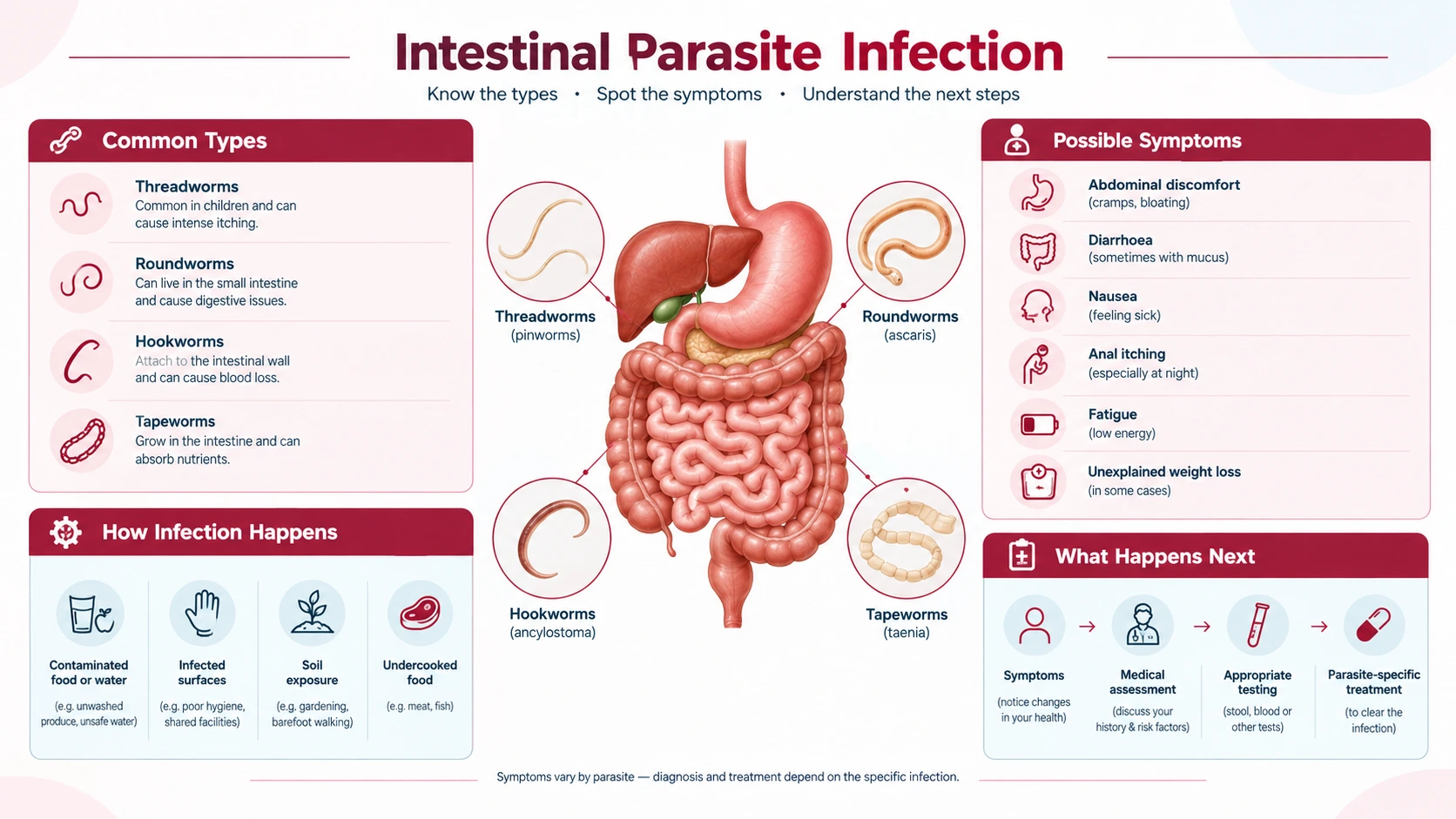
Intestinal Parasite Infection Symptoms: What Should You Look For?
A plain list of parasite infection symptoms rarely helps, because the same complaints can point to dozens of other conditions. A clearer approach is to group symptoms by how they actually show up in daily life.
Digestive complaints are the most common first sign:
- Abdominal pain or cramping
- Diarrhoea, and sometimes constipation with certain infections
- Nausea and shifts in appetite
- Bloating and general digestive discomfort
Whole body symptoms appear when the infection drains resources over time. Tiredness, weakness, unexplained weight loss and a reduced appetite can develop slowly enough that people blame stress or ageing rather than parasites. With blood feeding worms like hookworm, anaemia adds another layer of exhaustion and paleness.
More specific clues are the ones worth remembering:
- Itching around the anus at night is almost a signature of threadworms
- Seeing a worm or worm segments in stool is unmistakable when it happens
- Digestive trouble that begins during or soon after overseas travel is a strong hint
- Certain larvae can trigger unexplained skin rashes or creeping trails where they entered
Can You Have an Intestinal Parasite Without Symptoms?
Yes, and this is one of the most overlooked truths on the topic. Light infections, especially in adults with healthy immune systems, may produce no noticeable signs at all. The absence of visible worms or obvious illness does not rule out infection. This is exactly why testing exists rather than guesswork.
Is Every Stomach Problem a Parasite Infection?
It is tempting to blame worms the moment the gut feels off, but an intestinal parasite infection is only one of many possible explanations. The digestive tract is a crowded neighbourhood of possible culprits.
Abdominal pain can come from food intolerance, stress, ulcers or irritable bowel syndrome. Diarrhoea has causes ranging from viral gastroenteritis to medication side effects. Bloating alone says almost nothing about parasites, despite what wellness forums suggest. Lactose intolerance, coeliac disease, small intestinal bacterial overgrowth and ordinary infections can all mimic the same symptoms.
The danger of self diagnosing from a single complaint is that it leads to the wrong treatment. Taking a deworming medicine for what is actually irritable bowel syndrome does nothing for the real problem and can delay proper care.
Symptoms can suggest that something is wrong, but they cannot reliably identify which parasite, or whether a parasite is involved at all.
How Is an Intestinal Parasite Infection Diagnosed?
Diagnosis has moved well beyond simply looking at a stool sample, and confirming an intestinal parasite infection depends entirely on what the doctor suspects.
Stool Testing
A stool examination remains the starting point for most suspected infections. A healthcare professional asks for a small sample, which the laboratory checks under a microscope for eggs, larvae or cysts. Because parasite output can be patchy, more than one sample collected on different days is often requested to improve accuracy. This is especially true for organisms that shed intermittently.
Sticky Tape Test
For suspected threadworms, a different method works better than stool testing. A piece of clear sticky tape is pressed against the skin around the anus, usually first thing in the morning before bathing. The tape picks up any eggs laid overnight, and the laboratory examines it under a microscope. Timing matters because washing can remove the evidence.
Blood Tests and Other Testing
When stool results are unclear, or when a parasite like Strongyloides is suspected, blood tests come into play. Antibody testing can reveal whether the immune system has encountered a particular organism. Other investigations depend on the suspected parasite, the symptoms, the travel history and any underlying medical conditions. In difficult cases, specialised cultures or molecular tests may be ordered.
Intestinal Parasite Infection Treatment Options
The single most important point about treating an intestinal parasite infection is that different organisms do not all respond to the same medicine. A dose that clears threadworms may do nothing for Giardia, and the approach for Strongyloides is nothing like the approach for tapeworms.
Antiparasitic medicines are the mainstay for many infections, but the choice of drug, dose and treatment duration depend on the organism identified. Our guide to medicines used for parasite infections explains how treatment differs between intestinal worms and other parasitic infections. Some infections clear with a single dose, while others require daily medicine for several days or even weeks. Repeat doses are sometimes needed to catch worms that hatched after the first round, since eggs can survive the initial treatment.
Many threadworm treatments are available from a pharmacy, and because the whole household tends to share the exposure, treating everyone at once is often recommended alongside a thorough cleaning of bedding and towels. Other intestinal worm infections usually need a healthcare professional to select the appropriate medicine and confirm the correct dose.
A point that is easy to miss is that treatment alone does not always fix the underlying exposure. If the source remains, reinfection can follow. Follow up matters when symptoms continue, and a second test may be ordered to confirm the parasite has actually cleared rather than just gone quiet.
Related Medicines for Intestinal Parasite Infections
The medicine used for an intestinal parasite infection depends on the organism responsible. Different antiparasitic medicines work against different parasites, so treatment should not be chosen solely from symptoms.
Some medicines commonly discussed in the treatment of intestinal worm infections include:
- Albendazole 400: used for several types of intestinal worm infections, depending on the parasite involved.
- Mebendazole 500: commonly used for certain intestinal worms, including threadworms and other susceptible worm infections.
- Praziquantel 600: used for specific parasitic worm infections, including certain tapeworm and fluke infections.
Other intestinal parasites, including protozoal infections, may require completely different medicines. For example, treatment for Giardia is not the same as treatment for a typical intestinal worm infection.
Why Do Parasite Infections Sometimes Come Back?
Reinfection is one of the most frustrating parts of dealing with an intestinal parasite infection, and it is rarely discussed honestly.
With threadworms, eggs can survive on household surfaces for days. Scratching transfers them back to fingers and under fingernails, and from there back to the mouth, restarting the cycle. Bedding, towels, soft toys and even dust can carry eggs, which is why a single dose of medicine is often not enough on its own.
Other parasites can be picked up again through the same contaminated food, water or soil that caused the first infection. Someone who walks barefoot in the same garden, drinks from the same untreated source, or eats the same undercooked meat is simply reopening the door.
Strongyloides is the exception that proves the rule. Because of its autoinfection cycle, it can persist without any new external exposure at all. The parasite sustains itself from within, which is why it sometimes resurfaces years after the original infection and why it needs a different treatment strategy than other worms.
How to Prevent Intestinal Parasite Infection
Prevention works best when it is practical rather than a list of vague advice about being clean.
Everyday habits matter more than people think:
- Wash hands before eating and after using the toilet
- Keep fingernails short and clean, especially on children
- Wash produce thoroughly, particularly anything eaten raw
- Cook meat until it is properly done all the way through
- Drink water from a safe, treated supply
- Wear shoes in areas where soil may be contaminated
- Avoid swallowing water while swimming in lakes, rivers or untreated pools
When threadworms are suspected in the household, extra steps help. Wash bedding and towels in hot water, vacuum frequently, and discourage thumb sucking or nail biting.
Travel adds another layer. In regions where soil transmitted infections are common, be cautious with untreated water, choose thoroughly cooked food, avoid raw salads unless you are confident in the washing, and never walk barefoot on soil or beaches where contamination is possible.
Food choices can support general digestive health, but they should not be confused with treatment for an established infection. Our guide to foods discussed for parasite prevention looks at the evidence and limitations around dietary approaches.
When Should You See a Doctor About Possible Parasites?
Some situations call for professional assessment rather than a pharmacy visit.
Persistent diarrhoea or abdominal pain that does not settle within a week or two deserves attention. Unexplained weight loss, especially when appetite has also changed, is a red flag. Significant or ongoing fatigue that has no obvious cause should be investigated. Seeing a large worm or worm segments in stool is a clear reason to seek advice, and bringing a photo can help with identification.
Symptoms that begin after overseas travel are worth mentioning explicitly to the doctor, because some parasites are rare enough locally that they would not otherwise be considered. Anyone with a weakened immune system, ongoing digestive illness, or symptoms that continue after treatment should also be reviewed. Severe or rapidly worsening symptoms need prompt care rather than a wait and see approach.
Intestinal Parasite Infection in Children
Children are not just small adults when it comes to an intestinal parasite infection. Their habits and their developing bodies change both the risk and the picture.
Threadworms are particularly common in children across Australia. The classic signs are nighttime anal itching, disturbed sleep, irritability and scratching that leads to sore skin. Because children share close spaces, toys and bedding, the infection often moves through a classroom or a household quickly.
Parents should speak with a pharmacist or doctor before assuming any childhood abdominal complaint is worms. Many ordinary stomach upsets in children have nothing to do with parasites, and treating every tummy ache with deworming medicine teaches the wrong lesson about how to manage health.
Intestinal Parasites and Nutrition: Can They Affect Your Health?
The connection between an intestinal parasite infection and nutrition is real but often exaggerated. Not every infection drains the body, but heavier or prolonged ones certainly can.
Some worms compete directly for nutrients, leaving the host with less of what they eat. Hookworms are the clearest example because they cause ongoing intestinal blood loss, which over months can deplete iron and produce anaemia. Whipworms and roundworms, in heavy infections, have been associated with reduced nutritional status and, in children, with effects on growth.
The honest version is that a light, short lived infection in a well nourished person may have no measurable nutritional impact at all. The concern grows with the intensity and duration of the infection, which is another reason not to ignore symptoms that linger.
Final Takeaway
The clearest way to think about intestinal parasite infection is as a decision path rather than a panic button. Notice possible symptoms, then consider your exposure history, including travel, food, water and household contact. Resist the urge to assume every digestive complaint is a parasite, because overlapping conditions are far more common. When symptoms persist or risk factors apply, get the appropriate test rather than guessing. Use treatment matched to the specific parasite, not a generic dewormer, and take reinfection seriously by addressing the source. The people who recover fastest are the ones who identify the organism first and treat it on its own terms.
FAQ
Can an intestinal parasite infection go away on its own?
Some mild infections do clear without treatment, particularly certain single celled parasites in a healthy adult. Many worm infections, however, persist or worsen without medicine, and Strongyloides can last for decades. Waiting it out is rarely the safest choice.
Can you have worms without seeing them?
Absolutely. Most infections never produce a visible worm. Eggs and larvae are microscopic, and adult worms are not always passed in stool. Absence of anything visible does not mean absence of infection.
What does parasite infection stool look like?
There is no single appearance. Stool may look completely normal. Sometimes it becomes loose, mucousy or unusually coloured. Visible worms or segments are the exception, not the rule, and food fibres can easily be mistaken for worms.
Can intestinal parasites cause diarrhoea?
Yes. Diarrhoea is one of the most common symptoms, especially with protozoan parasites like Giardia and Cyclospora. It can be watery, persistent and accompanied by cramping.
Can intestinal parasites cause weight loss?
They can, particularly when the infection is heavy or long lasting. The mechanism is a mix of reduced appetite, nutrient competition and, with some worms, blood loss. Unexplained weight loss should always be discussed with a doctor.
How do you know if you need a stool test?
A stool test is worth considering when digestive symptoms persist beyond a week or two, when they follow travel, or when they accompany unexplained weight loss or fatigue. A healthcare professional can decide whether testing is appropriate and which type to order.
Can intestinal parasites spread between family members?
Threadworms spread readily within households through shared bedding, towels and close contact. Other parasites are less likely to pass directly between people but can affect several family members who shared the same contaminated food or water.
What should you do if you see a worm in your stool?
Do not panic, but do seek medical advice. Note the appearance, save a photo if possible, and arrange a stool test or doctor visit. Most worm infections are treatable, and identifying the specific organism leads to the right medicine.

Years of Experience: 10+ years Education: B.Sc. in Biomedical Science (Monash University, Melbourne, Australia) PG Diploma in Health & Medical Communication (University of Sydney, Australia) Experience: Erica Wilson is an…

