
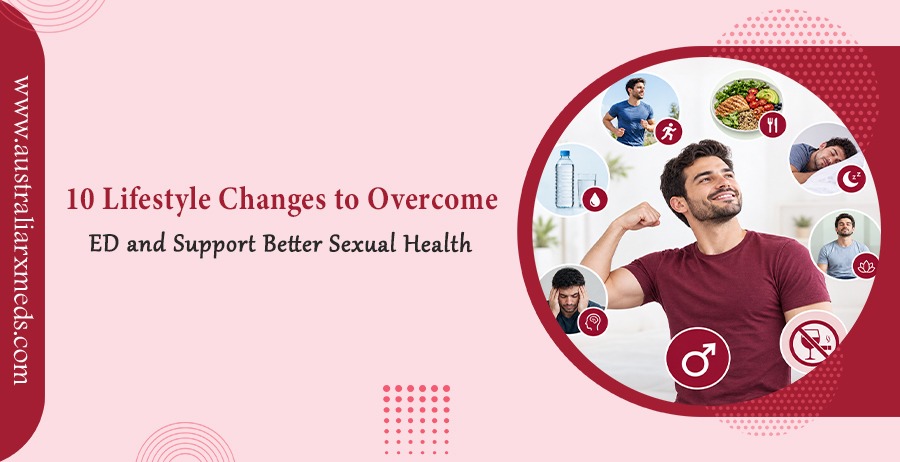
10 Lifestyle Changes to Overcome ED and Support Better Sexual Health
By Erica Wilson, Oct-05-2026

 Dr. Arjun Srivastav Medical Reviewer (Pharm D)
What People Are Really Searching For
Most people who type lifestyle changes to overcome ED into a search bar are not looking for a clinical lecture. They are looking for practical, honest answers to questions they may not feel comfortable asking out loud. The search intent behind queries like lifestyle changes for ED or lifestyle changes for erectile dysfunction usually falls into a few clear buckets.
People want to know what actually helps. They want to know if small daily habits can make a difference. They are searching for natural ways to overcome ED and natural ways to improve erectile dysfunction because they want options they can explore before or alongside medical care. Some are looking for reassurance that ED is common and not a personal failing. Others want to understand how to overcome ED naturally, how to improve ED, or how to improve erections naturally without jumping straight to medication.
There is also a quieter intent behind many of these searches. People want to understand the connection between their overall health and sexual function. They search ways to improve erectile dysfunction and how to improve erectile function naturally because they sense that ED might be connected to something bigger going on in their body. This article walks through the lifestyle changes to overcome ED with information, not promises.
Lifestyle changes are one part of understanding erectile dysfunction and overall sexual health. Regular physical activity, a balanced eating pattern, maintaining a healthy weight, avoiding smoking, being mindful of alcohol intake, managing stress and anxiety, getting adequate sleep, reducing prolonged sitting, and paying attention to cardiovascular and metabolic health are useful areas to consider when reviewing lifestyle factors associated with erectile function.
Why Lifestyle and Erectile Function Are Connected
Erections depend on blood entering and staying in the erectile tissue. The condition of your blood vessels directly shapes that process. Anything that narrows or damages circulation can make things harder.
This is where metabolic health enters the picture. Conditions such as diabetes, obesity, high blood pressure and high cholesterol are linked with erectile difficulties because they affect the same vessels and nerves involved in sexual response.
Psychological wellbeing plays its own role. Stress, anxiety and relationship difficulties can interfere with the signals and relaxation needed for an erection, even when the body is otherwise healthy.
Everyday habits round out the picture. Physical activity, diet, smoking and alcohol are among the lifestyle factors discussed by major health organisations in relation to ED. Understanding this connection is the foundation behind the lifestyle changes to overcome ED covered in this article.
The useful shift here is to think beyond the erection. Rather than viewing ED only as a sexual issue, it helps to understand that erectile function exists within the broader context of cardiovascular, metabolic, mental and sexual health. This is informational. It does not mean ED necessarily signals another disease, only that the systems overlap.
Healthdirect explains that ED can have physical, psychological or combined causes. The NIDDK lists factors such as physical inactivity, smoking and excessive alcohol among lifestyle related contributors.
Lifestyle changes are one part of maintaining sexual and general health.
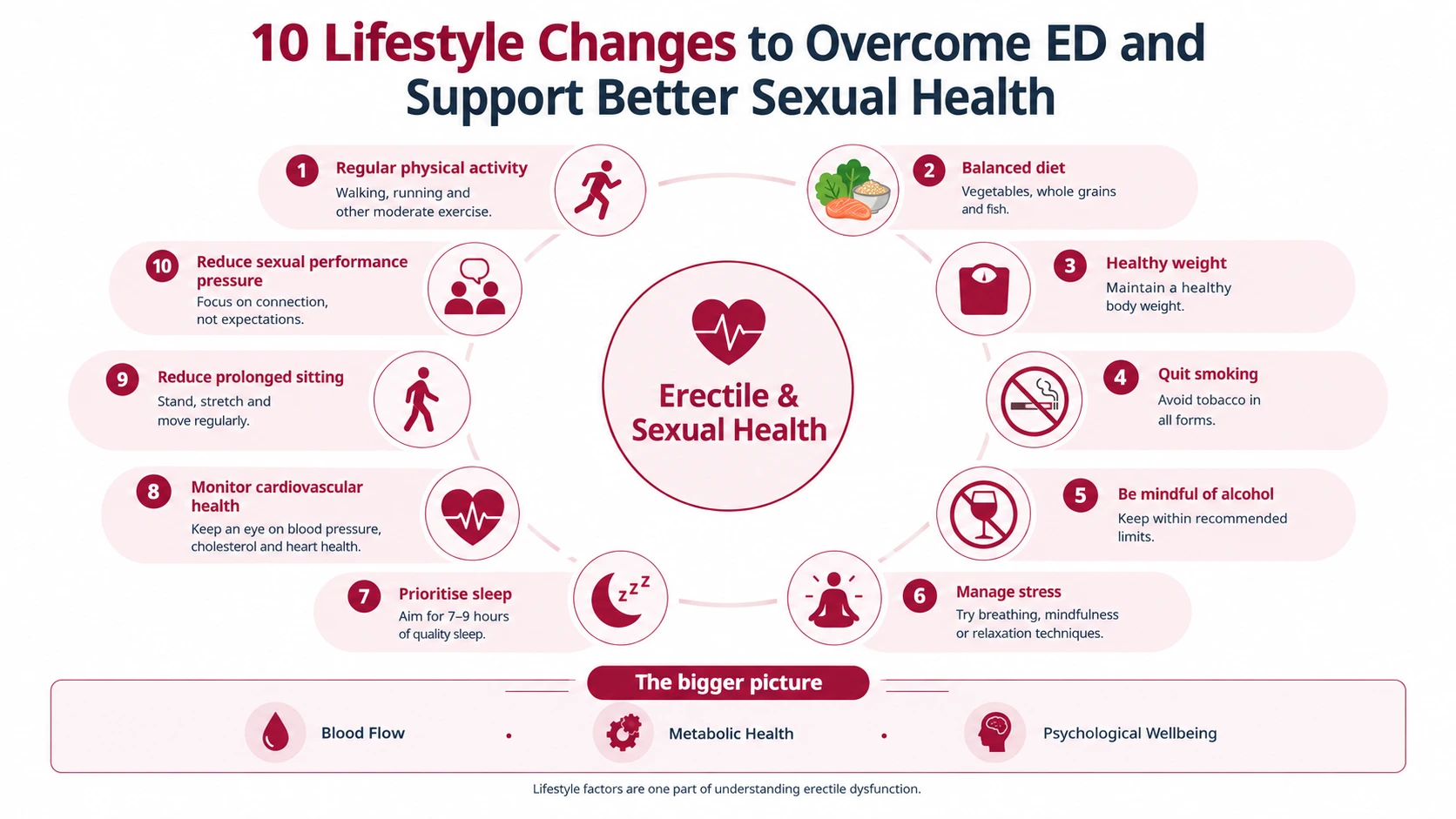
10 Lifestyle Changes to Overcome ED
The lifestyle changes to overcome ED below are written as practical starting points, not a rigid prescription. Each one is grounded in the connection between everyday habits and erectile function.
1. Make Regular Physical Activity Part of Your Routine
Exercise for erectile dysfunction comes up often in health guidance. The link between erectile dysfunction and exercise makes sense when you consider circulation. This is why physical activity is usually one of the first lifestyle changes to overcome ED that health professionals mention.
So does exercise help erectile dysfunction? Research on erectile dysfunction and exercise suggests regular movement is commonly included in lifestyle guidance for men with ED. The best exercise for erectile dysfunction is not one magic workout. It is whatever you will actually keep doing.
Walking and erectile dysfunction guidance often go together since brisk walking is accessible and low impact. You can also add cycling, swimming or other aerobic activity plus some resistance training. If your daily routine involves long periods of sitting, it is also worth considering how sitting all day affect erectile function.
Here is a simple way to think about weekly activity.
| Activity type | Examples | How it fits |
|---|---|---|
| Aerobic | Brisk walking, cycling, swimming | Supports circulation and heart health |
| Resistance | Bodyweight moves, light weights | Supports muscle and overall function |
| Daily movement | Walking breaks, taking stairs | Breaks up long sedentary periods |
Gradually increase activity over time. The NIDDK recommends regular physical activity as part of lifestyle management around ED and gives 150 minutes of moderate activity per week as a general physical activity guideline.
Regular physical activity is commonly included in lifestyle guidance for men with ED.
2. Build a Balanced, Heart Healthy Eating Pattern
A diet for erectile dysfunction tends to look a lot like a diet for your heart. When people ask about the best diet for erectile dysfunction, the answer is less about one ingredient and more about an overall pattern. Among the lifestyle changes to overcome ED, food choices have a steady, cumulative influence.
Foods that help erectile dysfunction are the same ones that support circulation.
- Vegetables and fruits
- Legumes and whole grains
- Nuts and seeds
- Fish
- Unsaturated fats
The Mediterranean diet and erectile dysfunction have been studied together. The NIDDK specifically discusses healthy dietary patterns and the Mediterranean diet in relation to ED.
It is just as important to limit certain things.
- Highly processed foods
- Foods high in saturated fat
- Refined carbohydrates
- Added sugars
- Excess sodium
Think food pattern, not miracle food. Overall dietary patterns are far more meaningful than treating any single item as an ED remedy. Natural ways to improve erectile dysfunction usually involve consistency rather than a so called cure.
3. Pay Attention to Weight and Metabolic Health
Weight loss and erectile dysfunction are connected through the conditions that often travel with excess weight. The relationship between obesity and erectile dysfunction shows up through blood pressure, blood sugar and cholesterol, all of which influence vascular health.
So can losing weight improve erectile dysfunction? It can be one factor. Weight management is one part of broader metabolic and cardiovascular health, and it sits naturally within the lifestyle changes to overcome ED.
Physical activity and eating patterns both feed into this, alongside the medical management of any underlying conditions. The NIDDK includes maintaining a healthy body weight among lifestyle measures associated with ED prevention and management.
Weight loss and ED improvement are linked, but not through a fixed promise about a specific number on the scale.
4. Quit Smoking
Smoking and erectile dysfunction share a vascular pathway. Cigarette smoking affects blood vessels and cardiovascular health. Because erectile function depends on healthy circulation, the connection is logical.
The NIDDK notes the link between smoking, heart and blood vessel disease and ED. Quitting smoking and ED recovery are therefore often discussed together.
Smoking is a modifiable lifestyle factor that is relevant to both vascular health and erectile health.
Support makes quitting far more manageable, whether that is nicotine replacement, counselling or a structured program.
5. Understand the Relationship Between Alcohol and ED
Alcohol and erectile dysfunction have a complicated relationship. Occasional drinking is different from excessive drinking.
The question of whether alcohol causes ED has no universal answer. Alcohol can affect sexual function, but it is one potential contributing lifestyle factor rather than a simple equation. Other beverages and daily habits can also be relevant to sexual health. For example, energy drinks can cause erectile dysfunction explores another beverage-related topic that readers may want to understand.
Individual differences matter a great deal.
- Amount matters
- Frequency matters
- Personal circumstances matter
Reducing alcohol and erectile dysfunction improvements can go hand in hand for some people. The NIDDK includes limiting alcohol among lifestyle measures relevant to ED. Avoid the simplistic reading that alcohol equals ED. The reality is that amount plus frequency plus individual circumstances shape the effect.
6. Manage Stress and Performance Anxiety
Stress and erectile dysfunction are linked through both mind and body. Everyday stress, sexual performance anxiety, relationship tension and anxiety following a previous difficult sexual experience can all interfere with the relaxation an erection requires.
So can stress cause erectile dysfunction? It can contribute. Healthdirect identifies stress, anxiety and sexual performance anxiety among psychological factors associated with ED. Managing stress is a genuinely useful part of the lifestyle changes to overcome ED.
Relaxation techniques, open communication with a partner and counselling where appropriate are all worth considering.
For some people, this becomes the ED anxiety cycle. A difficult sexual experience leads to worry about recurrence. That worry increases pressure. The pressure makes it harder to relax. The difficulty relaxing produces more worry. For some people this can become a repeating cycle. Not everyone experiences this, but enough do that recognising the pattern is useful.
Performance anxiety and ED often feed each other in this way.
7. Make Sleep Part of Your Health Routine
Sleep and erectile dysfunction are connected through the recovery systems of the body. Lack of sleep and ED can be linked since persistent tiredness affects overall health and the regulation that underlies sexual function.
Does poor sleep cause erectile dysfunction? It is not a direct one to one relationship. Sleep quality and a consistent sleep routine matter more than any single number.
Daytime tiredness and sleep disorders can all play a part. Healthdirect lists sleep disorders among conditions that can contribute to ED.
The more useful focus is sleep quality and dealing with persistent sleep problems rather than reducing the topic to a single number of hours.
8. Keep Track of Cardiovascular and Metabolic Health
Diabetes and erectile dysfunction are strongly associated. So are high blood pressure and ED, cholesterol and erectile dysfunction, and broader cardiovascular health and ED. These conditions affect the vessels and nerves involved in sexual response.
Keeping track of key health markers is worthwhile.
| Health marker | Why it matters |
|---|---|
| Blood pressure | Affects vascular health and circulation |
| Blood glucose | Relevant to diabetes related ED |
| Cholesterol | Linked to blood vessel health |
| Weight | Part of broader metabolic health |
This is the bigger health picture. ED does not mean you have heart disease. But because ED can occur alongside cardiovascular and metabolic conditions, persistent erectile difficulties can be worth discussing with a healthcare professional. Understanding ED is a sign of a serious medical issue can also help put persistent symptoms into a broader health context. Monitoring these markers works alongside the lifestyle changes to overcome ED rather than replacing them.
Healthdirect lists diabetes, high blood pressure, high cholesterol, cardiovascular disease and metabolic syndrome among health conditions associated with ED. Routine check ups help connect the dots rather than treating ED in isolation.
9. Reduce Long Periods of Sitting
A sedentary lifestyle and ED can be linked even in people who exercise. The key distinction is that an exercise session is not the same as an entire day of movement.
Someone can train hard for an hour and still spend many hours sitting. This is why physical activity and erectile dysfunction guidance increasingly looks at the whole day. Breaking up sitting time is one of the more overlooked lifestyle changes to overcome ED.
To improve blood flow naturally, try the following.
- Walking breaks during the day
- Standing periodically
- A short walk after meals
- Active hobbies
Reducing prolonged sedentary periods is part of maintaining an active lifestyle. It is not a claim that less sitting specifically treats ED. It is one more habit that supports circulation over the course of a day.
10. Take a Healthier Approach to Sexual Performance
Sexual health is not only mechanical. Communication with a partner, realistic expectations and focusing on intimacy rather than performance can ease the pressure that sometimes surrounds erections.
If erectile difficulties are affecting intimacy or confidence, how to enjoy sex life with erectile dysfunction provides additional information about maintaining a fulfilling sex life while dealing with ED.
Performance anxiety is recognised as one potential contributor to ED. Avoiding excessive pressure around erections is a reasonable approach. Professional counselling when appropriate can help, especially when anxiety or relationship tension is involved.
The core idea is that an erection is not a performance test. Sexual experiences can involve physical and psychological factors together. Reframing intimacy this way is not a claim that removing pressure will fix everything. It is only that anxiety and ED are genuinely linked for some people, and erectile function is influenced by more than physiology alone. This mindset pairs well with the lifestyle changes to overcome ED described earlier.
Which Lifestyle Changes Should You Start With
There is no need to overhaul your entire lifestyle overnight. A simple way to prioritise is to start where the biggest gap is.
| Your situation | Where to start |
|---|---|
| Mostly inactive | Regular movement |
| Diet is highly processed | Meal quality |
| You smoke | Smoking cessation with support |
| Stress is a major issue | Stress management and psychological support |
| You have diabetes, hypertension or high cholesterol | Discuss overall management with your healthcare professional |
| Several of the above apply | Choose two manageable changes first |
The NIDDK health behaviour guidance emphasises that developing new habits is a process and that maintaining healthy eating and activity patterns is an ongoing practice. Picking two realistic lifestyle changes to overcome ED is often more sustainable than trying everything at once.
You do not need to change everything at once. Start with the areas that are most relevant to your everyday routine.
Activity, diet, smoking, alcohol, sleep or stress
Focus on habits you can consistently manage
Make the changes practical and repeatable
Adjust your approach as your routine changes
How Long Do Lifestyle Changes Take to Become Habits
It is tempting to ask how long it takes to improve erectile dysfunction. There is no honest ED improvement deadline.
A better approach separates two things.
- Habit formation, which develops over time
- Changes in sexual function, which vary by person and cause
The NIDDK describes behaviour change as a process involving preparation, action and maintenance, with setbacks being a normal possibility. That is a far more useful answer than a claim that you will see results in 30 days.
When Lifestyle Changes Are Not the Whole Answer
ED can have many causes, including cardiovascular conditions, diabetes, hormonal issues, neurological conditions, medications, psychological factors and lifestyle factors. These different contributing factors are also why understanding the different types of erectile dysfunction can be useful when considering the broader picture. Because of that range, lifestyle changes are valuable but not always sufficient on their own.
When to see a doctor for ED is a judgment call. But persistent erectile dysfunction, meaning difficulties that happen repeatedly or continue over time, is worth investigating rather than ignoring.
Healthdirect notes that identifying underlying causes can be important and that treatment may involve lifestyle changes, counselling, medicines or other approaches depending on the situation.
If erection difficulties happen repeatedly or continue, speaking with a GP or other qualified healthcare professional can help identify possible contributing factors. Different causes may require different approaches, which is why erectile dysfunction causes deserve proper assessment rather than guesswork. This is why the lifestyle changes to overcome ED are best understood as one part of a wider picture.
Lifestyle Changes and Medical Treatment Are Not the Same Thing
It is worth drawing a clear line.
Lifestyle changes are everyday health behaviours. These are the activity, eating, sleep and stress habits you maintain day to day. Medical treatment is clinician guided treatment for ED, based on the underlying cause and individual circumstances.
One does not automatically replace the other. A person might benefit from both, or from neither, depending on what is driving their ED. The NIDDK lists lifestyle changes alongside counselling, medicines and other treatment approaches rather than presenting lifestyle changes as a universal replacement for medical care. The lifestyle changes to overcome ED and medical treatment can work in parallel, but they are not the same thing.
This section is informational, not promotional. The point is simply that treatment depends on the cause.
Conclusion
Erectile dysfunction is influenced by more than one factor. Physical activity, eating patterns, weight, smoking, alcohol, sleep, stress, cardiovascular health and psychological wellbeing can all form part of the broader picture. The lifestyle changes to overcome ED are one part of maintaining sexual and general health, not a cure. If erection difficulties are persistent or concerning, a healthcare professional can help identify possible causes and discuss appropriate options.
Medical Disclaimer
FAQ
Can lifestyle changes help with erectile dysfunction?
They can be one part of supporting erectile health, especially when inactivity, poor diet, smoking or stress are contributing factors. They are not a guaranteed fix for everyone.
What lifestyle changes are associated with erectile health?
Regular activity, a balanced eating pattern, weight management, not smoking, limiting alcohol, managing stress and good sleep are commonly discussed in relation to ED.
Does exercise help erectile dysfunction?
Regular physical activity is commonly included in lifestyle guidance for men with ED. It supports circulation and general health, though individual results vary.
What is a healthy diet for erectile dysfunction?
A heart healthy pattern built around vegetables, fruits, whole grains, legumes, nuts, seeds and fish, such as the Mediterranean diet, is commonly recommended.
Can losing weight improve ED?
Weight management can be one factor, particularly when excess weight is linked with blood pressure, blood sugar or cholesterol. It is part of broader metabolic health.
Does smoking affect erectile function?
Smoking affects blood vessels and cardiovascular health, which are connected to erectile function. Quitting is a modifiable factor relevant to both vascular and erectile health.
Can stress and anxiety contribute to ED?
Yes. Stress, anxiety and sexual performance anxiety are recognised psychological factors. A repeating cycle of worry and pressure can affect some people.
Does poor sleep affect erectile dysfunction?
Persistent sleep problems and sleep disorders can contribute to ED. Sleep quality and a consistent routine matter more than any single number of hours.
When should you speak with a doctor about ED?
If erection difficulties happen repeatedly or continue, speaking with a healthcare professional can help identify possible contributing factors and suitable approaches.

Years of Experience: 10+ years Education: B.Sc. in Biomedical Science (Monash University, Melbourne, Australia) PG Diploma in Health & Medical Communication (University of Sydney, Australia) Experience: Erica Wilson is an…