
At What Age Do Men Stop Getting Erection?
By Erica Wilson, Dec-14-2024


 Dr. Arjun Srivastav Medical Reviewer (Pharm D)
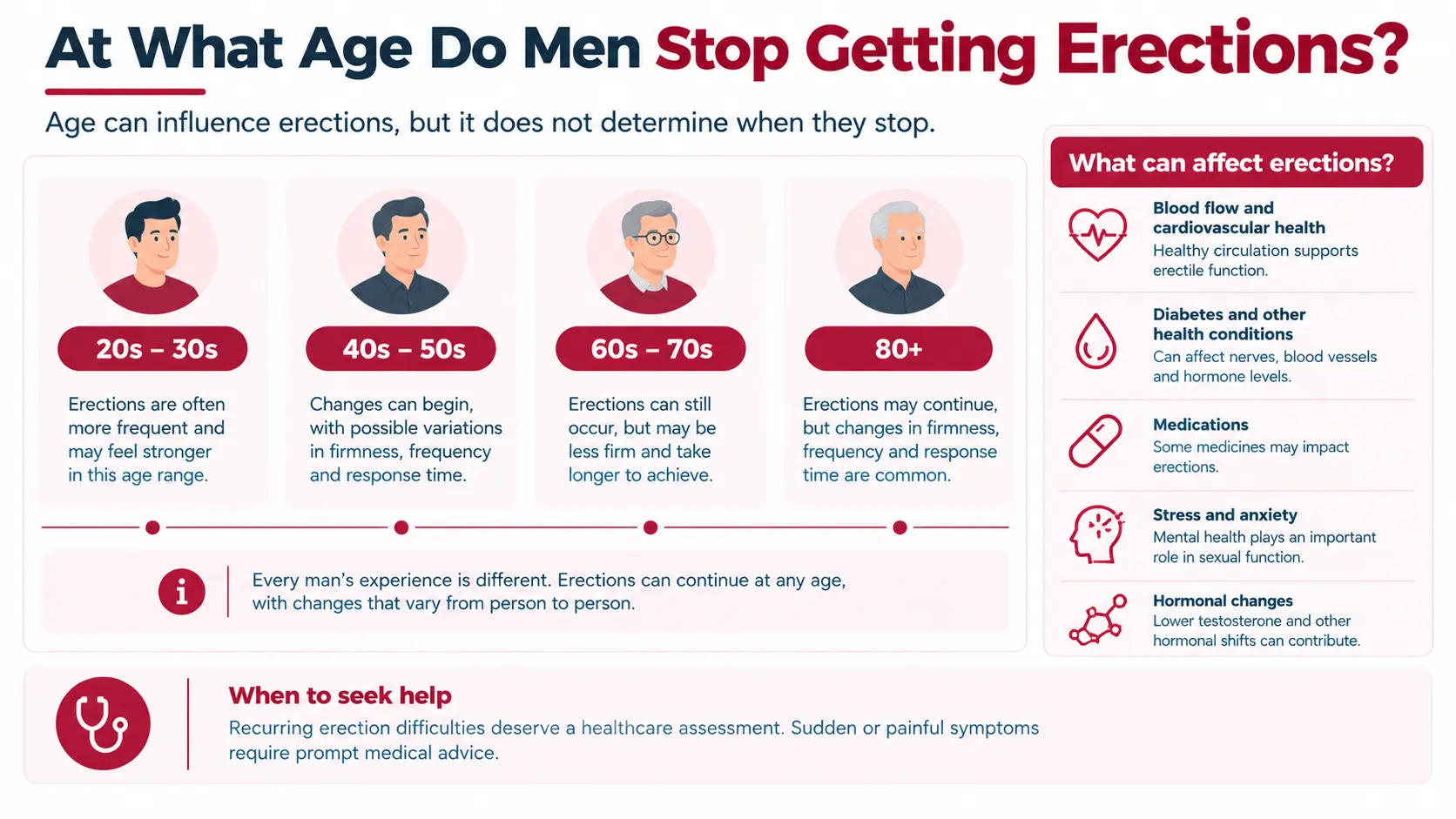
There is no specific age when men stop getting erections. Many men continue to experience erections well into their 60s, 70s, 80s and beyond.
What often changes over time is not whether erections happen at all but how often they occur, how firm they feel, and how quickly they develop. Age alone does not determine erectile function.
When erection difficulties become persistent, the reasons can be physical, psychological, or related to medications a person is taking, and these symptoms may indicate erectile dysfunction This is why understanding at what age do men stop getting erections requires looking beyond a single number.
✔ Quick Answer: At What Age Do Men Stop Getting Erections?
There is no specific age when men stop getting erections. Many men continue to experience erections into their 60s, 70s and beyond, although erections may become less firm or take longer to develop. Persistent erection difficulties can occur at any age and may be linked to health conditions, medications, stress or ageing. Speak with a healthcare professional if the problem keeps happening.
How Do Erections Change as Men Get Older?
Understanding the difference between natural age related changes and a complete loss of erectile function can help men know what to expect. Erections do not typically disappear at a certain birthday.
Instead, the experience shifts gradually, and the pattern varies from one person to another. Anyone asking at what age do men stop getting erections may be relieved to learn that the changes are usually gradual rather than sudden.
Erections in Your 20s and 30s
During these years, erections are often spontaneous and respond quickly to physical or visual stimulation. Sexual arousal tends to produce firm erections with little effort.
However, stress, poor sleep, and performance anxiety can still cause occasional difficulty even in younger men. A single episode of not getting or keeping an erection is common and usually not a sign of a lasting problem.
Erections in Your 40s and 50s
Many men notice that erections may not feel as firm as they once did or that direct stimulation becomes more important. The refractory period, which is the time needed before another erection is possible, often lengthens.
This is also the stage where cardiovascular risk factors such as high blood pressure, elevated cholesterol, and blood sugar concerns start to play a larger role in erectile function. For men wondering at what age do men stop getting erections, the 40s and 50s are often when the first noticeable shifts appear.
Erections in Your 60s and 70s
Chronic conditions and the medications used to manage them become more relevant during these decades. Erections may take longer to develop, require more consistent stimulation, and feel less firm.
Recovery time after ejaculation tends to increase. These changes reflect the cumulative effect of overall health rather than age by itself, which is a key point for anyone researching at what age do men stop getting erections.
Erections After 80
Erectile function varies considerably among men over 80. Some men continue to have erections suitable for sexual activity, while others experience significant changes.
There is no age based cutoff where erections simply stop. General health, activity level, medications, and individual biology all shape the outcome, reinforcing that there is no single answer to at what age do men stop getting erections.
| Possible Changes | Factors That Influence Them | When Assessment May Help |
|---|---|---|
| Less frequent or less firm erections | Age related blood vessel changes, cardiovascular health | When the change is persistent or affecting wellbeing |
| Longer time to develop an erection | Medication effects, reduced blood flow, nerve function | When difficulty occurs consistently during sexual activity |
| Fewer spontaneous or morning erections | Sleep quality, hormone levels, overall health | When accompanied by difficulty during partnered activity |
| Longer recovery time after ejaculation | Natural aging, circulation, fitness level | When other symptoms such as pain or libido changes appear |
Why Do Men Stop Getting Erections or Develop Weaker Erections?
When people ask at what age do men stop getting erections, the answer is rarely a single cause. Erection difficulties usually develop from several contributing factors working together rather than aging alone.
The same applies when someone wonders when do men stop getting erections, because timing depends far more on health than on reaching a particular age.
Reduced Blood Flow
Erections depend on healthy blood vessels that can expand and deliver adequate blood flow to the penis Conditions such as diabetes, high blood pressure, high cholesterol, and cardiovascular disease can affect blood vessel function over time.
When blood flow is limited, erections may become less firm or take longer to develop. Vascular health is one of the most significant influences on erectile function and is central to understanding at what age do men stop getting erections.
Hormonal Changes
Testosterone plays a role in sexual desire, and levels generally shift gradually with age. However, low testosterone is not the cause of every erection problem.
A man can have age appropriate testosterone levels and still experience erectile difficulties, just as someone with lower levels may not. Hormones are one piece of a larger picture.
Medications and Existing Health Conditions
Some prescription medicines list erection difficulties among their effects. Medications for blood pressure, depression, hair loss, and other ongoing conditions can contribute.
Neurological conditions and prostate related treatments may also play a part. Reviewing current medications with a healthcare professional can clarify whether they are a factor.
Stress and Psychological Factors
Anxiety, depression, relationship concerns, and performance pressure can all affect the ability to get or keep an erection. The mind and body work together during sexual arousal, so emotional strain can show up physically.
Psychological factors can exist alongside physical ones, and addressing them can make a meaningful difference. This is why the question at what age do men stop getting erections cannot be answered by age alone.
What Matters More Than Age?
Blood flow
Healthy blood vessels help support erections.
Medications
Some medicines can affect erectile function.
Stress and sleep
Mental wellbeing and sleep can influence erections.
Overall health
Diabetes and other conditions may contribute.
Remember: Erection difficulties can occur at any age. If they persist, speak with a healthcare professional to identify possible causes.
Is It Normal to Stop Getting Morning Erections?
Morning erections are linked to sleep related erectile activity and occur during certain stages of rest. They may not be noticed every day, and their absence on occasion does not mean erectile dysfunction is present.
Sleep quality, age, medication, and general health all affect whether morning erections happen and whether they are noticed.
What matters more than a single missed morning erection is a persistent pattern. If morning erections become consistently rare and the same difficulty appears during sexual activity, that combination may warrant a conversation with a healthcare professional.
Morning erections alone cannot diagnose or rule out erectile dysfunction, and their absence does not directly answer at what age do men stop getting erections.
Does Testosterone Affect Erections as Men Age?
Testosterone influences libido, energy, and mood, and its levels generally change gradually as men get older. The variation between individuals is substantial.
Some men maintain levels similar to those of younger years, while others experience a noticeable decline.
Low testosterone may contribute to reduced sexual desire and other symptoms such as fatigue. However, erectile dysfunction can occur even when testosterone levels fall within a normal range.
When symptoms suggest a hormonal problem, a healthcare professional may recommend a testosterone level test alongside other assessments. Testosterone therapy is not a default response to growing older, and hormone levels alone do not determine at what age do men stop getting erections.
When Should You Worry About Erection Problems?
Occasional difficulty with erections is common at various stages of life. What deserves attention is a pattern rather than an isolated incident.
Repeated trouble achieving or maintaining an erection, a noticeable and ongoing change in firmness, or symptoms that affect confidence, relationships, and sexual wellbeing are all reasons to seek guidance.
Erection difficulties can sometimes signal an underlying health condition that has not yet been identified. A healthcare professional may review medical history, current medications, blood pressure, blood glucose, cholesterol, and other relevant factors.
This assessment can help identify whether a treatable contributor is involved.
There is no need to wait until a particular age or until symptoms become severe. Early conversation often leads to clearer understanding and more options, which matters regardless of where a man falls on the timeline of at what age do men stop getting erections.
One situation that requires immediate emergency care is a painful erection that lasts four hours or longer, as this needs urgent medical attention.
How Can Men Maintain Erectile Health as They Age?
Several habits support overall vascular and general health, which in turn can support erectile function over time.
- Regular physical activity supports cardiovascular fitness and circulation, both of which are connected to erectile health.
- Balanced eating habits help manage weight, blood glucose, cholesterol, and blood pressure.
- Avoiding smoking supports blood vessel health and circulation.
- Limiting alcohol intake can help, since excessive amounts may interfere with sexual function.
- Managing stress and prioritizing sleep can support arousal and overall wellbeing.
- Reviewing existing conditions and medications with a healthcare professional is worthwhile if symptoms begin or worsen.
These steps may help some men, but lifestyle changes cannot guarantee that erection difficulties will resolve. They work best as part of a broader approach that includes medical guidance when needed, especially for men concerned about at what age do men stop getting erections.
What Treatments Are Available for Erectile Dysfunction?
Treatment usually begins with understanding the underlying cause. A healthcare professional may assess physical and psychological contributors before discussing appropriate treatments for erectile dysfunction.
Medical management of conditions such as diabetes, high blood pressure, or sleep disorders can sometimes improve erectile function. Psychological support, including therapy or counseling, can help when stress, anxiety, or relationship concerns are involved.
Prescription medicines such as sildenafil and tadalafil are available for suitable patients. These work by supporting blood flow to the erectile tissue.
Other options include vacuum erection devices and specialist treatments, depending on individual circumstances and preferences.
One important safety consideration is that these medicines can interact dangerously with nitrate medicines. Suitability depends on a person’s overall health and current medications, so professional guidance is essential.
This section is educational and does not promise results or imply that any option suits every older man. Treatment decisions are personal and depend on individual health.
Conclusion
There is no fixed age when men stop getting erections. Erections can continue well into later life, though they may become less frequent, less firm, or slower to develop over time.
Age alone does not determine erectile function. Overall health, cardiovascular condition, medications, hormones, stress, and sleep all play a role. Persistent changes are worth discussing with a healthcare professional rather than waiting or assuming they are simply part of getting older.
Lifestyle habits that support general and vascular health can help some men, and several treatment options exist for those who need them. The most important step is seeking guidance early when changes become noticeable or ongoing, rather than searching for a fixed answer to at what age do men stop getting erections.
Medical Disclaimer
How Long Does an Erection Last?
Understand how erection duration can vary, what may influence it, and when a prolonged erection needs urgent medical attention.
FAQ
Can a 70 year old man still get an erection?
Yes, erections can continue at 70 and beyond. The experience varies considerably between individuals depending on overall health, medications, activity level, and other personal factors. Age alone does not prevent erections.
Do men stop getting erections after 50?
No, 50 is not a cutoff. Many men continue to have erections well past this age. Health, lifestyle, and individual circumstances influence erectile function far more than reaching a particular age.
What age do you stop getting erections?
There is no set age. The question of what age do you stop getting erections depends on individual health rather than a number. Erections can continue throughout life, though they may change in frequency and firmness over time.
Can younger men develop erectile dysfunction?
Yes, erectile dysfunction can affect younger men. It is not exclusively an age related condition. Stress, anxiety, sleep problems, and underlying health factors can contribute at any age, and speaking with a healthcare professional can help identify the cause.

Years of Experience: 10+ years Education: B.Sc. in Biomedical Science (Monash University, Melbourne, Australia) PG Diploma in Health & Medical Communication (University of Sydney, Australia) Experience: Erica Wilson is an…