

PCOS Discharge: What Is Normal, What Is Not, and When to Worry
By Erica Wilson, Oct-10-2026


 Dr. Arjun Srivastav Medical Reviewer (Pharm D)
 People living with PCOS often pay close attention to their bodies. They notice small changes and wonder what those changes might mean. One area that frequently raises questions is vaginal discharge. When your cycle is unpredictable, you may start watching every sign your body gives you and trying to connect the dots.
It helps to understand that vaginal discharge is not a defining symptom of PCOS. The condition is diagnosed through a combination of factors such as irregular periods, elevated hormone levels, and ovarian features seen on imaging. Discharge happens in almost everyone with a vagina, whether or not they have PCOS. Still, many people search for PCOS discharge to understand what they are experiencing.
This article explains how PCOS can relate to discharge, what normal vaginal secretions look like, and which changes may need a conversation with a healthcare professional.
💡 Quick Answer: What Is PCOS Discharge?
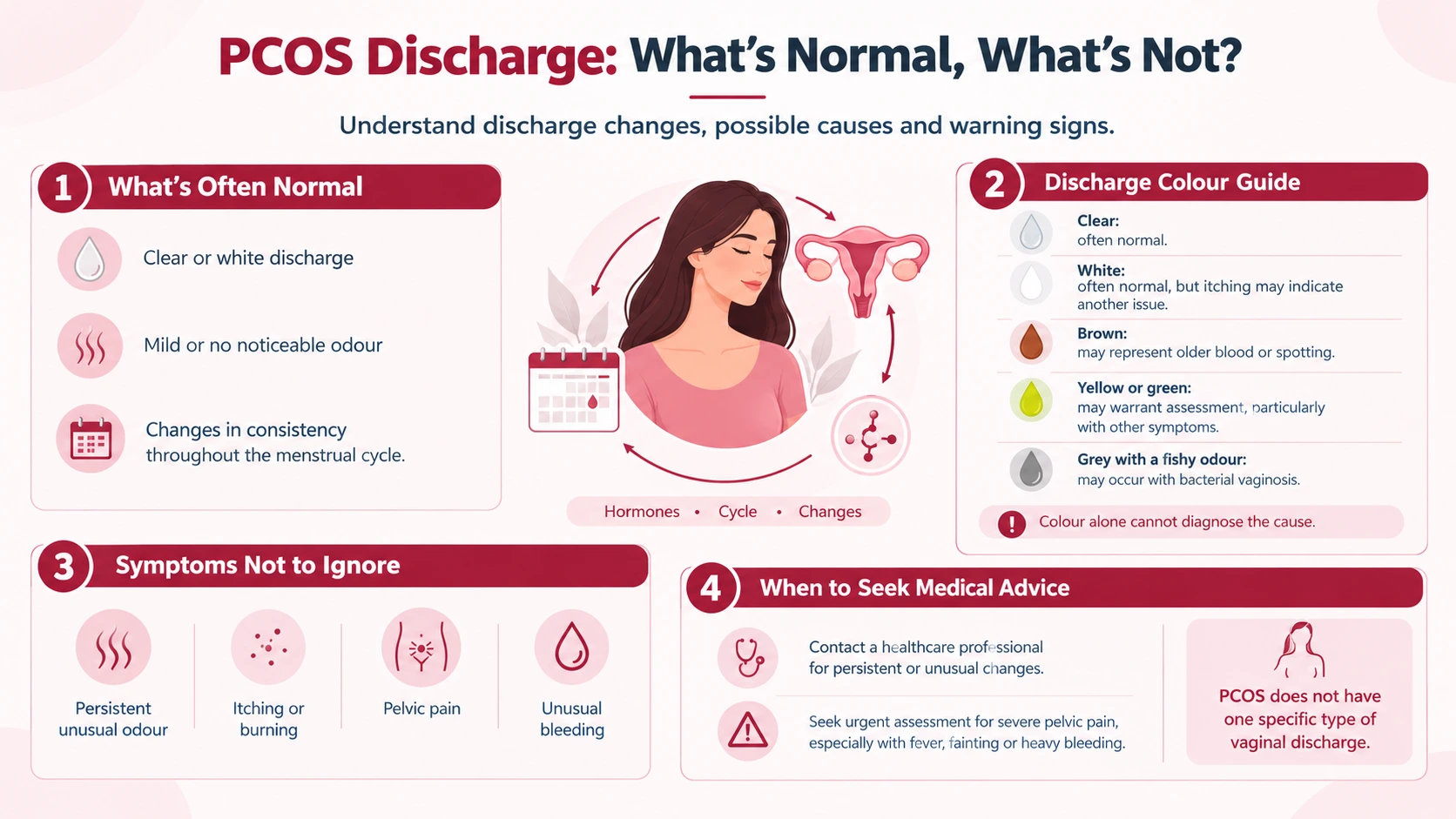
PCOS does not cause one specific type of vaginal discharge. Clear or white discharge can be normal, while irregular ovulation may make cycle-related changes less predictable. Brown discharge may be spotting, and unusual odour, itching, burning or pelvic pain can indicate another issue. Seek medical advice if discharge changes persist or occur with concerning symptoms.
Does PCOS Cause Vaginal Discharge?
Many people search for whether PCOS causes vaginal discharge and what it should look like. The honest answer is that PCOS does not produce its own distinct discharge pattern. Vaginal discharge is a normal bodily function. The glands inside the vagina and cervix produce fluids that keep the area clean and protected.
PCOS can influence discharge indirectly through its effect on hormones and ovulation. When ovulation happens on a typical schedule, cervical mucus changes in predictable ways. It may become clear and stretchy around fertile days and thicker at other times. When PCOS disrupts ovulation, that rhythm can shift and PCOS discharge may feel less predictable.
PCOS can affect menstrual regularity and ovulation, but vaginal discharge alone cannot confirm the condition. If you want to understand the broader management of PCOS, explore these PCOS treatment options and discuss suitable care with a healthcare professional.
How PCOS Can Affect Your Menstrual Cycle
PCOS is often associated with irregular or absent ovulation. Some people have cycles that are much longer than average. Others skip periods for months. Because cervical mucus responds to the hormones that drive ovulation, timing changes in discharge become harder to track when your cycle is unpredictable.
A change in discharge alone cannot confirm PCOS. Many things affect vaginal secretions, and PCOS is evaluated through a broader clinical assessment.
Is Discharge a Common Symptom of PCOS?
The symptoms most commonly associated with PCOS include irregular periods, excess androgen activity, and polycystic ovaries on ultrasound. Vaginal discharge is not on that list. People with PCOS experience the same normal vaginal secretions as anyone else, so PCOS discharge is not considered a defining feature of the condition.
If discharge changes in an unusual way, the cause may be something unrelated to PCOS. Infections, hormonal shifts, and hygiene products can all play a role. It is worth looking at the full picture rather than assuming PCOS is the reason.
What Does PCOS Discharge Look Like?
There is no single appearance that identifies PCOS discharge. The look and feel of vaginal secretions vary from person to person and from day to day. What is normal for one individual may be different for another.
Normal Vaginal Discharge With PCOS
Typical discharge can be clear or white. It may shift in thickness, stickiness, and wetness throughout your cycle. Some days you may notice more, and other days almost nothing. These variations are part of how the vagina maintains its own balance.
People with PCOS may still see these ordinary changes. The presence of normal discharge does not mean something is wrong. Understanding your own baseline helps you notice when PCOS discharge shifts in a way that stands out.
Changes in Discharge to Pay Attention To
Some changes are worth paying closer attention to. A noticeable change in odour can be a signal. A sudden or persistent shift in consistency or amount may also stand out. Discharge that comes with itching, burning, soreness, or pain is something to discuss with a clinician.
No particular colour or texture should be assumed to come from PCOS. Context matters, and patterns matter more than a single observation.
PCOS Discharge Colour: What Different Changes May Mean
Colour is one of the first things people notice about discharge. The table below offers a general way to think about what different appearances may suggest. None of these descriptions can diagnose anything on their own.
| Discharge appearance | What to understand |
|---|---|
| Clear discharge | Often normal and may vary during the cycle |
| White discharge | Can be normal but itching or irritation may point to another issue |
| Creamy discharge | May reflect normal variation in consistency |
| Watery discharge | Can be normal and is best assessed alongside other symptoms |
| Brown discharge | Often reflects older blood or spotting |
| Yellow discharge | Interpretation depends on accompanying symptoms and context |
| Green discharge | Can be associated with infection, particularly when other symptoms are present |
| Grey discharge | May occur with bacterial vaginosis, especially when a fishy smell is noticed |
Does Discharge Colour Tell You Whether You Have PCOS?
Colour alone cannot diagnose PCOS. It also cannot reliably identify the underlying cause of a discharge change. The same colour can mean different things in different situations. Looking at the full set of symptoms gives a clearer picture than focusing on colour by itself.
PCOS Discharge Before Your Period or Between Periods
Timing is another common question. People often want to know whether discharge before a period or spotting between periods is connected to PCOS.
Discharge can change throughout the menstrual cycle as hormone levels fluctuate. Understanding the menstrual cycle can help put these changes into context, although irregular cycles may make patterns less predictable for people with PCOS.
PCOS Discharge Before Your Period
Before menstruation, vaginal discharge often becomes thicker and lighter in colour. This happens as hormone levels shift in preparation for a period. When PCOS makes ovulation irregular, the timing of these changes becomes less predictable. You may notice discharge patterns that do not follow a clear schedule.
There is no specific discharge pattern that always appears before a period with PCOS. Variation is normal, and irregular timing is part of what makes the condition frustrating to track.
Brown Discharge, Spotting and Irregular Periods
It helps to distinguish between vaginal discharge and blood tinged spotting. Spotting is light bleeding that can appear brown or pink because the blood has taken time to leave the body. With irregular cycles, spotting can happen at unexpected times.
Persistent or unusual bleeding should not automatically be attributed to PCOS. Other factors can cause bleeding between periods, and a clinician can help sort through the possibilities.
🔔 Reminder: Discharge Cannot Confirm Ovulation
What Causes Unusual Discharge If You Have PCOS?
When PCOS discharge changes in a way that feels off, several possible explanations exist. The colour table above covers appearance, so this section focuses on causes.
Vaginal Infections
Infections are among the most common reasons for unusual discharge. Bacterial vaginosis can cause a greyish discharge with a fishy odour. Vaginal Yeast infections often produce thick white discharge along with itching. Sexually transmitted infections can also change discharge and may come with other symptoms.
Hormonal and Cycle-Related Changes
Cycle variations affect discharge naturally. When ovulation timing shifts, the texture and amount of discharge may change too. An irregular cycle does not automatically explain every unusual discharge pattern, but it can contribute to day to day variation.
Irritation and Other Possible Causes
Everyday products can also affect vaginal discharge. Scented washes, soaps, and some hygiene products may irritate the area and change how discharge looks or feels. Other causes may need clinical assessment to identify.
Irritation from scented products can also cause discomfort around the vaginal area. Understanding the causes of vaginal burning may help you recognise when symptoms need further assessment.
⚠️ Warning: Don't Blame Every Change on PCOS
When Should You Worry About PCOS Discharge?
Some changes in PCOS discharge call for a conversation with a healthcare professional. This section is meant to help you recognise those moments.
Signs That Need Medical Assessment
The following changes are worth discussing with a clinician:
- A persistent or strong unpleasant odour
- Itching, burning, soreness, or pain in the vaginal area
- Unusual discharge along with painful urination
- Pelvic pain or bleeding that is unusual for you
- New symptoms following possible exposure to a sexually transmitted infection
These signs do not mean something is seriously wrong, but they are worth checking rather than ignoring.
When to Seek Urgent Care
Some situations call for prompt medical attention. Severe pelvic or abdominal pain, especially with fever, fainting, or heavy bleeding, warrants urgent assessment. Sudden severe pain with possible pregnancy also requires immediate evaluation.
Not every change in colour is an emergency. Context and severity help determine how quickly to seek care.
🚨 Important: Know When to Get Checked
PCOS Discharge vs Ovulation Discharge vs Infection Related Discharge
Understanding the difference between cycle related discharge and infection related discharge can help you interpret what you are seeing. The comparison below is a general guide, not a diagnostic tool.
| Feature | Cycle related discharge | Possible infection related discharge |
|---|---|---|
| Appearance | May be clear, white, or variable | May change in colour or consistency |
| Odour | Usually mild or not noticeable | May develop a strong or unusual odour |
| Other symptoms | Usually no itching or pain | Itching, burning, soreness, or pain may occur |
| Timing | May vary across the cycle | Can occur at any time |
| What it means | May be normal variation | Assessment may be needed |
PCOS can make ovulation less predictable, but PCOS discharge appearance cannot reliably confirm whether ovulation happened. Infection related symptoms can overlap with normal variation, so this table is not a substitute for professional assessment.
How Is the Cause of Unusual Discharge Diagnosed?
If you consult a healthcare professional about discharge changes, you can expect a practical process.
The clinician will ask about your symptoms, menstrual history, and any recent changes. An examination may be offered if appropriate and with your consent. A vaginal swab or other testing may be done when indicated. STI testing can be carried out when relevant. For persistent irregular bleeding, further assessment may be recommended.
A vaginal discharge test does not diagnose PCOS itself. PCOS is assessed through separate clinical criteria, including hormone levels, cycle patterns, and sometimes imaging.
How to Track Discharge When You Have PCOS
Keeping a simple record of PCOS discharge can help you and your clinician understand patterns. This is especially useful when periods are irregular and timing is hard to predict.
Consider noting the following details over time:
- The date and approximate amount of discharge
- Colour and consistency
- Any odour or associated irritation
- Period dates and any spotting
- Pelvic pain or urinary symptoms
- Recent medication changes or new hygiene products
This record can support a clinical assessment by showing patterns that a single visit might miss. Tracking is a helpful tool, but it does not replace professional evaluation.
💡 Tip: Look for a Pattern, Not Just a Colour
PCOS Discharge Tracker
Four details worth noting before an appointment.
Keep in mind: PCOS may make cycle timing less predictable, but discharge alone cannot confirm ovulation, diagnose PCOS or rule out infection.
Seek medical advice for persistent changes or discharge accompanied by unusual odour, itching, burning or pain.
How to Manage Vaginal Discharge When You Have PCOS
Practical steps can help you care for your vaginal health without overcomplicating things.
Wash the external genital area gently with warm water. Avoid douching and scented vaginal products, as these can upset the natural balance. Do not self diagnose based on discharge colour alone. If symptoms seem unusual, seek testing and treatment that addresses the actual cause. Avoid taking antifungals or antibiotics without appropriate advice.
There is no single treatment for PCOS discharge because discharge itself is not a specific PCOS condition. Management focuses on identifying and addressing whatever is causing a change.
PCOS and other reproductive health concerns can require different types of medical assessment and care. If you’re exploring related women’s health topics, you can browse the women’s care category for additional information about products in this area.
FAQ
Does PCOS cause white discharge?
White discharge can be completely normal and is not specific to PCOS. If itching or irritation accompanies it, another cause may be responsible.
Can PCOS cause watery discharge?
Watery discharge can occur at various points in a normal cycle. PCOS may shift the timing, but watery discharge is not a defining feature of the condition.
Is brown discharge normal with PCOS?
Brown discharge often reflects older blood or spotting. With irregular cycles, this can happen at unexpected times. Persistent or frequent spotting is worth discussing with a clinician.
Can PCOS cause discharge with a smell?
A strong or unusual odour is not a typical PCOS discharge symptom. It may point to an infection or other cause that needs assessment.
Does PCOS affect cervical mucus?
PCOS can affect ovulation timing, which in turn can change how cervical mucus varies. The mucus itself still follows the same basic principles.
Can vaginal discharge confirm PCOS?
No. PCOS discharge cannot confirm or rule out PCOS. Diagnosis involves a broader evaluation of cycle history, hormone levels, and other clinical criteria.

Years of Experience: 10+ years Education: B.Sc. in Biomedical Science (Monash University, Melbourne, Australia) PG Diploma in Health & Medical Communication (University of Sydney, Australia) Experience: Erica Wilson is an…

