

Does Screen Time Affect Male Sexual Health? What Men Should Know
By Erica Wilson, Oct-17-2026


 Dr. Arjun Srivastav Medical Reviewer (Pharm D)
Screen time is not established as a direct cause of sexual dysfunction. What research has started to uncover is an association between prolonged screen based sedentary behaviour and erectile difficulties in some adult men.
The connection appears to work indirectly through sleep, physical inactivity, stress and daily routines. When people ask about screen time male sexual health, the more useful focus is often what a man does on his device, when he uses it and what that screen time replaces rather than the raw number of hours.
A useful way to think about it is that screen time may function as a marker of a lifestyle pattern rather than an isolated cause on its own. Understanding this distinction is central to any honest conversation about male sexual health.
Excessive screen use is not proven to directly cause sexual problems, but research suggests that prolonged sedentary screen time may be associated with erectile dysfunction. Late-night device use, poor sleep, inactivity and other lifestyle factors may also influence sexual wellbeing. The evidence is still developing, so screen time should be viewed as one possible factor rather than a single cause.
What Counts as Screen Time?
Screen time covers any period spent looking at a digital display. This includes smartphones, computers, laptops, television, gaming consoles, streaming services and social media.
It also covers both work or study use and leisure use. Screen based sedentary behaviour refers to the time spent sitting while using these devices.
Not all screen time is equal. Four hours of work related computer use during the day is not the same as four hours of uninterrupted nighttime scrolling. The setting, the content and the timing all shape how that exposure fits into a person overall routine.
Can Too Much Screen Time Affect Erectile Function?
What recent research found
A 2025 study published in Scientific Reports looked at 4,047 adult men and examined screen based sedentary behaviour.
The researchers found that men who reported more than two hours per day of this behaviour had higher odds of erectile difficulties. The adjusted odds ratio was 1.32, meaning the association was modest rather than dramatic.
The study used a cross sectional design, which means it captured a single snapshot in time rather than tracking men over months or years. This is an important detail for anyone exploring the link between screen time male sexual health and everyday habits.
Why the finding needs context
An association does not prove causation. Screen use often correlates with physical inactivity, and other lifestyle factors can also influence erectile function.
Reverse causation is possible too, meaning the underlying issue could come first and the screen habits could follow. One study cannot establish a universal threshold that applies to every man.
The two hour figure should be treated as an observation within that specific study, not as a rule that two hours of screen time produces erectile difficulties. Drawing simple lines based on a single study would oversimplify a complex topic.
How Could Screen Habits Influence Sexual Health?
Rather than pointing only at the device, it helps to look at the pathways through which screen habits might shape sexual wellbeing. These pathways are often where the real stories begin.
Prolonged sitting
Extended sedentary periods can quietly become part of an inactive routine. Long stretches in a chair, whether working or watching, reduce overall movement throughout the day. This is also why prolonged sitting and erectile function deserve attention when looking at the wider relationship between screen habits and sexual health.
Less physical activity
Screen use can replace movement and exercise. When hours fill up with scrolling or streaming, the time available for walks, training or outdoor activity often shrinks.
Sleep disruption
Late night device use can interfere with bedtime routines. Bright displays and stimulating content may push rest later and reduce the calm that helps people wind down.
Stress and mental load
Constant notifications, social media pressure and digital demands may contribute to mental fatigue for some people. A crowded mind is not the same as a relaxed one.
The Displacement Effect
The question is not only what the screen is doing. It is also what the screen time is replacing.
Sleep, exercise, outdoor activity, relationships and intimacy can all be pushed aside when digital use expands. This displacement is one reason the conversation around screen time male sexual health keeps coming back to lifestyle rather than the device alone.
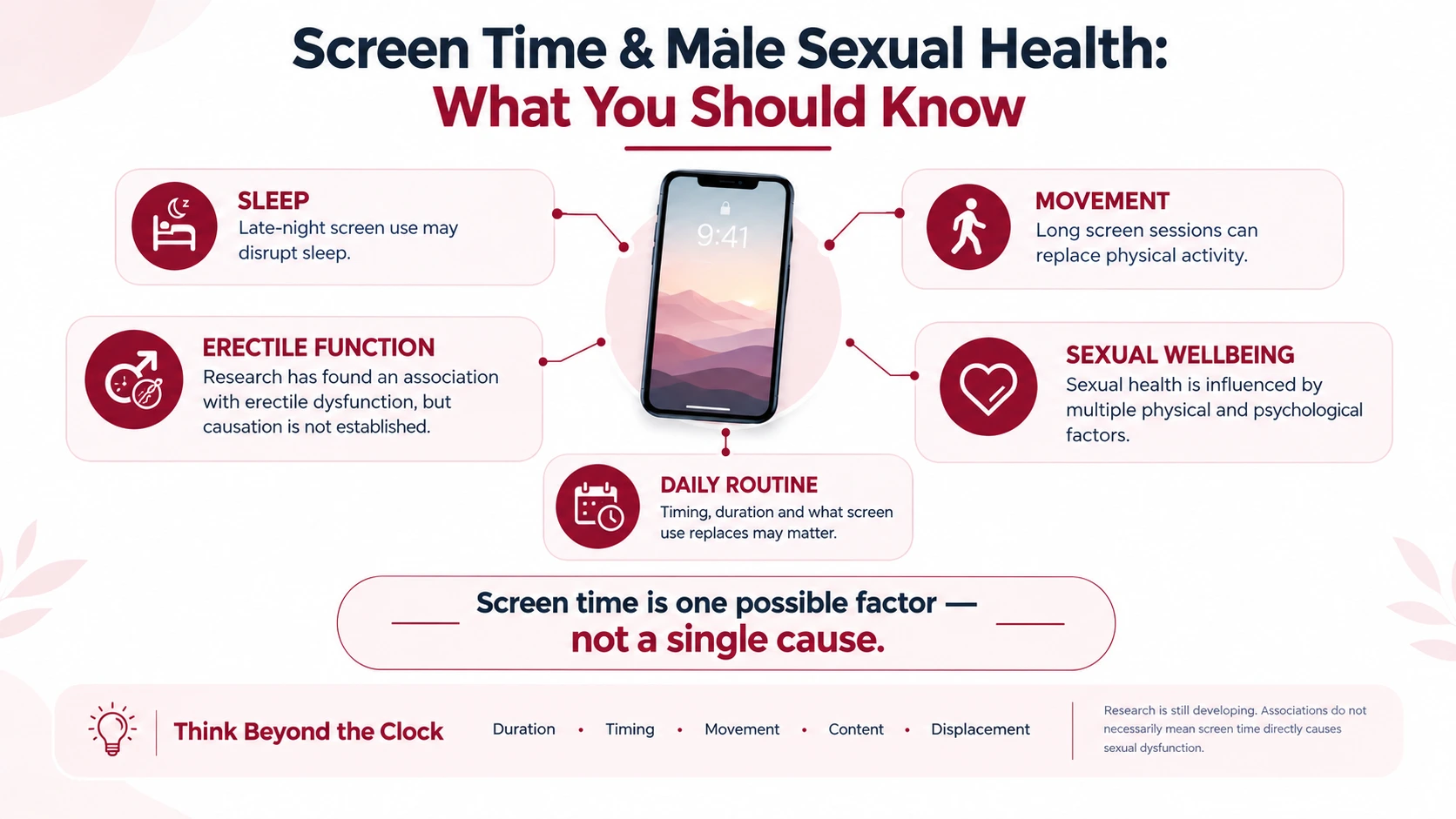
Screen Time, Sleep and Male Sexual Health
Recent evidence links greater screen exposure with shorter sleep, delayed bedtime, sleep difficulties and poorer sleep quality. These patterns have been observed across several studies looking at how devices fit into evening routines.
Sleep belongs in a sexual health discussion because rest is connected to many aspects of physical and mental function. When sleep shrinks or fragments, energy, mood and recovery can all be affected.
For men, this can show up in areas that are easy to overlook.
Timing may matter as much as total hours
A man might have moderate daily screen use but spend his most stimulating screen time immediately before bed. That final session can carry more weight than the total count suggests, which is a key insight for anyone studying these patterns.
The Last Screen Test
Ask a simple question. What is the last thing I do on a screen before going to sleep?
It might be scrolling social media, gaming, watching videos, reading work emails or messaging. Whatever the answer, it reveals the content that fills the gap between waking and sleeping.
Does Screen Time Affect Libido?
Libido and erectile function are not the same thing. Libido refers to sexual desire, while erectile difficulties relate to getting or maintaining an erection.
Screen time has not been established as a direct cause of low libido in men, and this distinction matters in discussions that often blur these two concepts together.
That said, possible indirect influences exist. Poor sleep, stress, fatigue, inactivity, relationship disruption and excessive digital stimulation can all shape how desire feels day to day.
It would be inaccurate to say screen time lowers libido in a direct or automatic way.
Is There a Link Between Screen Time and Premature Ejaculation?
A small 2023 study examined smartphone screen time in men with acquired premature ejaculation. The researchers reported higher average screen time in that group compared with men who did not have the condition.
The study was small, and an association does not establish causation. More research is needed before any broader conclusion can be drawn about premature ejaculation.
Premature ejaculation can have multiple contributing factors, including emotional, relational and physical elements.
Screen use may be one behavioural factor worth investigating, but it should not automatically be treated as the cause.
Does Screen Time Lower Testosterone?
There is not enough evidence to conclude that ordinary screen time directly lowers testosterone in men.
It helps to separate direct screen exposure from indirect lifestyle factors, particularly sleep and physical activity. Both of these are already known to play a role in male sexual health more broadly.
Without solid data, claims that blue light automatically reduces testosterone are not supported.
Can Screen Time Affect Male Fertility?
Fertility research often looks at sperm health, sleep, sedentary behaviour and overall lifestyle. Smartphone and laptop use sometimes appear in these discussions.
Evidence is still developing, and ordinary screen use should not automatically be described as a cause of infertility. Fertility is one part of male sexual health where the research is still in early stages.
Evidence Status
Known. Screen habits can overlap with lifestyle factors relevant to health.
Uncertain. Whether ordinary screen exposure independently harms fertility.
Not established. That using a smartphone automatically causes infertility.
Screen Time Is Not the Same as Pornography Use
Screen time describes the amount of time spent using digital devices. Pornography is a specific type of digital content.
Four hours of work, four hours of gaming and four hours of adult content are not the same exposure, even though the clock shows the same total.
Pornography deserves its own separate discussion. It should not be folded into general screen time research, and it should not be framed as something that automatically causes erectile difficulties.
Content matters as much as the clock. Two men can have the same screen time total but completely different digital habits and completely different sexual health experiences.
The Screen Time Stack. 5 Questions That Matter More Than Hours
Instead of looking only at total screen time, it helps to assess a wider picture. This is especially true for men focused on screen time male sexual health and the everyday patterns behind it.
1. Duration. How long are you using screens across the day?
2. Timing. When does most of that use happen?
3. Posture. How long are you sitting without moving?
4. Content. What are you actually doing on the device?
5. Displacement. What activities are being pushed aside?
Consider two men with identical screen totals. One spends his hours on work tasks during the day, takes walking breaks, keeps his phone out of the bedroom and sleeps on a regular schedule.
The other scrolls late into the night, sits for long stretches, skips exercise and brings his phone into bed. The clock reads the same, but the routines and their possible effects are very different.
Instead of asking only “How many hours am I on a screen?”, look at what those hours are doing to your daily routine.
The goal is not to find a “safe” number of screen hours. Look for patterns where screen use consistently replaces sleep, movement, relationships or other parts of a healthy routine.
Signs Your Screen Habits May Be Worth Changing
A practical self check can help you notice patterns that may be relevant to male sexual health over time.
- Screen use regularly delays bedtime
- Leisure scrolling replaces exercise
- Long periods pass without movement
- Phone use continues in bed
- Screen habits interfere with relationships
- Digital activity feels difficult to control
- Sexual changes appear alongside major lifestyle shifts
These signs do not prove that screen time is causing a sexual problem. They simply highlight habits that may be worth adjusting, which is a practical angle often missing from these guides.
How Men Can Reduce the Possible Impact of Excessive Screen Time
Protect the final hour before sleep
Reduce stimulating screen activity before bed so your mind has time to settle.
Break up prolonged sitting
Stand, walk or move regularly throughout the day rather than sitting for long unbroken stretches.
Keep recreational screens away from bedtime
Move phones, tablets and laptops out of the sleep space, especially if they interfere with rest.
Replace rather than simply remove
Swap some scrolling time for walking, exercise, hobbies or face to face social interaction.
Protect real world intimacy
Do not allow recreational device use to consistently replace couple time or social connection.
Track patterns, not perfection
Focus on whether screen habits are affecting sleep, movement and daily functioning. Lifestyle changes that support better sexual health can also help create a broader approach rather than focusing on screen time alone. Small consistent changes tend to matter more than a single perfect day.
When Sexual Changes Should Not Be Blamed on Screen Time
Persistent sexual problems can have many possible causes. Men should consider speaking with a healthcare professional if they experience persistent erectile difficulties, ongoing low libido, recurrent premature ejaculation, fertility concerns, sudden changes in sexual function or other concerning symptoms.
A change in sexual function deserves assessment rather than automatically being attributed to your phone, computer or television.
Sexual dysfunction can have several possible causes, so identifying the underlying issue is more useful than assuming the device is responsible. This is a core principle for protecting male sexual health rather than misdirecting attention.
What Does the Research Actually Tell Us?
| Topic | Evidence |
|---|---|
| Screen time and erectile function | Emerging association |
| Smartphone use and premature ejaculation | Limited preliminary evidence |
| Screen time and sleep | Stronger evidence of an association |
| Screen time and libido | Direct evidence limited |
| Screen time and testosterone | Insufficient evidence |
| Screen time and fertility | Still uncertain |
The evidence supports caution, not alarm.
Conclusion
Screen time itself is not established as a direct cause of male sexual health problems.The more useful question is whether excessive digital use is disrupting sleep, movement, exercise, relationships or other parts of a healthy routine. Men looking for information about related conditions and treatment options can also explore our Men’s Health category.
Research is still developing, particularly around erectile function and other outcomes tied to screen time male sexual health.
Men experiencing persistent sexual changes should look beyond screen habits and consider speaking with a healthcare professional to identify possible underlying causes. Male sexual health is best understood as part of a wider lifestyle picture rather than a single habit to fix or fear.
Natural Approaches to Male Sexual Enhancement
Explore lifestyle factors and natural approaches that may form part of a broader approach to male sexual wellbeing.
FAQ
Does screen time cause erectile dysfunction?
Research has found an association between prolonged screen based sedentary behaviour and erectile difficulties, but an association is not the same as a confirmed cause. More research is needed.
Can too much phone use affect erections?
Phone use that replaces sleep, movement and exercise may be part of a broader lifestyle pattern. The phone itself has not been established as a direct cause.
Does screen time lower testosterone?
There is not enough evidence to conclude that ordinary screen time directly lowers testosterone in men. Sleep and physical activity are more likely to be the relevant factors.
Can screen time affect male fertility?
Evidence is still developing. Screen habits can overlap with lifestyle factors, but ordinary screen use has not been established as a cause of infertility.
Does using your phone before bed affect sexual health?
Late night phone use can disrupt sleep, and sleep is connected to many aspects of wellbeing. The timing of screen use may matter as much as the total hours.
Can excessive screen time affect libido?
Libido has not been linked directly to screen time. Possible indirect influences include poor sleep, stress, fatigue and inactivity rather than the screen itself.

Years of Experience: 10+ years Education: B.Sc. in Biomedical Science (Monash University, Melbourne, Australia) PG Diploma in Health & Medical Communication (University of Sydney, Australia) Experience: Erica Wilson is an…