

COPD vs Asthma: What Is The Difference
By Erica Wilson, Feb-24-2025

 Dr. Arjun Srivastav Medical Reviewer (Pharm D)
If you have ever wheezed, coughed, or struggled to catch your breath, you have probably wondered what is really going on inside your lungs. Two of the most common chronic lung conditions, COPD and asthma, share many of the same symptoms, yet they are not the same disease. Understanding copd vs asthma is the first step toward better breathing, the right treatment, and fewer flare ups.
Both conditions can cause coughing, wheezing, shortness of breath, and chest tightness. But they differ in their underlying airway changes, symptom patterns, risk factors, progression, and management. When people search for this topic, they are usually looking for a clear, honest answer, not a textbook definition. So let’s answer the question right away and then go deeper.
COPD vs Asthma: What’s the Difference?
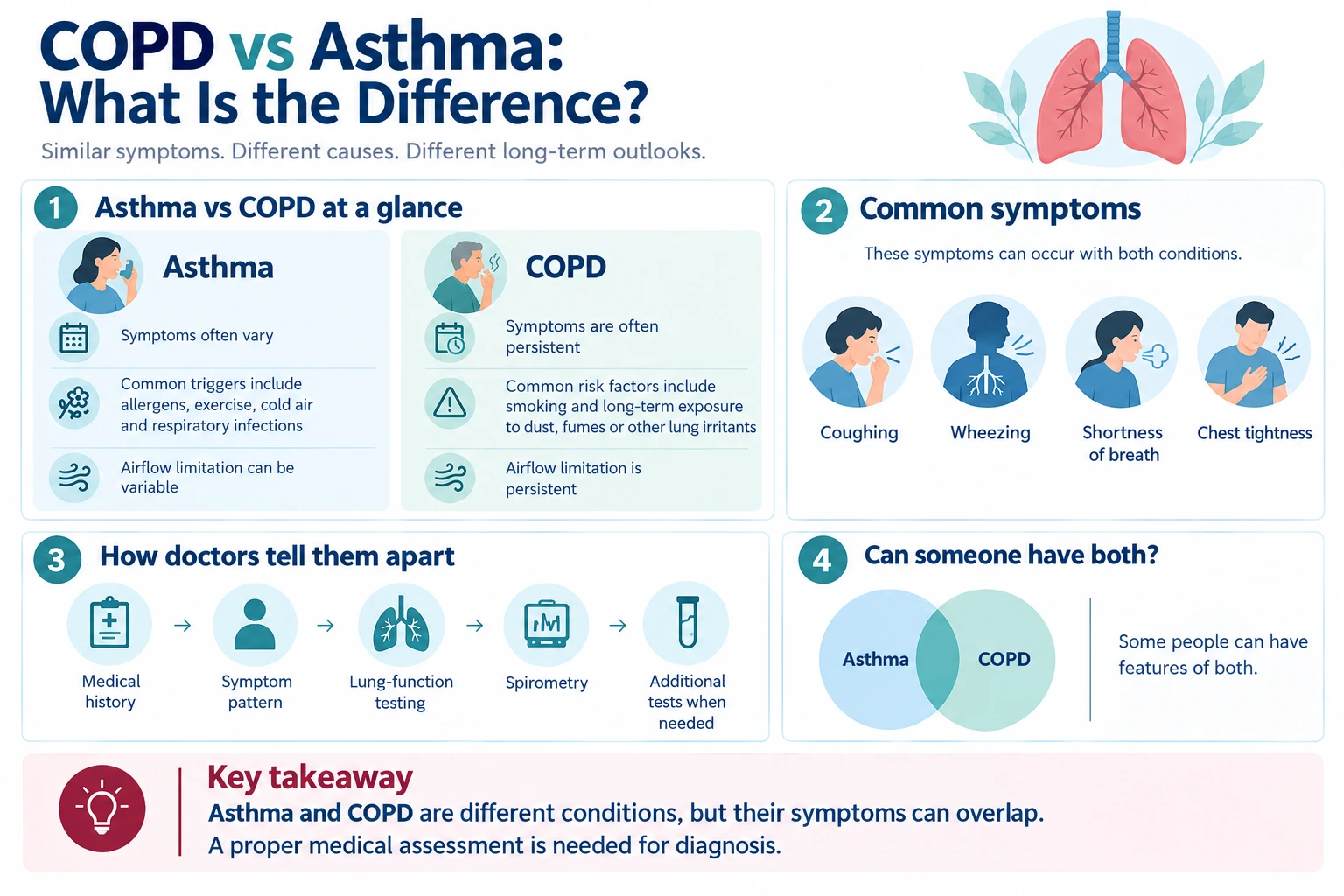
The simplest way to understand copd vs asthma is this: Asthma typically involves variable airway narrowing and symptoms that can change over time, while COPD is characterised by persistent airflow limitation and ongoing respiratory symptoms. In asthma, airway inflammation and sensitivity can cause variable narrowing, while COPD involves more persistent changes in airflow. In COPD, the airway changes are more fixed and long lasting.
When you explore the comparison, it comes down to onset, pattern, triggers, and whether airflow limitation is reversible. Here is a quick comparison to make the distinction clearer:
Typical onset
- Asthma: Can begin at any age, often earlier in life
- COPD: More common in adulthood
Symptom pattern
- Asthma: Often varies over time
- COPD: Usually more persistent
Common symptoms
- Asthma: Wheezing, cough, chest tightness, breathlessness
- COPD: Breathlessness, cough, phlegm, wheezing
Common triggers and risk factors
- Asthma: Allergens, exercise, cold air, infections, irritants
- COPD: Smoking, second hand smoke, occupational dust and fumes and other exposures
Airflow limitation
- Asthma: Often variable
- COPD: Persistent
Flare ups
- Asthma: Symptoms can worsen after triggers
- COPD: Exacerbations can cause sudden worsening
Can both occur together?
- Asthma: Yes
- COPD: Yes
In plain language, asthma tends to come and go, often responding to triggers and relievers. COPD tends to be a steady, daily presence that slowly limits what a person can do. That said, learning copd vs asthma means accepting that the two can overlap, and only proper testing can confirm which condition, or combination of conditions, you are dealing with.
What Are the Symptoms of COPD vs Asthma?
This is one of the most searched parts of the copd vs asthma topic, because symptoms are what people actually feel and worry about. The symptoms of copd vs asthma overlap a lot, which is why self diagnosis is unreliable.
Asthma symptoms
Asthma symptoms commonly include:
- Wheezing (a whistling sound when breathing)
- Cough, often worse at night or early morning
- Shortness of breath
- Chest tightness
- Symptoms that vary over time, better some days, worse others
- Symptoms triggered by certain situations such as exercise, cold air, allergens, or respiratory infections
Asthma symptoms can vary from person to person and may come and go depending on triggers. Understanding asthma symptoms can provide useful context when comparing asthma with COPD.
COPD symptoms
COPD symptoms commonly include:
- A persistent cough that does not go away
- Phlegm or mucus production, especially in the morni
- Breathlessness that gradually worsens
- Wheezing
- Reduced exercise tolerance, everyday tasks start to feel harder
- Frequent respiratory infections
How the symptom patterns differ
Here is the important part of understanding copd vs asthma: a single symptom cannot reliably distinguish the two. Wheezing alone does not mean asthma, and a chronic cough alone does not mean COPD. Instead, doctors consider the bigger picture:
- When the symptoms started
- How frequently they occur
- Whether symptoms vary or stay constant
- What triggers them
- Smoking or exposure history
- Lung function test results
This is why thinking about the two conditions through symptoms alone can be misleading. The pattern matters more than any one symptom.
What Causes Asthma and COPD?
Causes and triggers are another area where the distinction becomes clearer. The two conditions have different root drivers.
Common asthma triggers and risk factors
- Allergens such as pollen, dust mites, pet dander, and mould
- Exercise, particularly in cold or dry air
- Cold air and sudden temperature changes
- Respiratory infections
- Smoke and other irritants
- Family history or atopic conditions such as eczema and hay fever
COPD risk factors
- Smoking, the single biggest risk factor
- Second hand smoke exposure
- Long term exposure to dust and fumes
- Air pollution
- Certain occupational exposures
- Rare genetic causes such as alpha 1 antitrypsin deficiency
The key distinction: asthma is often associated with airway inflammation and sensitivity, while COPD is strongly associated with long term exposure to harmful particles or gases. And it is important not to oversimplify. Smoking is a major cause of COPD, but it is not the only cause. Long term occupational and environmental exposures matter too.
How Is Asthma vs COPD Diagnosed?
Diagnosis is where copd vs asthma moves from symptoms to evidence. This is one of the strongest sections because many people search for how to diagnose asthma vs COPD, how to diagnose COPD vs asthma, and asthma vs COPD spirometry.
Medical history and symptoms
Recognising the early warning signs and diagnosis of asthma can also help explain why symptoms need to be assessed alongside medical history and lung function testing.
A doctor will usually start by asking about:
- The age when symptoms began
- Smoking history
- Allergies
- Occupational exposure to dust, fumes, or chemicals
- How often symptoms occur
- What triggers them
- Previous respiratory problems
This history is the foundation of any assessment.
Spirometry
Spirometry is a lung function test that measures how much air you can breathe out and how quickly you can do it. It is central to understanding the difference in a clinical setting.
For COPD, spirometry is used to identify persistent airflow obstruction, with assessment after bronchodilator use.
For asthma, doctors may look for variable airflow limitation and changes in lung function following bronchodilator use or other appropriate testing.
But here is the key: spirometry alone does not tell you whether you have asthma or COPD. The diagnosis uses test results alongside the clinical history and symptoms. Anyone studying copd vs asthma should remember that a single number never tells the whole story.
Other tests
Depending on the person, doctors may also consider:
- Chest X ray
- CT scan
- Additional lung function testing
- Blood tests
- Other investigations to rule out alternative causes
Can You Have Asthma and COPD Together?
Yes, and this is an important part of the copd vs asthma conversation. Some people can have characteristics of both conditions. This is often referred to as asthma COPD overlap.
Having asthma does not automatically mean someone has COPD, and having COPD does not automatically mean someone has asthma. Diagnosis requires looking at the person’s history, symptoms, and objective testing. When people search for asthma and COPD together, asthma COPD overlap, or can you have asthma and COPD, the honest answer is that overlap is real but it needs proper evaluation, which is exactly why understanding copd vs asthma is so valuable.
Asthma vs COPD Treatment: What’s the Difference?
Treatment is where copd vs asthma becomes practical. Although some inhaled medicine classes are used in both conditions, treatment is not identical.
Asthma treatment
- Inhaled medicines
- Preventer or controller treatment when prescribed
- Reliever treatment where appropriate
- Trigger management
- Good inhaler technique
- Individual asthma action plans
Because inhaled medicines are commonly used in asthma management, knowing more about asthma inhalers can help explain how asthma treatment differs from COPD treatment.
COPD treatment
- Inhaled medicines
- Smoking cessation, one of the most impactful steps
- Physical activity
- Pulmonary rehabilitation
- Vaccination to reduce respiratory infections
- Managing exacerbations
- Oxygen therapy for people who meet clinical criteria
Why treatment isn’t interchangeable
This is a crucial point in any copd vs asthma guide: a person should not choose an inhaler based solely on whether their symptoms sound like asthma or COPD. The right treatment depends on a proper diagnosis, lung function results, and individual circumstances. Comparing copd vs asthma is useful for understanding, but treatment decisions belong with a healthcare professional.
Can Asthma Turn Into COPD?
Asthma does not simply turn into COPD. However, some people with long standing asthma can develop persistent airflow limitation, and some people can have features of both conditions. Smoking and other long term exposures can also affect lung function over time. So while asthma does not become COPD, the two can coexist, another reason the distinction matters.
COPD vs Asthma: Which Is Worse?
There is no blanket answer. Both can cause serious breathing problems. Severity differs between individuals. Asthma can cause severe attacks, while COPD can cause persistent breathing limitations and exacerbations. The appropriate comparison depends on disease severity, lung function, symptoms, and individual circumstances. When weighing copd vs asthma, the real question is not which is worse overall, but how severe the condition is for the specific person.
When Should You See a Doctor?
See a doctor if you experience:
- A persistent cough
- Repeated wheezing
- Breathlessness
- Breathlessness during ordinary activities
- Persistent phlegm
- Repeated chest infections
- Symptoms getting worse
Conclusion
COPD and asthma may share similar symptoms like wheezing, coughing, and breathlessness, but they are distinct conditions with different causes, patterns, and treatments. Asthma is often variable and trigger sensitive, while COPD is persistent and progressive. Understanding the difference helps you recognise the signs, ask the right questions, and seek proper diagnosis through spirometry and medical evaluation. Whether you have one condition, both, or neither, the key is working with a healthcare professional to get an accurate diagnosis and the right treatment plan. Do not rely on symptoms alone, and never self diagnose. Your lungs deserve expert care.

Years of Experience: 10+ years Education: B.Sc. in Biomedical Science (Monash University, Melbourne, Australia) PG Diploma in Health & Medical Communication (University of Sydney, Australia) Experience: Erica Wilson is an…