

High SHBG in Females: Causes, Symptoms and Treatment
By Erica Wilson, Oct-13-2026


 Dr. Arjun Srivastav Medical Reviewer (Pharm D)
 You had a blood test and the report came back with a high SHBG in females reading. That single line on a lab result can feel unsettling, especially when you are already dealing with fatigue, low drive or irregular cycles.
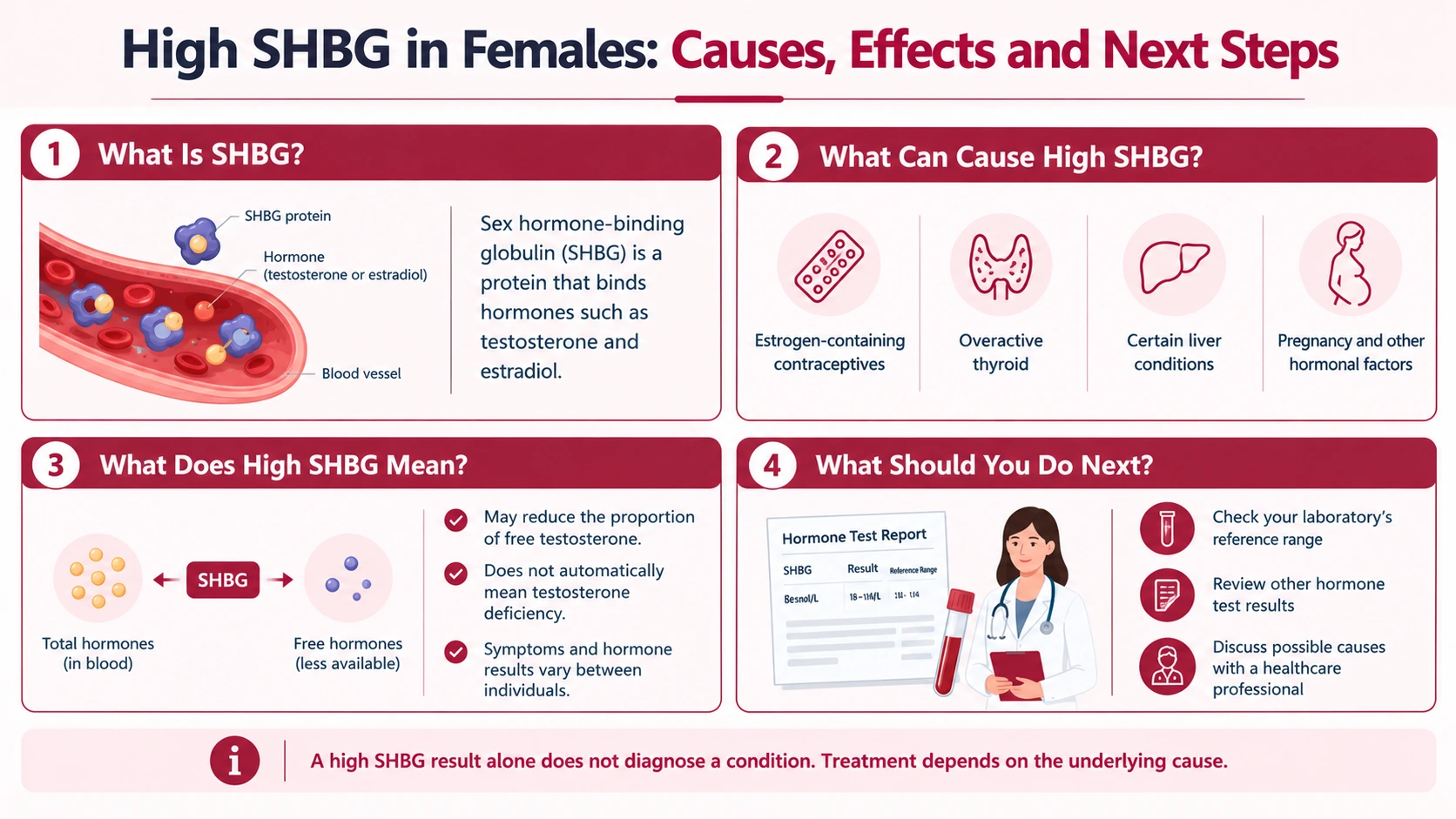
SHBG, or sex hormone binding globulin, is a protein your liver makes that binds to sex hormones like testosterone and estradiol. When the level rises, it can reflect something as simple as a medication change or as involved as a thyroid or liver condition.
The most important thing to understand up front is that an elevated result does not automatically point to a serious health problem, and it does not always mean treatment is required. Knowing what the number actually represents on your report is the first step.
💡 Quick Answer: High SHBG in Females
High SHBG means your blood has more sex hormone-binding globulin than the laboratory’s reference range. It can affect how much testosterone is available in its free form. Possible causes include estrogen-containing contraceptives, an overactive thyroid and certain liver conditions. A high result does not automatically mean a health problem or require treatment. Your symptoms, medications and other hormone test results help determine what it means for you.
What Is SHBG in Females?
Sex hormone binding globulin is a protein produced mainly by the liver, and its job is to carry sex hormones through your bloodstream. It binds tightly to testosterone and estradiol, holding most of these hormones in a form your tissues cannot directly use.
Only the small fraction that remains unbound, called free testosterone, is available to your cells. This is why a total testosterone result and a free testosterone result can look very different.
Total testosterone measures everything, both bound and unbound, while free testosterone measures only the active portion. Because SHBG controls how much hormone stays bound, the number only makes sense when your clinician reads it alongside your other hormone results and your individual context. This relationship is central to making sense of high SHBG in females.
What Is Considered High SHBG in Females?
Blood reports measure SHBG in nanomoles per liter, written as nmol/L. The number alone does not tell you much until you compare it with the reference interval printed beside it by the laboratory that processed your sample.
Every lab sets its own range based on the equipment and the population it serves, so a value flagged as high at one lab may sit comfortably inside the normal range at another.
Age, pregnancy, menopausal status and hormonal medicines all shift what counts as typical for you. A result that sits above the printed reference interval is not a diagnosis on its own. It is a prompt for your clinician to look at the wider picture.
Consider a fictional report that lists an SHBG result of 110 nmol/L next to a reference interval of 30 to 90 nmol/L. The value sits above the upper end, so the lab flags it. Reading the interval tells you why, but only your clinician can explain what that means for your body, your medicines and your stage of life. When people talk about high SHBG in females, they are usually referring to a result that sits above this kind of printed interval.
What Causes Elevated SHBG in Females?
Several factors can push SHBG above its reference interval, and they are not equally likely in every person. When investigating high SHBG in females, your clinician looks at each of these possibilities in turn.
Estrogen containing contraceptives and hormone therapy. Oral estrogen has a strong effect on SHBG because it reaches the liver first at a high concentration. Combined oral contraceptive pills and oral menopausal hormone therapy commonly raise SHBG while you use them. Transdermal estrogen, delivered through the skin, generally has a smaller effect because it bypasses that first pass through the liver.
An overactive thyroid. Hyperthyroidism can increase the amount of SHBG your liver produces. When thyroid hormone levels settle back into range with treatment, SHBG often follows.
Liver conditions, including cirrhosis. Because the liver makes SHBG, certain liver conditions can change the level. Cirrhosis is one example, though the relationship is complex and depends on the individual.
Pregnancy and physiological hormone changes. SHBG rises naturally during pregnancy as part of normal hormonal adaptation. A high result in pregnancy is often expected rather than unusual.
Certain medicines, including some anticonvulsants. Some prescription medicines can influence SHBG. Your clinician can review your current medications to see whether any are contributing.
Low body weight or nutritional concerns. Where clinically relevant, very low body weight or restricted nutritional intake can be associated with higher SHBG.
It is worth noting that PCOS is commonly associated with lower SHBG rather than higher SHBG, although individual results vary and nothing here applies uniformly to everyone. This is why high SHBG in females requires individual assessment rather than a one size fits all assumption.
What Are the Symptoms of High SHBG in Females?
SHBG itself may not cause noticeable symptoms. What people sometimes notice are changes linked to the amount of free hormone available to their tissues.
When SHBG rises, it can hold more testosterone in its bound form, which may reduce the active free fraction. Some people associate this with reduced sexual desire, particularly in certain circumstances such as ongoing oral contraceptive use.
Sexual desire and physical arousal are related but distinct experiences, and female sexual arousal can be influenced by physical health, emotional wellbeing, medications and hormonal factors.
Fatigue and mood changes are often mentioned in this conversation, but these experiences are not specific to SHBG. They overlap heavily with sleep, stress, iron levels, thyroid function, depression and many other factors. Because reduced sexual desire can have several possible causes, understanding female sexual dysfunction may help put these symptoms into a broader context.
A person can notice symptoms even when a total testosterone result sits within the laboratory range, because the free portion is what tissues actually use. This is why symptoms should be assessed in their full context rather than attributed to one blood marker alone. The symptoms of high SHBG in females are best understood as part of a broader clinical picture.
How Does High SHBG Affect Testosterone in Females?
When SHBG increases, it binds a larger share of testosterone, leaving less in the free, active form your cells can use. Understanding this means keeping four related ideas separate.
Total testosterone is the complete amount measured in blood, both bound and unbound. Free testosterone is the small unbound fraction available to tissues.
SHBG concentration is the level of the binding protein itself. The calculated free androgen index is a number derived from total testosterone and SHBG, and it has limitations because it is an estimate rather than a direct measurement.
A normal total testosterone result does not always answer every clinical question, because a high SHBG can still reduce the free portion. At the same time, high SHBG alone cannot diagnose androgen deficiency. The interpretation depends on symptoms, history and other results reviewed together. This interaction between SHBG and testosterone is a key reason high SHBG in females can be confusing on a standard lab report.
Can High SHBG Cause Infertility in Females?
This is a common search question, so it helps to address it directly. SHBG is relevant to reproductive hormone assessment because it influences how much free hormone is available, and hormones are part of the fertility picture.
High SHBG alone does not prove infertility. Fertility depends on many factors working together, including ovulation, menstrual patterns, age, ovarian function and partner factors. A single SHBG reading cannot capture all of that.
Changes in cycle length or missed periods can also be relevant when assessing reproductive health, so understanding the menstrual cycle and its different stages may help you prepare questions for your healthcare professional.
If you have fertility concerns, the right step is to discuss them with a healthcare professional who can look at your full hormone profile, cycle history and individual circumstances. There is no basis here to suggest that lowering SHBG on its own improves conception rates. Questions about high SHBG in females and fertility are best answered with a complete hormone workup rather than one isolated value.
High SHBG in Females and Hair Loss
Hair loss is another topic people search alongside SHBG. Female pattern hair loss has several potential causes, including genetic and hormonal factors, and it is rarely driven by one number on a blood test.
High SHBG is not an established standalone explanation for hair loss. In fact, elevated SHBG is associated with lower free testosterone rather than excess androgen activity, which makes a simple cause and effect link unlikely.
If you experience sudden or progressive hair loss, the right response is an assessment of the wider clinical picture rather than focusing on SHBG alone. Linking high SHBG in females directly to hair loss oversimplifies a complex issue that usually involves multiple factors.
How Is High SHBG Diagnosed?
Diagnosis starts with the right tests read in the right context. A SHBG blood test is usually requested alongside a total testosterone test, and your clinician may also assess free testosterone where the clinical question calls for it.
Depending on what is suspected, thyroid function tests and liver tests may be added. A detailed medication history matters, because hormonal contraception and other medicines can move the number.
Your clinician will also want to know about relevant symptoms, cycle changes and your stage of reproductive life. Australian laboratories set their own reference intervals. The Royal College of Pathologists of Australasia provides guidance on how these intervals are established and interpreted, which helps clinicians read results consistently across different labs.
Additional tests may be requested depending on the suspected cause, so the workup is tailored to the individual rather than fixed for everyone. Diagnosing high SHBG in females properly means looking at the full set of results together rather than focusing on the SHBG value in isolation.
🔎 High SHBG: What to Check Before Changing Anything
A high result is a starting point for investigation, not a diagnosis. Review these four areas with your healthcare professional.
1. The full hormone panel
Check SHBG alongside total testosterone and other tests relevant to your symptoms.
2. Medicines and hormones
Mention contraceptives, estrogen therapy, supplements and other prescribed medicines.
3. Possible underlying causes
Ask whether thyroid function, liver health or nutritional factors need assessment.
4. Your personal context
Discuss menstrual changes, pregnancy, menopause, symptoms and previous results.
Important: Do not stop prescribed medication or try to lower SHBG with hormones or supplements without medical advice. The right response depends on the cause and your overall results.
How to Decrease SHBG in Females
The question of how to decrease SHBG in females comes up often, and the medically appropriate pathway begins with finding the factor that caused the elevation in the first place.
Identify the underlying factor. SHBG usually reflects something else happening in the body, so the first step is understanding why it rose.
Review hormonal contraception and other medicines. If oral estrogen is contributing, your prescriber can discuss whether a dose change or a switch to transdermal estrogen makes sense for you. Never stop a prescribed medicine on your own.
Assess and treat a thyroid or liver condition if diagnosed. When an overactive thyroid or a liver condition is involved, treating that condition is the path forward, and SHBG may move as the underlying issue settles.
Address nutritional or weight related concerns with appropriate support. Where low body weight or restricted intake is relevant, guided nutritional support can help.
Recheck hormone results when clinically indicated. Follow up testing shows whether the level has shifted in a meaningful way.
It is important to state clearly that lowering SHBG is not always necessary or beneficial. Readers should not stop prescribed medicines or take testosterone or other hormone products to change a laboratory result on their own. Managing high SHBG in females is about addressing the root cause, not chasing a single number.
Can You Lower SHBG Naturally?
The search for how to decrease SHBG in females naturally often leads to supplement lists and restrictive diets. The evidence is much more modest than that.
Habits that support general health are the sensible starting point. A balanced diet is part of general health, and this article on the potential benefits of eggs for hormonal health provides related nutritional context.
Balanced nutrition, adequate energy intake matched to your activity level, and appropriate physical activity all support overall hormone balance. Managing any underlying health condition, such as a thyroid concern, is also part of the picture.
These habits support general wellbeing, but they are not proven universal methods for lowering SHBG. Unsupported supplement recommendations, restrictive diets and promises of rapid hormone changes are not helpful. You should not deliberately try to increase or decrease SHBG without first understanding why it is elevated. Natural approaches to high SHBG in females should always be discussed with a healthcare professional before making changes.
When Should You See a Healthcare Professional?
Schedule a review if you have a persistent abnormal result, menstrual changes, fertility concerns or ongoing symptoms that worry you. For information on related topics affecting women’s health, you can browse our Women Care category.
Seek prompt assessment if new androgen related changes develop rapidly, such as a deepening voice or rapidly progressive coarse facial hair. These signs warrant timely medical attention rather than self management. Any concern related to high SHBG in females deserves a proper clinical review rather than guesswork.
🩺 Medical Disclaimer
Conclusion
High SHBG in females is a lab finding that raises questions, but it rarely answers them on its own. The number reflects what is happening elsewhere in the body, whether that is a medication, a thyroid or liver condition, a normal stage like pregnancy, or a nutritional concern. Reading it alongside your full hormone profile, symptoms and medical history is what gives it meaning. The right next step is always a conversation with your healthcare professional who can interpret the result in your individual context and guide any follow up if it is needed.
FAQ
Is high SHBG dangerous in females?
A high result is not automatically dangerous. It often reflects a medication, a thyroid or liver condition, or a normal physiological state such as pregnancy. Your clinician determines whether it points to anything that needs attention. High SHBG in females is a signal to investigate, not a verdict on its own.
Can high SHBG cause infertility?
High SHBG alone does not prove infertility. Fertility involves ovulation, ovarian function, age, cycle patterns and partner factors. Discuss fertility concerns with a healthcare professional for a full assessment.
Does high SHBG cause hair loss?
High SHBG is not an established standalone cause of hair loss. Elevated SHBG is associated with lower free testosterone rather than excess androgen activity. Sudden or progressive hair loss warrants a broader clinical assessment.
Can birth control increase SHBG?
Yes. Combined oral contraceptive pills and oral hormone therapy commonly raise SHBG while you use them, because oral estrogen reaches the liver first at a high concentration. This is one of the most common reasons for high SHBG in females on a routine blood test.
How can SHBG be lowered naturally?
Balanced nutrition, adequate energy intake and appropriate physical activity support general health, but they are not proven universal methods for lowering SHBG. Address any underlying condition first and avoid unsupported supplements or restrictive diets.
Can high SHBG return to the normal range?
Yes. When the underlying factor is identified and addressed, whether that is a medication, a thyroid or liver condition or a nutritional concern, SHBG can move back toward the reference interval. Follow up testing confirms the trend. In many cases of high SHBG in females, the level settles once the contributing factor is resolved.

Years of Experience: 10+ years Education: B.Sc. in Biomedical Science (Monash University, Melbourne, Australia) PG Diploma in Health & Medical Communication (University of Sydney, Australia) Experience: Erica Wilson is an…

