

Dapoxetine for Premature Ejaculation: Uses, Benefits, Dosage & Side Effects
By Erica Wilson, Oct-03-2026


 Dr. Arjun Srivastav Medical Reviewer (Pharm D)
 Dapoxetine is a short acting selective serotonin reuptake inhibitor developed specifically for the on demand treatment of premature ejaculation in men. Unlike traditional antidepressants that are taken daily, this medicine is taken only when needed around sexual activity.
That is one of the main reasons it stands apart from other SSRIs. The active ingredient is dapoxetine hydrochloride, and it works by influencing serotonin signalling in the nervous system to help improve control over ejaculation.
💡 Dapoxetine for Premature Ejaculation: Quick Answer
A short-acting SSRI used for premature ejaculation.
Usually taken on demand before sexual activity.
30 mg, when medically appropriate.
Usually 1–3 hours before sexual activity.
No more than once in 24 hours.
Dizziness, nausea, fainting and medicine interactions.
Important: Dapoxetine is not suitable for everyone. Check your medicines, medical history and appropriate dose with a healthcare professional.
Before Taking Dapoxetine: Is It Actually Premature Ejaculation?
Not every instance of finishing sooner than you would like counts as premature ejaculation. Many men experience occasional early ejaculation due to stress, fatigue, a long gap since last intimacy, or simply novelty with a new partner.
These one off situations are common and usually settle on their own without any medicine. Individual sexual habits and experiences can also raise questions about ejaculation timing. If this is a concern, our guide on masturbation and early ejaculation explores whether the two are actually related.
Premature ejaculation is generally understood as a persistent pattern rather than a rare event. The features that separate an ongoing problem from an occasional occurrence include:
- Difficulty controlling ejaculation that happens repeatedly
- Ejaculation that occurs sooner than desired across most or all encounters
- Personal distress or a clear impact on the relationship
When these patterns continue over time, the conversation shifts from a normal variation to something worth assessing properly.
Identifying the type of premature ejaculation matters before choosing any treatment, because the approach that suits one person may not suit another. For some men, sensitivity may also be part of the overall concern. Understanding the relationship between penile sensitivity and premature ejaculation can help put the symptoms into context.
Lifelong vs Acquired Premature Ejaculation
Lifelong premature ejaculation is present from the first sexual experiences onward. It tends to be a consistent pattern that has been there since the beginning of sexual activity, and it often relates to how the nervous system handles the ejaculation reflex.
Acquired premature ejaculation develops later in life after a period of normal ejaculation control. Because it appears after previously normal function, it often prompts a closer look at contributing factors. Changes in ejaculation can also occur with age, so men experiencing a new change later in life may benefit from understanding how ejaculation changes in older men can differ from lifelong premature ejaculation.
These can include:
- Erectile difficulties
- Other sexual or genitourinary concerns
- Situational and psychological influences
Why This Matters for Treatment
Treatment should address the underlying situation rather than focusing only on stretching intercourse duration. If an acquired problem is driven by erectile difficulties, then working on ejaculation timing alone may not resolve what is actually going on.
Understanding the type of premature ejaculation helps direct attention to the right factors, which is far more useful than chasing a particular number of minutes.
Where Does Dapoxetine Fit Into Premature Ejaculation Treatment?
Dapoxetine occupies a specific place in premature ejaculation management. It is designed for on demand use, meaning it is taken only around sexual activity rather than as a standing daily medicine.
As a short acting SSRI, it is absorbed and cleared relatively quickly compared with traditional antidepressants. That is why it suits intermittent use rather than continuous daily dosing.
This is quite different from daily antidepressant treatment, where SSRIs build up in the body over weeks. Dapoxetine was developed with the on demand pattern in mind, and its pharmacokinetic profile reflects that purpose.
Other approaches to premature ejaculation also exist, including behavioural techniques and topical options, and these are discussed briefly later in this article.
One point worth keeping in mind is that the objective of treatment is not simply to reach a specific number of minutes. Control over ejaculation, the distress associated with the problem, and overall sexual satisfaction all matter.
A treatment that improves how a person feels about their experience can be meaningful even when a stopwatch is not involved.
How Does Dapoxetine Work for Premature Ejaculation?
To understand how dapoxetine works, it helps to look at how the body handles the ejaculation process. Ejaculation is mediated by the sympathetic nervous system and is influenced by signalling in the central nervous system.
One of the key messengers involved is serotonin.
The Role of Serotonin in Ejaculation
Serotonin is a neurotransmitter that carries signals between nerve cells in the brain and spinal cord. In the context of ejaculation, serotonin signalling helps regulate the reflex that leads to ejaculation.
When serotonin is active at certain receptors, it tends to inhibit or delay the ejaculatory pathway.
Serotonin does not stay in the gap between nerve cells forever. After it is released, it is normally taken back up into the nerve endings through a process called reuptake.
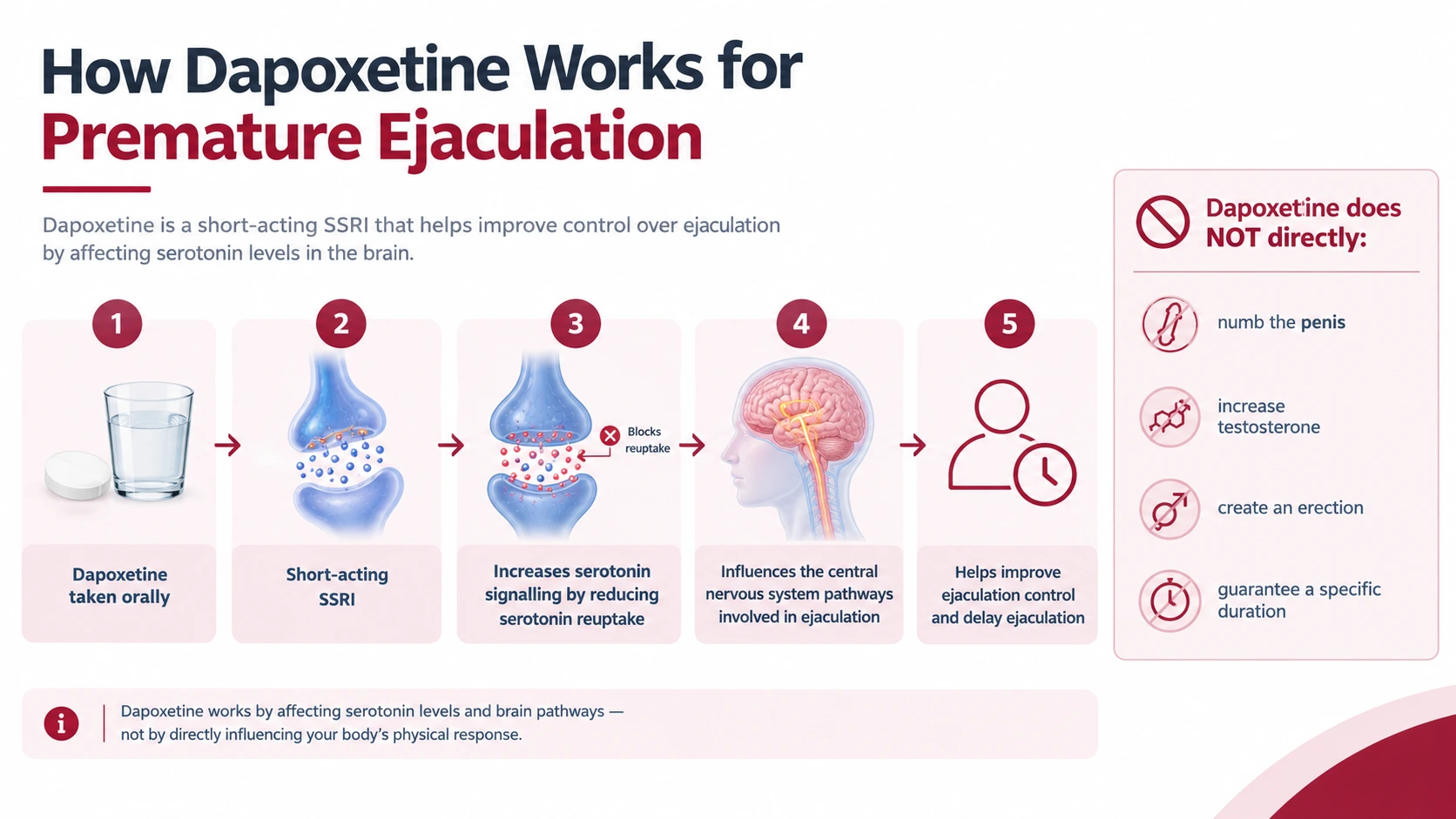
Dapoxetine blocks this reuptake of serotonin, which means more serotonin remains available at the pre and postsynaptic receptors for longer. With more serotonin activity at those receptors, the ejaculation reflex can be delayed, which is the basis for how the medicine helps improve control.
What Dapoxetine Does and Does Not Do
There are a few common misunderstandings about what this medicine actually does. Dapoxetine:
- Does not numb the penis
- Does not directly produce an erection
- Is not testosterone
- Does not guarantee a particular intercourse duration
What it primarily targets is ejaculation control through its effect on serotonin signalling. This is why searches such as how does dapoxetine work and how does dapoxetine delay ejaculation often lead back to the same underlying mechanism.
💡 Did You Know
What Does Working Actually Mean With Dapoxetine?
One of the most useful ways to think about this medicine is to ask what working really means. Effectiveness with dapoxetine can involve several different outcomes, and not all of them are about timing.
Ejaculation Time
Clinical studies often use a measure called intravaginal ejaculatory latency time, usually shortened to IELT. This is the time between vaginal penetration and ejaculation.
Researchers use IELT because it gives a consistent, comparable number across a study population. It is a useful research tool, but it is only one part of the picture.
Ejaculatory Control
Improved ability to delay ejaculation can matter independently of the stopwatch. Feeling more in control, being able to recognise the point of inevitability, and having the option to slow down can change the experience even when the exact number of minutes does not shift dramatically.
Distress
Many people with premature ejaculation carry frustration, anxiety, or embarrassment about the situation. A reduction in that distress can be a meaningful outcome in its own right.
Feeling less preoccupied with performance can change the overall experience of intimacy.
Sexual Satisfaction
Satisfaction is another outcome that studies look at. It reflects how the person and often their partner feel about the sexual experience overall.
Satisfaction can improve even when timing changes only modestly, because confidence, control, and distress all feed into it.
Why How Many Minutes Is Not the Only Question
There is a real difference between a clinical measurement and an individual lived experience. A study reports averages across hundreds of people, but a single person experiences their own response.
That is why asking how many minutes does it add is not always the most useful question. Control, distress, and satisfaction can matter as much as, or more than, the raw timing.
How Effective Is Dapoxetine for Premature Ejaculation?
The evidence for dapoxetine comes from clinical trials and from systematic reviews and meta analyses that pool data across multiple studies. In pooled analyses of randomised controlled trials, dapoxetine taken on demand produced a statistically significant increase in IELT compared with placebo.
Improvements were also seen in perceived control over ejaculation, in measures of distress, and in sexual satisfaction.
Both the 30 mg and 60 mg doses have been studied. The findings suggest that the 60 mg dose is associated with greater effects on timing and control, but also with a higher incidence and intensity of adverse effects.
The difference between the two doses is a matter of degree rather than a dramatic change in how the medicine works. Individual response can vary, which is an important point to hold alongside the clinical averages.
Clinical Average vs Individual Experience
A statistically meaningful improvement across a study population does not mean every person experiences the same degree of benefit. Some people notice a clear difference, some notice a modest one, and some feel little change.
This is normal variation and not a sign that something is wrong. It is also why it is not appropriate to promise a specific number of minutes for any individual user. The research describes groups, while treatment is experienced by a person.
Dapoxetine Dosage: 30 mg vs 60 mg
Dosage is one of the most common reasons people search for information about this medicine, so it is worth covering in detail.
Why 30 mg Is Usually the Starting Dose
The recommended starting dose for all men is 30 mg, taken as needed approximately 1 to 3 hours before sexual activity. Treatment should not be initiated with the 60 mg dose.
Starting at the lower dose helps assess both how well the medicine works for that individual and how well it is tolerated. Because side effects can differ from person to person, beginning at 30 mg gives a sensible baseline before any change is considered.
When Is 60 mg Considered?
The 60 mg dose may be considered when the response to 30 mg is insufficient and the person has not experienced moderate or severe adverse reactions or warning symptoms such as feeling faint.
Even then, any dose change should follow medical advice rather than personal judgement. A higher dose is not automatically better, and it is certainly not a shortcut to a better result.
What Changes When the Dose Increases?
There is a trade off between benefit and side effects when the dose goes up. The 60 mg dose may be associated with a greater treatment effect, but it also carries a greater likelihood and intensity of adverse effects such as:
- Nausea
- Dizziness
- Fainting related symptoms
This is why 60 mg should not be framed as the stronger or best option. It is simply a different point on the same balance between effect and tolerability, and the right choice depends on the individual.
When Should Dapoxetine Be Taken?
Dapoxetine is usually taken 1 to 3 hours before sexual activity. It is an on demand medicine, not a routine daily one.
The maximum frequency is once in any 24 hour period, and it is not intended to be taken every day.
It is worth noting that timing does not mean the medicine produces an instant effect. Taking it closer to sexual activity does not make it work faster in the way some people expect, because the body still needs time to absorb it.
Common Timing Mistakes to Avoid
A few patterns tend to cause problems:
- Taking it too close to sexual activity, so it has not had enough time to be absorbed
- Taking more because the expected effect was not immediate
- Treating it like a daily medicine rather than an on demand one
- Combining it with alcohol, which can increase dizziness and the risk of fainting
- Ignoring hydration and dizziness precautions
The guidance here is educational rather than an invitation to experiment.
🔵 Reminder
What Can Make Dapoxetine Feel Different From One Occasion to Another?
Many people notice that the experience with this medicine is not identical every time. Several factors can influence how it feels and how well it works on a given occasion.
Individual response is one factor, since no two bodies process a medicine in exactly the same way. Dose matters, as does timing relative to sexual activity.
Alcohol can amplify dizziness and drowsiness, and hydration can affect how light headed a person feels. Other medicines being taken at the same time can change how dapoxetine behaves.
The underlying characteristics of the premature ejaculation itself, whether lifelong or acquired, can play a role. Coexisting erectile difficulties can also shape the experience.
Finally, expectations about treatment can colour how a person interprets what they feel. Because so many variables are in play, one experience should not automatically be treated as a reliable prediction of every future experience.
Dapoxetine Side Effects: What Is Common and What Matters Most?
Common Side Effects
The most frequently reported side effects are documented in the product information and clinical trials. Very common effects, meaning they may affect more than 1 in 10 men, include:
- Feeling dizzy or faint upon standing
- Nausea
Other commonly reported effects include:
- Headache
- Dizziness
- Diarrhoea
- Drowsiness, slow reflexes, and altered judgment
The incidence and severity of these effects are higher with the 60 mg dose than with the 30 mg dose.
The Side Effect Users Should Understand: Fainting
Fainting, also called syncope, deserves particular attention because it is an important safety consideration. Dizziness or light headedness can occur, especially when standing up quickly, and getting up rapidly can worsen these feelings.
The product information advises swallowing the tablets whole with at least a full glass of water, which may help lower the chance of fainting.
If a person feels warning signs, they should immediately lie down so their head is lower than their body. These warning signs include:
- Nausea
- Dizziness or light headedness
- Confusion
- Sweating
- An abnormal heartbeat
Following the safety instructions in the product leaflet is an important part of using this medicine sensibly.
Why Alcohol Matters
Alcohol can increase the effects of dapoxetine such as dizziness, drowsiness, slow reactions, and altered judgment. Combining alcohol with dapoxetine may also increase the risk of fainting or other adverse effects, including accidental injury.
This is why the guidance is to avoid alcohol while taking this medicine.
⚠️ Warning
Dapoxetine Interactions: What Should You Check Before Taking It?
Rather than listing every possible medicine, it is more useful to think about interactions by category. The table below sets out the main categories and why each one matters.
| Medicine or substance category | Why it matters |
|---|---|
| Other antidepressants | Serotonin related interaction risk |
| Tramadol | Serotonergic interaction concern |
| Certain migraine medicines | Potential serotonergic interaction |
| Blood pressure medicines | May increase dizziness or low blood pressure concerns |
| ED medicines | Blood pressure effects may require assessment |
| Certain antifungals | Can alter dapoxetine exposure |
| Certain HIV medicines | May affect metabolism |
| St John’s wort | Can interact with antidepressant medicines |
| Alcohol | Can worsen dizziness and fainting risk |
| Grapefruit juice | Can increase dapoxetine exposure |
The complete medicine list should always be checked with a healthcare professional or pharmacist before starting treatment. Some interactions relate to how the body metabolises dapoxetine through specific liver enzymes, which is why a full review matters.
🔎 Check This
Dapoxetine + Sildenafil: Why Do People Combine Them?
A common search around this medicine involves combining dapoxetine with sildenafil, the active ingredient in Viagra. The distinction between the two is straightforward.
Dapoxetine is used for ejaculation control, while sildenafil is used for erectile function. They address different concerns.
Erectile dysfunction and premature ejaculation can occur together, and combination treatment has been studied. Because both medicines can affect blood pressure, their combined use requires consideration of orthostatic tolerance and other interaction concerns.
Combining them should not be treated as automatically appropriate for everyone, and the decision belongs with a healthcare professional. Tadalafil, another medicine in the same group as sildenafil, is a related search query, but the focus of this article stays on dapoxetine rather than turning into a general discussion of erectile dysfunction medicines.
If Dapoxetine Doesn’t Work, Don’t Assume You Need More
When the expected benefit does not appear, the instinct to take more is exactly the wrong move. A lack of expected benefit can have several explanations:
- The diagnosis may need reassessment, because what looks like premature ejaculation might involve other factors
- Timing or pattern of use may not have been appropriate
- Individual response may simply differ
- The 30 mg dose may not provide sufficient benefit for that person
- Erectile difficulties may also be present and influencing the situation
- The premature ejaculation may be acquired rather than lifelong
- Another treatment approach may be more appropriate altogether
The key point is explicit: do not increase the dose on your own. A higher dose raises the risk of side effects without any guarantee of a better outcome, and the better next step is a conversation with a healthcare professional.
Dapoxetine Is Only One Part of Premature Ejaculation Management
Dapoxetine is one option among several. Other approaches include behavioural techniques that can help some people build control over time. Kegel exercises for premature ejaculation are one example of a behavioural approach that may be discussed as part of broader PE management.
- Topical anaesthetic approaches that offer another route
- Other pharmacological approaches
- Management of erectile dysfunction where it is present
- Assessment of relevant genitourinary conditions
This section is kept short on purpose, so the page stays focused on dapoxetine rather than becoming a general premature ejaculation treatment guide.
What Current Research Says About Dapoxetine
The current evidence base includes clinical trials, systematic reviews, and meta analyses. These studies generally report improvements in IELT, perceived control, distress, and satisfaction with on demand dapoxetine compared with placebo.
Current guidelines position dapoxetine as an on demand pharmacological option for premature ejaculation.
Research also compares the 30 mg and 60 mg doses, with the 60 mg dose showing greater effect but higher adverse event rates. Combination treatment, particularly with PDE5 inhibitors, has also been studied.
There are limitations to keep in mind, including:
- Study duration
- Heterogeneity between studies
- Differences between study populations
How to Read Dapoxetine Research
A statistically significant average improvement in a clinical study does not mean every individual will experience the same result. Research describes what happens across a group, while treatment is felt by a person.
Reading the evidence with that distinction in mind keeps the findings useful without turning them into promises.
FAQ
How long does dapoxetine take to work?
Dapoxetine is taken 1 to 3 hours before sexual activity, and its rapid absorption means it is generally active within that window. Individual response can vary, so the experience is not identical for everyone.
Can dapoxetine be taken every day?
Dapoxetine is generally intended for on demand use rather than daily use. The maximum is once in any 24 hour period, and it is not designed as a routine daily medicine.
Does dapoxetine work from the first dose?
Some people may notice an effect with an early dose, but individual response varies. For others, the experience may take a few uses to understand and assess.
Can dapoxetine make ejaculation take too long?
Altered ejaculation timing can occur, but the medicine is intended to improve control over ejaculation rather than to eliminate ejaculation altogether.
Can dapoxetine cause erectile problems?
Sexual side effects can occur with this class of medicine. This is distinct from the primary purpose of dapoxetine, which is ejaculation control rather than erectile function.
Can I take dapoxetine with tadalafil?
Taking dapoxetine with tadalafil requires consideration of blood pressure effects, other medicines being used, and individual circumstances. This is a decision for a healthcare professional rather than a simple yes or no.
Can I drink grapefruit juice with dapoxetine?
The product information includes a precaution regarding grapefruit juice, which can increase dapoxetine exposure. The guidance is to avoid drinking grapefruit juice within 24 hours before taking the medicine.

Years of Experience: 10+ years Education: B.Sc. in Biomedical Science (Monash University, Melbourne, Australia) PG Diploma in Health & Medical Communication (University of Sydney, Australia) Experience: Erica Wilson is an…

