

Mebendazole vs Fenbendazole: Differences, Uses & Safety Comparison
By Erica Wilson, Aug-25-2026

 Dr. Arjun Srivastav Medical Reviewer (Pharm D)
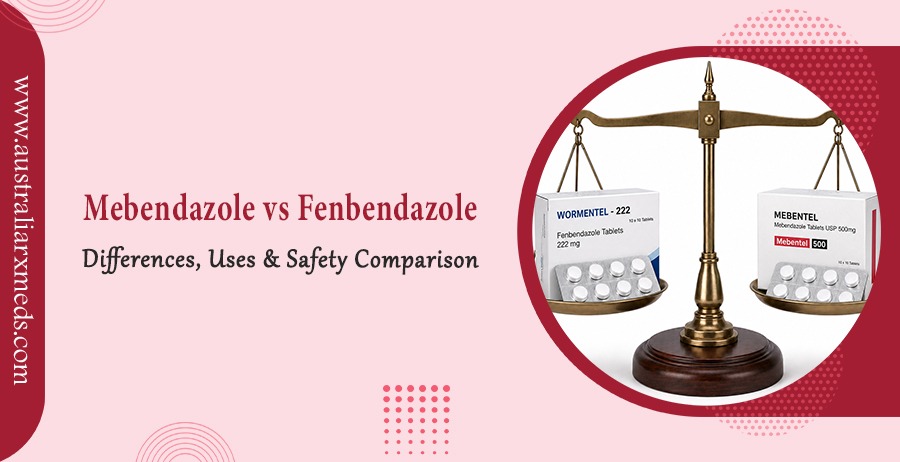
When comparing mebendazole vs fenbendazole, it is important to look beyond their similar names and chemical structures. Both belong to the benzimidazole class of anthelmintic drugs, but their approved uses, clinical evidence, and safety profiles differ.
Mebendazole is a proven drug used to treat worm infections in humans, whereas fenbendazole is more of a veterinary drug. The awareness of the fact will help people avoid the mistaken notion of replacing one drug with the other.
The article will give an insight into the differences between the two drugs in terms of usage, mechanism of action, safety issues, side effects, among others.
What Is Mebendazole?
Mebendazole is a benzimidazole anthelmintic medicine used for certain parasitic infections in humans. It works by interfering with structures that parasites need for normal cellular function and survival.
Depending on the infection and local prescribing information, mebendazole may be used for infections caused by:
- Pinworms
- Whipworms
- Roundworms
- Hookworms
Because mebendazole has established use in human medicine, its dosing, precautions, and potential adverse effects have been studied more extensively than those of veterinary-only medicines.
What Is Fenbendazole?
Fenbendazole is another benzimidazole anthelmintic, although it is mainly employed in veterinary medicine. The drug is found in veterinary preparations used to treat some kinds of parasitic infections in animals. For a broader explanation of its properties and veterinary use, see what is fenbendazole.
The similarity in the chemical composition of both drugs explains why the mebendazole vs fenbendazole comparison is popular. Nevertheless, chemical similarity does not imply that the drugs have the same safety, dosage guidelines, and indications for use.
There is interest in fenbendazole in the Internet community due to the alleged use of the drug in the therapy of cancer in humans. However, laboratory studies and anecdotal evidence cannot prove the efficiency of fenbendazole against cancer.
Mebendazole vs Fenbendazole: Key Differences
The most important differences can be summarized by looking at their intended use, regulatory status, evidence, and safety information.
Mebendazole vs Fenbendazole: Main Differences
| Feature | Mebendazole | Fenbendazole |
|---|---|---|
| Drug class | Benzimidazole anthelmintic | Benzimidazole anthelmintic |
| Main use | Certain parasitic worm infections in humans | Certain parasitic infections in animals |
| Human use | Established human medicine | Not an approved human treatment |
| Veterinary use | Depends on the specific product and jurisdiction | Commonly used in veterinary medicine |
| Human dosing information | Established for approved indications | No established approved human dosing regimen |
| Human safety evidence | Well characterized compared with fenbendazole | Limited |
| Formulations | Human oral formulations vary by market | Veterinary formulations vary by animal and product |
| Interchangeable? | No | No |
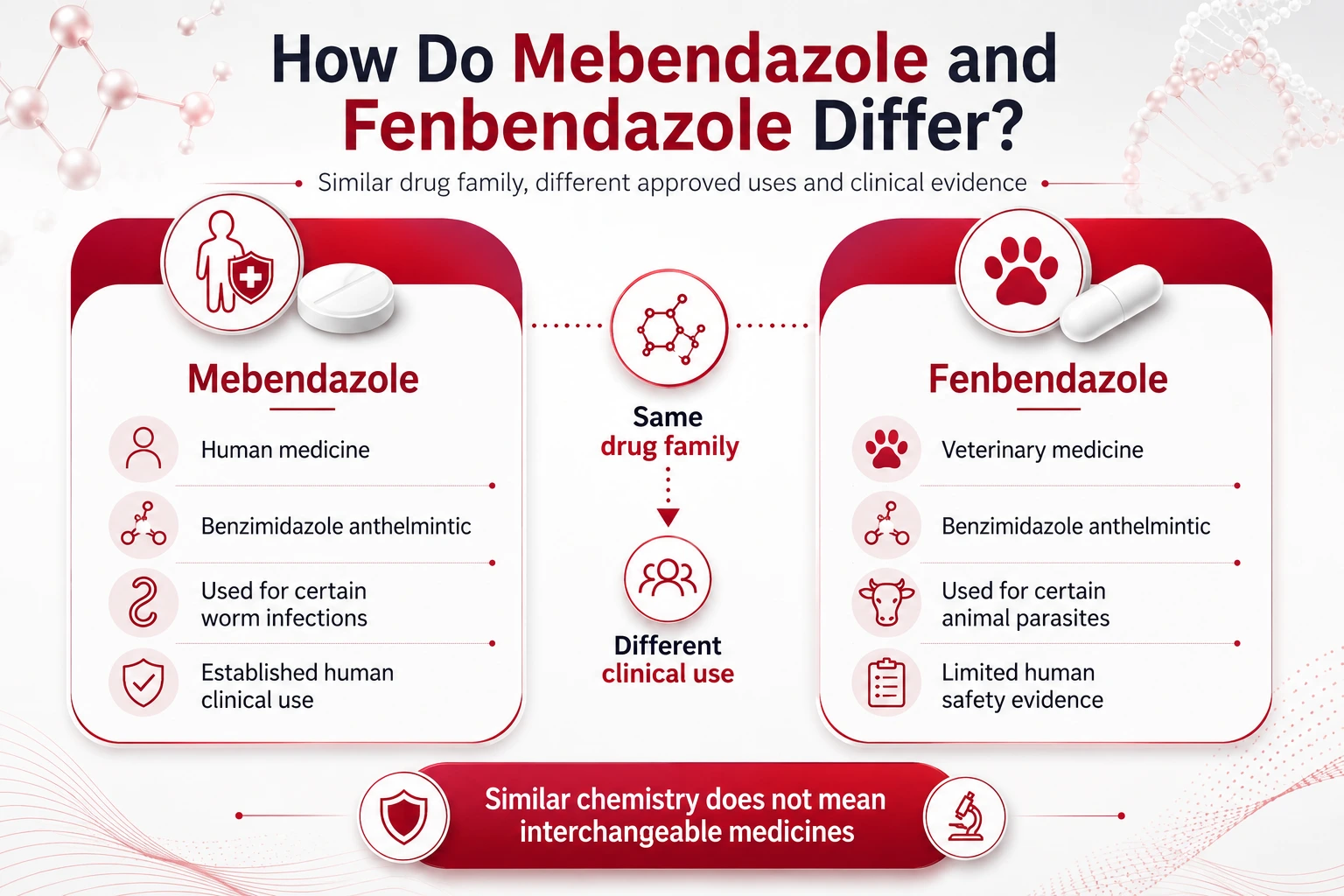
The key point in mebendazole vs fenbendazole is that belonging to the same drug family does not make two medicines interchangeable.
How Do Mebendazole and Fenbendazole Work?
Both medications are members of the benzimidazole class of drugs and inhibit the microtubules of the parasites sensitive to these medications. Microtubules play an important role in different physiological processes.
By inhibiting the physiological processes in microtubules, the benzimidazoles may affect some physiological processes in parasitic worms and cause the elimination of the latter.
The similarity between these two medicines is one of the reasons for the comparison of mebendazole vs fenbendazole, although this alone does not say which of these medications is appropriate for a particular individual.
The time needed for symptoms to improve can vary depending on the type of infection and individual response. For more information, see how long mebendazole takes to work.
💡 Tip
Mebendazole Uses in Humans
Mebendazole is used to treat certain intestinal worm infections in people. The appropriate treatment depends on the parasite causing the infection.
Pinworm infections
Mebendazole may be used to treat pinworm infections. Reinfection can occur easily, so hygiene measures may be important alongside treatment.
Whipworm infections
Mebendazole can be used for certain whipworm infections. Treatment duration depends on the infection and the recommended regimen.
Roundworm infections
Mebendazole is also used for certain roundworm infections. The appropriate treatment depends on the parasite and the patient’s individual circumstances.
Hookworm infections
Certain hookworm infections may also be treated with mebendazole. Medical advice may be necessary when symptoms are persistent or the diagnosis has not been confirmed.
When considering mebendazole vs fenbendazole, these established human indications are an important distinction because fenbendazole does not have the same approved role in human medicine.
Related Medicines for Worm Infections
Fenbendazole Uses in Veterinary Medicine
Fenbendazole is used in veterinary medicine to manage certain parasitic infections in animals. Depending on the species and veterinary product, it may be used against parasites such as:
- Roundworms
- Hookworms
- Whipworms
- Other susceptible gastrointestinal parasites
The appropriate dose depends on the animal’s species, body weight, parasite, and product instructions.
Veterinary formulations should not be assumed to be suitable for people. This is one of the clearest practical differences when looking at mebendazole vs fenbendazole.
⚠️ Warning
Why Are Mebendazole and Fenbendazole Often Confused?
Mostly, the confusion has been attributed to the similarity in names, chemical structure, and belonging to the benzimidazole class of drugs.
They are both capable of affecting the microtubules of the parasites, hence making them look like substitutes when analyzed chemically. However, in terms of clinical application, the case is a bit different.
The increase in conversations about fenbendazole on the Internet has also fueled interest in mebendazole vs fenbendazole, especially with regard to human usage.
It is necessary to separate the laboratory tests, experiments done on animals, and anecdotes from those of humans. These forms of evidence are not equal scientifically.
Mebendazole vs Fenbendazole: Safety Comparison
Safety is one of the most important areas to consider when comparing these medicines.
Mebendazole has established use in human medicine, so healthcare professionals have considerably more information about its appropriate use, adverse effects, precautions, and interactions.
Fenbendazole is primarily a veterinary medicine. Human safety and dosing information are therefore much more limited.
🔔 Reminder
Mebendazole safety
Mebendazole is generally tolerated when used according to appropriate directions, although side effects can occur.
People should inform their healthcare professional about other medicines they take and any significant medical conditions. Additional caution may be needed in people with certain liver problems or when longer treatment courses are being considered.
The time a medicine remains in the body can vary depending on several factors. You can also read about how long mebendazole stays in your system for more information.
Fenbendazole safety
Fenbendazole should not be considered a human alternative to mebendazole simply because both medicines belong to the same drug class.
Human safety information is limited, and veterinary products are formulated for animal use. A veterinary product should not be used to self-treat a suspected human worm infection.
Drug Interactions
There are known drug interactions between mebendazole and some drugs. Some drugs might affect mebendazole levels, and some combinations might pose the risk of experiencing unwanted side effects.
The case is not the same for fenbendazole, as there is a lack of clinical information about the interaction of fenbendazole with drugs.
It is a significant factor when comparing mebendazole vs fenbendazole, especially for individuals who are under treatment with prescribed medications or have pre-existing medical conditions.
Individuals on medication should consult their healthcare provider before starting an anthelmintic treatment.
Common Side Effects of Mebendazole
Mebendazole can cause mild side effects in some people. For more information about potential reactions and warning signs, see mebendazole side effects. Possible reactions include:
- Abdominal discomfort or cramping
- Diarrhea
- Nausea
- Vomiting
- Headache
- Dizziness
- Flatulence
- Changes in appetite
The severity and duration of side effects can vary between individuals.
Serious Side Effects
Serious reactions are uncommon but may include:
- Severe allergic reactions
- Significant skin reactions
- Liver problems
- Changes in blood cell counts, particularly with prolonged or high-dose treatment
Seek medical attention if severe symptoms such as difficulty breathing, extensive skin reactions, yellowing of the skin or eyes, or unusual weakness occur.
What Is Known About Fenbendazole Safety in Humans?
It is not possible to say that fenbendazole is supported by the same extent of human clinical safety data as an approved human drug like mebendazole.
There have been single case reports associated with human beings taking fenbendazole, with some of them describing liver test abnormalities and liver injury. Single case reports cannot help in determining the safety and efficacy of a drug.
Animal studies are helpful in providing relevant information, although the results cannot be extrapolated from animals to humans.
In the comparison of mebendazole vs fenbendazole, the quantity and quality of human data should be taken into account. Because human safety information is limited, understanding the reported fenbendazole side effects in humans can provide additional context.
What Happens If a Person Takes Fenbendazole?
Taking a veterinary medicine does not provide a reliable human dose. Fenbendazole does not have an established, approved dosing regimen for treating worm infections in people.
A person who has taken fenbendazole should not assume that the absence of immediate symptoms means the medicine is safe for continued use.
Medical advice should be sought if someone feels unwell after taking a veterinary product or is concerned about the amount taken. The product packaging and amount consumed can help a healthcare professional assess the situation.
Seek prompt medical attention if symptoms such as yellowing of the skin or eyes, dark urine, severe fatigue, persistent vomiting, unusual bruising, or signs of an allergic reaction occur.
Can Fenbendazole Replace Mebendazole?
Fenbendazole should not be used as a substitute for mebendazole in humans.
Although mebendazole vs fenbendazole involves two medicines from the same broad drug family, their approved uses and available human evidence are different.
If a person has symptoms suggesting a worm infection, the appropriate medicine depends on the parasite involved and the individual’s circumstances. A doctor or pharmacist can recommend an appropriate treatment based on the suspected or confirmed infection.
⚠️ Important Warning
Conclusion
The key difference in mebendazole vs fenbendazole is their intended use and available human evidence. Mebendazole is an established medicine for certain human worm infections, while fenbendazole is primarily used in veterinary medicine. Despite their similar drug class, they should not be considered interchangeable. If you suspect a parasitic infection, speak with a healthcare professional about the appropriate treatment.
FAQ
1. Are mebendazole and fenbendazole the same medicine?
No. Mebendazole and fenbendazole are different medicines, although both belong to the benzimidazole group of anthelmintics. Their approved uses, formulations, dosing information, and available human safety evidence are not the same.
2. What is the main difference between mebendazole and fenbendazole?
The biggest difference is their intended use. Mebendazole is an established human medicine used for certain parasitic worm infections, while fenbendazole is primarily used as a veterinary medicine.
3. Can humans take fenbendazole?
Fenbendazole is not an established approved human treatment. Its veterinary formulation and dosing should not be assumed to be suitable for people. Anyone considering fenbendazole for a health condition should discuss appropriate treatment options with a healthcare professional.
4. Can fenbendazole replace mebendazole?
No. Even though the medicines have related structures and mechanisms, they should not be treated as interchangeable. The appropriate medicine depends on the parasite being treated and whether the medicine is approved for that use.
5. Is fenbendazole stronger than mebendazole?
There is no simple basis for describing one as “stronger.” The medicines are used in different settings, and their effectiveness depends on the parasite, species being treated, formulation, and approved treatment regimen.
6. Does mebendazole work for the same worms as fenbendazole?
There can be overlap in the types of parasites affected by benzimidazole medicines, but their approved uses differ. A medicine that works against a particular parasite in animals is not automatically an appropriate treatment for the same type of infection in humans.
7. Why is fenbendazole popular in discussions about cancer?
Fenbendazole became widely discussed online because of laboratory research and anecdotal claims involving cancer. However, laboratory findings and individual reports do not establish it as a safe or effective cancer treatment for humans. Fenbendazole should not replace evidence-based cancer treatment.
8. Does mebendazole have side effects?
Yes. Mebendazole can cause side effects such as abdominal discomfort, diarrhea, nausea, vomiting, headache, or dizziness. Serious reactions are uncommon but can occur. Follow the product directions and seek medical advice if severe or unusual symptoms develop.

Years of Experience: 10+ years Education: B.Sc. in Biomedical Science (Monash University, Melbourne, Australia) PG Diploma in Health & Medical Communication (University of Sydney, Australia) Experience: Erica Wilson is an…