

How Does Retrograde Ejaculation Work?
By Erica Wilson, Aug-24-2024

 Dr. Arjun Srivastav Medical Reviewer (Pharm D)
Retrograde ejaculation is a condition where semen moves into the bladder instead of leaving the body through the penis during climax. The bladder neck, which normally closes to keep semen flowing outward, does not function as expected.
This directs semen backward along the path of least resistance. A person may still notice the physical sensation of orgasm even when little or no visible semen appears.
Several factors can contribute to this change. These include certain medicines, nerve related conditions and prostate surgery. This article explains the physical process, possible symptoms, health implications and how doctors assess the condition.
💡 Quick Answer
Retrograde ejaculation occurs when the bladder neck does not close properly during orgasm, causing semen to flow into the bladder instead of leaving through the penis. It is usually not physically harmful, but it can affect natural fertility. A doctor can confirm the cause and discuss suitable options.
What Is Retrograde Ejaculation?
Retrograde ejaculation describes a change in the direction semen travels during climax. Instead of moving forward and out through the penis, semen enters the bladder.
To understand this, it helps to separate two terms that people often use interchangeably. Semen is the fluid that carries sperm. Sperm are the reproductive cells produced in the testicles. Although retrograde ejaculation affects the direction of semen flow, it is different from erectile dysfunction, which involves difficulty achieving or maintaining an erection.
During a normal climax, semen, which contains sperm, leaves the body through the urethra. In retrograde ejaculation, that fluid takes a backward path.
The condition may be partial or complete:
- In a partial case, some semen still exits the penis while a portion moves into the bladder.
- In a complete case, little or no semen appears externally.
The extent depends on how well the bladder neck closes during the muscular contractions of climax.
Is Retrograde Ejaculation the Same as a Dry Orgasm?
A dry orgasm simply describes a climax where little or no visible semen is released. Retrograde ejaculation is one possible reason for this, but it is not the only explanation.
Another condition, called anejaculation, involves no ejaculation at all. With anejaculation, semen is not expelled from the body, and the release process itself may not occur.
Understanding what is retrograde ejaculation helps distinguish it from these related but separate experiences.
How Does Retrograde Ejaculation Work Inside the Body?
The mechanics of ejaculation involve a coordinated sequence of muscle contractions and nerve signals. When everything works as expected, semen follows a forward path. When the bladder neck does not close, that path changes.
What Happens During Normal Ejaculation?
The process begins when sperm travel from the testicles through the reproductive tract. Along the way, sperm combine with fluids from several glands, including the seminal vesicles and the prostate. This mixture forms semen.
During climax, semen enters the urethra. At the same moment, the bladder neck closes. This closure helps prevent semen from moving upward into the bladder.
Muscular contractions then propel semen through the urethra and out through the tip of the penis. The entire sequence relies on nerve signals that coordinate the timing of each step.
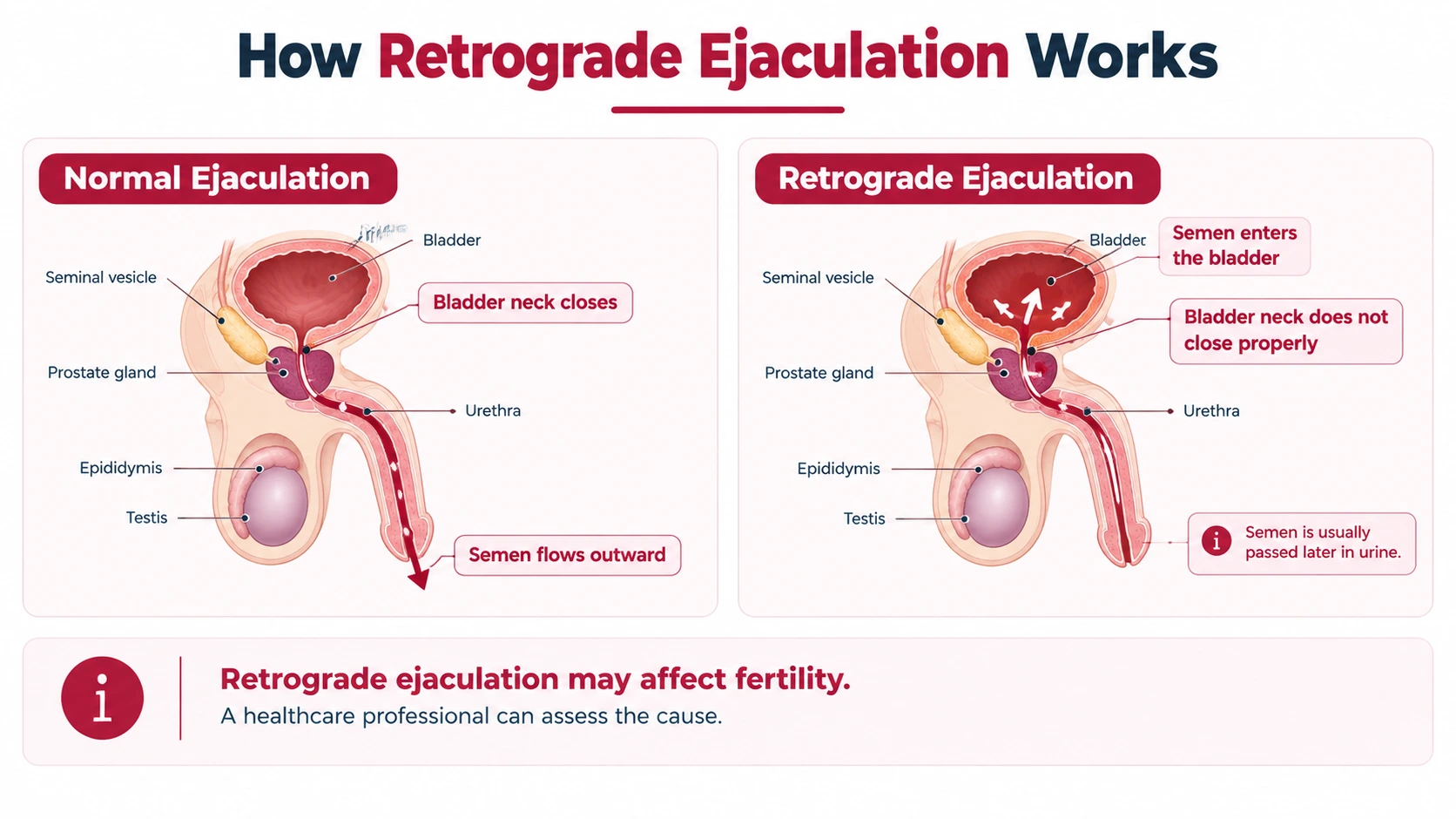
What Happens During Retrograde Ejaculation?
The sequence begins the same way, but the bladder neck does not close effectively. Because the path into the bladder remains open, some or all of the semen moves upward rather than outward.
- Little or no semen may emerge from the penis.
- Once inside the bladder, semen mixes with urine.
- The body generally passes this mixture during the next trip to the toilet.
The change in direction is the central feature that separates this condition from a normal climax.
Can You Still Experience an Orgasm?
Yes. Orgasm and ejaculation are related but distinct processes. Orgasm involves the physical sensation and muscular contractions of climax. Ejaculation is the release of semen.
A person may still experience the pleasurable sensation of orgasm even when little or no semen is released externally. Sensation can vary between individuals, and some people notice little difference in how climax feels.
The brain still registers the signals associated with pleasure even when the visible result changes.
What Causes Retrograde Ejaculation?
Several conditions and treatments can interfere with the normal closure of the bladder neck or the nerve signals that control it. When people ask what is the cause of retrograde ejaculation, the answer usually relates to one of a few categories. The same factors often explain what can cause retrograde ejaculation in different age groups.
Diabetes and Nerve Damage
Diabetes can affect the autonomic nerves that control many involuntary body functions. Over time, elevated blood sugar levels may damage these nerves.
The nerves that signal the bladder neck to close during climax can be among those affected. This is why retrograde ejaculation may appear in people with long standing diabetes. The nerve pathways that coordinate ejaculation rely on healthy autonomic function, and diabetes can gradually reduce that function.
Medicines That Affect Ejaculation
Certain medicines can interfere with ejaculation. Alpha blockers, which are often prescribed for urinary symptoms related to an enlarged prostate, are a common example.
These medicines relax muscles around the bladder and prostate. That relaxation can also affect the bladder neck. Other medicines may have similar effects.
The impact varies from one medicine to another. Anyone who notices changes while taking prescribed medicine should speak with their doctor rather than stopping treatment on their own. A clinician can weigh the benefits and the side effects together.
Prostate or Bladder Surgery
Procedures that involve the prostate or the bladder neck can alter the normal pathway of semen. Surgery may change the structures that direct semen forward.
This can lead to semen taking the backward path into the bladder. The extent of the change often relates to how much tissue was involved and how the procedure affected the surrounding anatomy.
Neurological Conditions
Conditions that affect the spinal cord or the nerves can also play a role. Spinal cord injury, multiple sclerosis and other neurological conditions may disrupt the nerve signals that coordinate bladder neck closure during climax.
When the communication between nerves and muscles breaks down, the timing of closure can fail, and semen may move backward.
Ejaculation concerns can have different causes and symptoms. For example, premature ejaculation is characterised by ejaculating sooner than desired, rather than semen flowing backward into the bladder.
What Are the Symptoms of Retrograde Ejaculation?
The most noticeable sign is little or no visible semen during orgasm. Some people observe cloudy urine after climax, which may indicate that semen has mixed with urine.
Difficulty conceiving can also be a sign when semen is not deposited in the usual way.
Other points to keep in mind:
- Orgasm may still feel normal.
- Some people have few noticeable symptoms beyond a change in semen output.
- Cloudy urine alone does not confirm retrograde ejaculation.
Other factors can cause urine to appear cloudy, so a broader assessment may be needed. The condition can go unnoticed for some time, especially when fertility is not an immediate concern.
Is Retrograde Ejaculation Harmful?
For many people, retrograde ejaculation itself is generally not physically harmful. The semen that enters the bladder simply passes out with urine. The condition does not typically cause pain or physical danger on its own.
However, it can affect natural conception. When semen does not leave the body in the usual way, sperm may not reach an egg during intercourse. This can make it harder to conceive naturally.
The underlying cause may still need attention. If the change relates to diabetes, a neurological condition or a medicine, that broader health picture matters.
Anyone who notices persistent or newly developed changes in ejaculation should seek medical assessment. The question is retrograde ejaculation harmful often depends on what lies behind it rather than the condition alone.
Why Does Retrograde Ejaculation Happen After TURP?
Transurethral resection of the prostate, known as TURP, is a procedure performed for certain prostate related urinary problems. Many people search for information on retrograde ejaculation after TURP because the two are closely linked.
How Can TURP Affect Ejaculation?
TURP involves removing prostate tissue to improve urine flow. The prostate sits near the bladder neck. Changes to the tissue around this area can affect how the bladder neck functions during climax.
When the bladder neck does not close as it did before, semen may move backward into the bladder. Orgasm may remain possible even when the visible semen output changes after surgery.
The procedure addresses urinary symptoms, and the effect on ejaculation is a recognised aspect of the recovery picture.
Is Retrograde Ejaculation Permanent After TURP?
For many people, ejaculation changes may persist after surgery. The outcome depends on the specific procedure and the anatomical changes involved.
- Some people find the change continues long term.
- It is worth discussing fertility goals and any postoperative changes with the treating urologist.
- The condition may not reverse with time or medicine, so realistic expectations matter.
Each case varies, and professional guidance can clarify what to expect.
How Is Retrograde Ejaculation Diagnosed?
Doctors use a combination of medical history, examination and targeted tests to identify the condition.
Medical History and Examination
A clinician will ask about symptoms, current medicines, diabetes, neurological conditions and any previous prostate or bladder surgery. A physical examination may follow to check for related factors.
The history helps narrow down whether a medicine, a surgical procedure or a nerve related condition is involved.
Post Ejaculation Urine Test
A doctor may request a urine sample collected after orgasm. The sample is checked for the presence of sperm.
Finding sperm in urine after climax supports the possibility of retrograde ejaculation. The result is interpreted alongside symptoms and medical history rather than in isolation.
Other Investigations
Additional tests may be considered when another cause of reduced or absent semen output is suspected. Self observation alone cannot reliably distinguish retrograde ejaculation from other causes of a dry orgasm, so professional assessment is important.
Blood tests, imaging or further nerve assessments may come into play depending on the situation.
What Is the Treatment for Retrograde Ejaculation?
Treatment depends on the cause, the symptoms and whether fertility is a concern. When people look into retrograde ejaculation treatment, they often want to know whether the condition can be addressed and what options exist.
Reviewing Medicines With a Doctor
If a medicine may be contributing, a clinician can review the current treatment. A doctor may adjust the dose or consider an alternative.
Patients should not change prescribed medicines independently. The goal is to balance the original reason for the medicine with the side effect it may be causing.
Medicines That May Help Selected Patients
Certain medicines may help some people in specific circumstances. Effectiveness varies from person to person, and potential adverse effects need to be considered.
A doctor can advise whether this approach is suitable based on the individual health picture.
Fertility Treatment Options
When fertility is the main concern, specialist assessment may help. In selected cases, sperm can be recovered from urine collected after orgasm. Assisted reproductive options may also be available where appropriate.
A fertility specialist can guide the process based on individual circumstances and goals.
Can Retrograde Ejaculation Be Reversed?
The outlook depends on the underlying cause:
- Cases related to medicines may improve after a supervised change in treatment.
- Changes that follow surgery may persist because the anatomical structures have altered.
- Nerve related cases may vary depending on whether the underlying condition is stable or progressing.
When Should You See a Doctor?
Medical assessment is recommended for:
- Persistent dry orgasms or a new change in semen volume.
- Difficulty conceiving.
- Changes following prostate or bladder surgery.
- Associated urinary symptoms or significant pain.
A GP or urologist can investigate possible causes and determine whether treatment is necessary.
Conclusion
Retrograde ejaculation occurs when the bladder neck fails to close effectively during climax, allowing semen to enter the bladder. The condition is generally not physically harmful in itself, but it can affect fertility and may point to a medication related, neurological or surgical cause.
Anyone experiencing persistent changes, fertility concerns or symptoms following prostate surgery should seek medical assessment to understand what lies behind the change.
Dapoxetine for Premature Ejaculation
Understand how dapoxetine is used for premature ejaculation, how it works, and important safety considerations.
FAQ
Can Viagra Help With Retrograde Ejaculation?
Viagra, which contains sildenafil, treats erectile dysfunction by improving blood flow to the penis. It is not an established treatment for retrograde ejaculation itself.
Does Retrograde Ejaculation Affect Fertility?
It can interfere with natural conception because semen may not be deposited in the usual way. Sperm production may continue, and fertility options may be available. A fertility specialist can offer guidance based on individual circumstances.
Does Retrograde Ejaculation Go Away on Its Own?
The outcome depends on the cause. Cases linked to medicines may improve after a supervised change. Those related to nerve dysfunction or changes after surgery may persist. Professional assessment can clarify what to expect.
Can You Still Have an Orgasm With Retrograde Ejaculation?
Yes. Orgasm may still occur even when little or no semen exits the penis. The sensation of climax and the release of semen are separate processes.
Why Is Urine Cloudy After Orgasm?
Semen in urine is one possible cause of cloudiness after climax. Cloudy urine can also have other explanations, particularly if it persists or occurs alongside other symptoms. A doctor can help identify the reason.

Years of Experience: 10+ years Education: B.Sc. in Biomedical Science (Monash University, Melbourne, Australia) PG Diploma in Health & Medical Communication (University of Sydney, Australia) Experience: Erica Wilson is an…