
How to Ejaculate Faster: 7 Tips That May Help
By Erica Wilson, Oct-21-2026

 Dr. Arjun Srivastav Medical Reviewer (Pharm D)
Some men find that reaching orgasm takes longer than they would like. If you have been wondering how to ejaculate faster, the experience varies widely from person to person.
The right approach depends on several factors including the type of stimulation involved, current stress levels, individual preferences and possible underlying medical influences. There is no single method that works for everyone.
For most men, small adjustments to routine and mindset can make a noticeable difference over time. Learning how to ejaculate faster is often a matter of understanding what affects your personal response. When difficulty persists or begins to cause distress, speaking with a healthcare professional is a sensible next step.
This article explores practical suggestions for how to ejaculate faster and explains what may contribute to longer lasting ejaculation so you can better understand your own body.
What Can Help You Ejaculate Faster?
Several approaches may help men who want to reach orgasm more quickly. If you are looking into how to ejaculate faster, the most effective strategies focus on finding the right type of stimulation, easing mental pressure and paying attention to any patterns that seem to interfere with climax.
No technique guarantees a faster outcome because sexual response is highly individual and influenced by both physical and emotional factors. Experimenting gradually and staying patient often produces better results than forcing a particular approach.
Quick Answer: How to Ejaculate Faster
Understanding your stimulation preferences, allowing enough time for arousal, reducing stress and communicating with your partner may help you reach orgasm sooner.
- Experiment with comfortable types of stimulation.
- Reduce distractions and performance pressure.
- Review persistent difficulties with a healthcare professional.
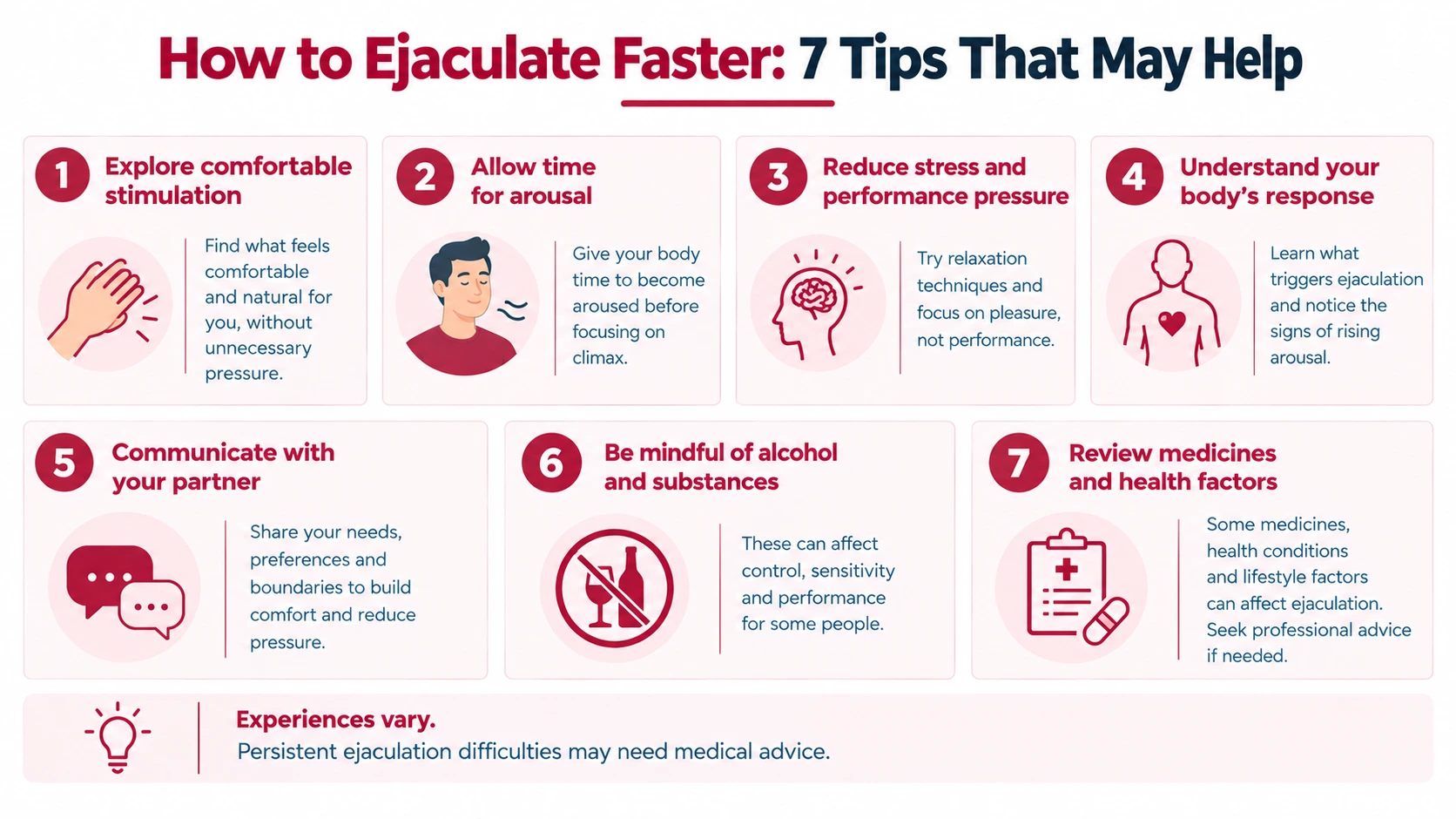
7 Tips That May Help You Reach Orgasm Faster
1. Understand What Type of Stimulation Works for You
Every person responds differently to touch. The pressure, rhythm and location of stimulation all play a role in how quickly arousal builds toward climax.
Some men find that firmer contact helps, while others prefer a lighter and more varied approach. Spending time discovering what feels most effective for your body is one of the simplest ways to figure out how to ejaculate faster without forcing it.
For example, adjusting your grip or changing the speed during solo play might reveal a technique that brings results more efficiently. The goal is comfort and effectiveness rather than speed alone.
If any approach causes discomfort or irritation, stop and try something different. Pain or soreness will not support arousal and may actually slow the process down further.
2. Allow Enough Time to Become Aroused
Rushing toward orgasm often has the opposite effect. When the body feels pressured to perform quickly, arousal can stall and reaching climax becomes harder rather than easier.
Allowing adequate time for excitement to build naturally gives your nervous system the opportunity to respond fully. A comfortable pace supports the physical changes that lead to ejaculation.
Blood flow, muscle tension and nerve sensitivity all need time to align. Trying to shortcut this process through urgency tends to introduce anxiety, which works against the relaxation needed for orgasm.
Giving yourself permission to enjoy the experience without a deadline often produces a faster and more satisfying result. Many men researching how to ejaculate faster overlook the fact that patience itself can speed things up.
3. Reduce Stress and Performance Anxiety
Mental distractions are among the most common barriers to reaching orgasm efficiently. Worrying about how long things are taking, feeling self conscious about your body or thinking about outside responsibilities can pull attention away from the sensations that drive climax. Stress and anxiety can also affect sexual wellbeing, as discussed in our article on how mental health issues impact sexual health.
The brain plays a central role in sexual response, and a preoccupied mind tends to slow everything down. Finding ways to relax before and during intimacy can help. Stress and anxiety can affect more than mood, as mental health issues may also influence sexual wellbeing and response.
Some men benefit from brief deep breathing, dimming the lights or choosing a setting where interruptions are unlikely. The key is to focus on physical sensations rather than monitoring the clock.
When attention stays on what the body is feeling, arousal tends to progress more smoothly. Reducing anxiety is a central part of any strategy for how to ejaculate faster.
4. Explore Your Response During Masturbation
Solo exploration offers a low pressure way to learn about your own arousal patterns. Paying attention to the specific touches, speeds and pressures that bring you closest to orgasm can build a clearer picture of what your body needs.
This self knowledge often translates into more efficient stimulation during partnered experiences. One useful observation is noticing any differences between how you stimulate yourself and how a partner stimulates you. Masturbation habits can influence individual sexual experiences, although ejaculating sooner than intended is different from having difficulty reaching orgasm.
Sometimes the grip, speed or technique used during solo play differs significantly from partnered contact. This gap can explain why climax takes longer with a partner. Understanding these differences can help you adjust your approach in partnered situations.
5. Communicate Clearly With Your Partner
Open conversation with a partner can ease much of the tension around delayed orgasm. Talking about ejaculation feels good, what might work better and how you both want to approach intimacy removes guesswork and reduces frustration on both sides.
Many men feel awkward starting this conversation, but partners generally appreciate honesty and the chance to help. Practical adjustments might include:
- changing the type of stimulation
- trying a different position
- spending more time on arousal before focusing on climax
It also helps to release any expectation of orgasming at the same time. Synchronized climax is not a requirement for satisfying intimacy, and removing that pressure often allows each person to relax and respond more naturally. For couples exploring how to ejaculate faster together, honest communication is often the most effective starting point. When erection difficulties also affect intimacy, open communication can help couples address their concerns together.
6. Limit Alcohol and Be Mindful of Other Substances
Alcohol can dull sensitivity and slow sexual response, which may contribute to taking longer to reach orgasm. While a small amount might reduce inhibition, larger quantities tend to interfere with the physical and neurological processes involved in climax.
Being aware of this effect can help you make choices that support rather than hinder your goals. If you want to understand how to ejaculate faster, looking at your alcohol intake is a practical place to start.
Certain recreational substances may also affect ejaculation timing. The impact varies depending on the substance, the amount and the individual.
If you notice a pattern where substances seem connected to longer lasting ejaculation, reducing or avoiding them may be worth considering. Observing your own response over time is the most reliable way to identify whether this factor plays a role for you.
7. Review Medicines and Underlying Health Factors
Some prescription medicines and health conditions can contribute to delayed ejaculation. Certain antidepressants, some strong pain relief medicines and particular treatments for high blood pressure and heart disease are among the medications that may have this effect.
If you suspect a medicine might be involved, the recommended step is a review with your doctor or pharmacist rather than stopping treatment on your own. Abruptly discontinuing prescribed medicines can cause additional problems.
A healthcare professional can assess whether a different option or adjusted dosage might suit you better while still managing the condition being treated. For anyone researching how to ejaculate faster, a medication review is an important step that should not be skipped.
Why Does It Take So Long to Ejaculate?
Understanding the possible reasons behind delayed ejaculation can help you identify what might be happening in your own situation. The causes are varied and often overlap, meaning more than one factor may be at play at the same time.
Psychological Factors
Mental and emotional influences frequently contribute to how long ejaculation takes. Stress from daily life, anxiety about sexual performance, depression and relationship concerns can all slow the arousal process.
Psychological factors related to delayed ejaculation include anxiety, depression, relationship issues, performance anxiety and stress.
When the mind is preoccupied or tense, the body often responds more slowly to sexual stimulation. Recognising these patterns is part of understanding how to ejaculate faster when psychological factors are involved.
Medication and Substance Effects
Certain medicines and substances can interfere with ejaculation. Antidepressants, some strong pain relief medicines, certain treatments for high blood pressure and heart disease, as well as alcohol and some recreational drugs, may contribute to delayed ejaculation.
If a medication seems connected to changes in your sexual response, discussing alternatives with your doctor is the appropriate path rather than adjusting dosage yourself.
Physical and Medical Causes
Physical factors may also play a role. Several possible physical causes include:
- surgery or trauma to the pelvis or genitals
- reproductive system problems
- nerve or spinal cord issues
- hormonal conditions
- chronic illnesses such as diabetes or multiple sclerosis
- ageing
Because the causes vary considerably and cannot be diagnosed from symptoms alone, a proper medical assessment is the only reliable way to understand what might be contributing. This is why self help guides on how to ejaculate faster can only go so far without professional input.
Is Taking Longer to Ejaculate a Problem?
There is no universal time limit for reaching orgasm. What counts as taking too long is largely a matter of personal experience and satisfaction.
Occasional delays do not automatically indicate any kind of disorder, and variation in timing is normal across different situations, moods and levels of energy. Persistent difficulty, personal distress or a noticeable change from your usual pattern is what tends to warrant attention.
If reaching orgasm has become consistently difficult or has changed significantly compared to before, exploring the reasons with a healthcare professional makes sense. Tips on how to ejaculate faster may not be enough if an underlying issue is affecting your response.
It is also worth distinguishing delayed ejaculation from premature ejaculation, as these are opposite concerns. Delayed ejaculation involves difficulty reaching climax or taking longer than desired, while premature ejaculation involves climaxing sooner than intended. Confusing the two can lead to unhelpful approaches, so understanding which situation applies to you is important.
Delayed vs Premature Ejaculation
These terms describe different ejaculation concerns.
Delayed Ejaculation
Ejaculation takes longer than desired or may not happen despite adequate stimulation.
Possible concern: Difficulty reaching orgasm that persists or causes distress.
Premature Ejaculation
Ejaculation occurs sooner than desired, often with limited control.
Possible concern: Difficulty delaying ejaculation that causes distress.
A healthcare professional can help assess ongoing symptoms. These descriptions are general and are not a diagnosis.
When Should You Seek Medical Advice?
Speaking with a GP is advisable in several situations. You may want to reach out if you experience:
- a persistent inability to ejaculate
- a sudden change in your usual response
- concerns about medicine side effects
- additional symptoms alongside the difficulty
- trouble conceiving due to the issue
An assessment typically begins with a conversation about your medical history and sexual health. A physical examination may follow, and in some cases tests such as blood work or urine analysis can provide useful information.
Diagnosis may involve reviewing symptoms and sexual history, a physical examination and tests where appropriate. The process is straightforward and aimed at identifying any contributing factors so that suitable guidance can be offered. For anyone who has tried methods for how to ejaculate faster without success, a medical evaluation can help uncover the reason.
Final Thoughts
The most useful approaches centre on finding effective stimulation, easing mental pressure, communicating openly and staying attentive to any patterns that affect your response.
There is no ideal time to ejaculate, and variation is entirely normal. If you have been exploring how to ejaculate faster and difficulty persists or causes distress, seeking medical advice is a practical and worthwhile step.
Medical Disclaimer
Dapoxetine for Premature Ejaculation
Understand how dapoxetine works, how it may help delay ejaculation, and what to know about its use and potential side effects.
FAQ
How to make yourself ejaculate faster?
Focus on effective stimulation, relaxation and awareness of your personal preferences. Experimenting with different pressures, rhythms and techniques during solo play can help you discover what works best. If you are searching for how to ejaculate faster on your own, these adjustments are a good place to begin.
How to make a man ejaculate faster?
Communication is key. Discussing preferences openly, exploring mutually enjoyable stimulation and avoiding pressure to perform can create a more relaxed environment. Partners looking into how to ejaculate faster may find that shared exploration works better than pressure.
Can you train yourself to ejaculate faster?
Understanding your arousal patterns and adjusting habits may help some people reach orgasm more quickly. Noticing which techniques and mental states support efficient climax and incorporating those into your routine can make a difference, though results vary between individuals.
Can masturbation affect ejaculation during sex?
Differences in stimulation habits between solo and partnered experiences may influence timing for some people. If the grip, speed or technique used during masturbation differs significantly from partnered contact, the body may respond more slowly. Masturbation itself does not automatically cause delayed ejaculation.
Is delayed ejaculation treatable?
Treatment depends on the underlying cause and may include a medication review with a doctor, counselling for psychological factors or other clinician recommended approaches. Speaking with a healthcare professional is the best way to understand what options might suit your situation. Professional guidance offers more reliable direction than any general guide on how to ejaculate faster.

Years of Experience: 10+ years Education: B.Sc. in Biomedical Science (Monash University, Melbourne, Australia) PG Diploma in Health & Medical Communication (University of Sydney, Australia) Experience: Erica Wilson is an…