

Premature Ejaculation Symptoms: 7 Signs to Know
By Erica Wilson, Oct-15-2026


 Dr. Arjun Srivastav Medical Reviewer (Pharm D)
 Ejaculating sooner than you or your partner would like can be a frustrating experience. Many men encounter this occasionally and it does not automatically point to a sexual health concern. When trying to understand premature ejaculation symptoms, three things matter most. Timing refers to how soon ejaculation happens. Control relates to the ability to delay it. Personal distress considers how the experience affects you emotionally and relationally. This article walks you through seven possible signs, when the experience may warrant a conversation with a doctor, and which health factors could be relevant.
💡 Quick Answer: Premature Ejaculation Symptoms
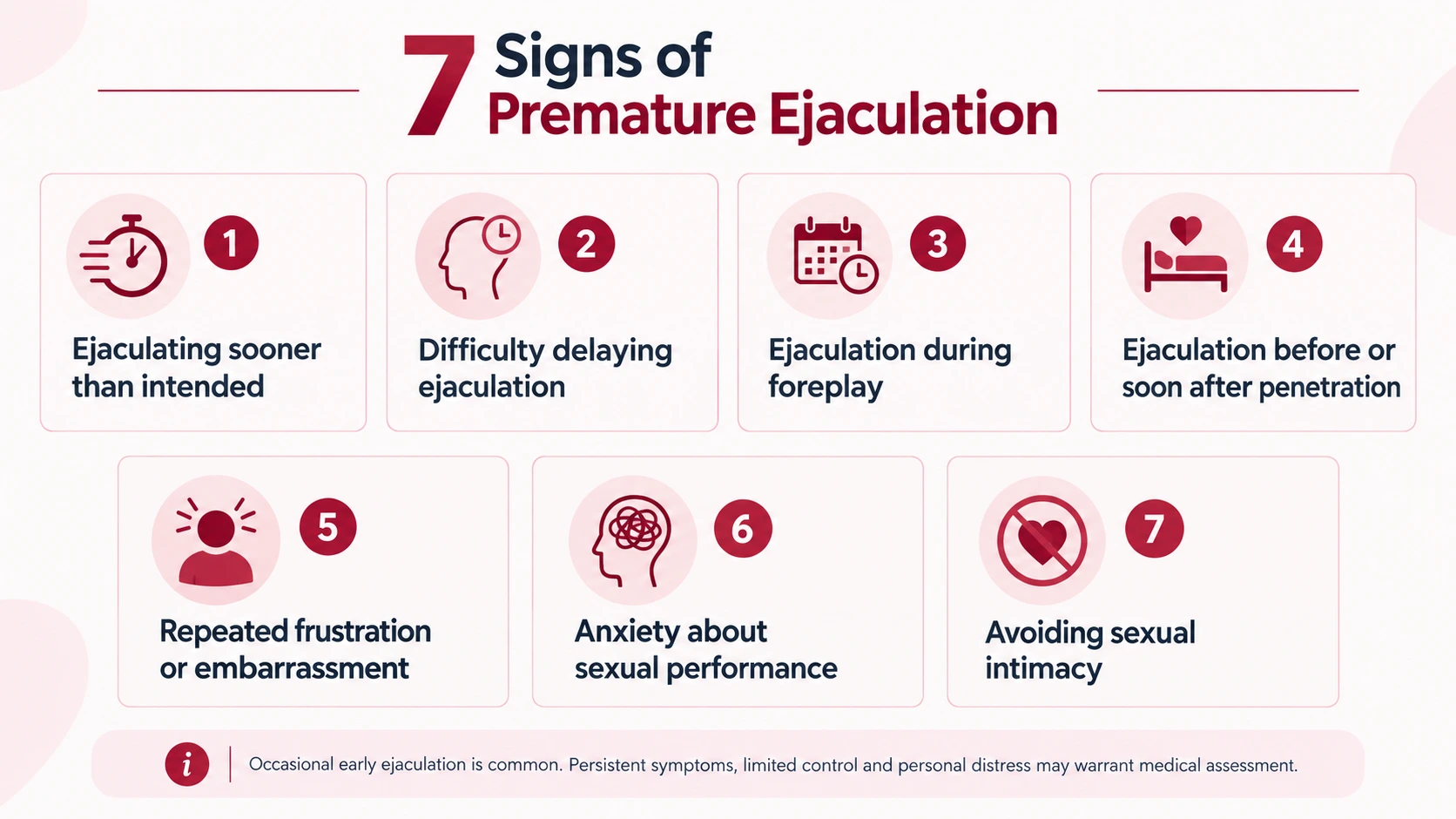
Premature ejaculation symptoms include ejaculating sooner than desired, difficulty delaying ejaculation, and repeated frustration or anxiety about sexual experiences. Some men may also avoid intimacy because of these concerns. Occasional early ejaculation is common, but persistent symptoms that cause distress may warrant assessment by a healthcare professional.
What Are the Symptoms of Premature Ejaculation in Men?
The main premature ejaculation symptoms include ejaculation earlier than desired, difficulty delaying ejaculation, ejaculation before or soon after penetration, and distress or avoidance of intimacy. Not every person experiences all of these signs. Symptoms vary from one individual to another.
Here is a quick overview of what to look out for:
- Ejaculation occurs sooner than desired on a repeated basis
- Little perceived control over when ejaculation happens
- Ejaculation during foreplay or before penetration
- Frustration, worry, or avoidance of sexual intimacy
If you recognize these patterns, reading the detailed signs below can help you understand your experience more clearly.
7 Premature Ejaculation Symptoms to Recognise
1. Ejaculating Sooner Than You Intend
An occasional early ejaculation can happen to anyone and does not necessarily indicate a problem. What sets premature ejaculation symptoms apart is the recurring nature of the experience. When ejaculation consistently happens sooner than you want it to across multiple encounters, it may be worth paying attention to.
There is no single ideal duration that applies to every sexual encounter. What matters is whether the timing differs from what you and your partner find satisfying and whether it happens often enough to be a concern.
2. Difficulty Delaying Ejaculation
Some men feel they cannot delay ejaculation even when they want to. This sense of limited control is one of the core premature ejaculation symptoms. You might try to slow down or pause but find that ejaculation still happens before you are ready.
Perceived control matters just as much as timing because it reflects your ability to influence the experience. When this difficulty persists across different situations, it can be a meaningful sign to explore further.
3. Ejaculation During Foreplay
Ejaculation can occur during sexual stimulation before penetration ever takes place. This is one of the premature ejaculation symptoms that some men experience but may not talk about openly. The context matters here. If it happens once in a while during an especially stimulating moment, it may not be a concern.
When it happens repeatedly and causes frustration or disappointment, the pattern becomes more significant. Recurrence and personal distress are what give this experience meaning beyond a single occurrence.
4. Ejaculation Before or Shortly After Penetration
Another common sign is ejaculation that happens before penetration or very soon after it begins. A single episode does not prove anything. Many factors can contribute to an occasional early ejaculation. What makes this one of the recognizable premature ejaculation symptoms is when it happens repeatedly.
If you notice this pattern occurring on a regular basis across different encounters, it may be something to discuss with a healthcare professional who can provide context specific to your situation.
5. Repeated Frustration or Embarrassment
Living with a pattern of early ejaculation can take an emotional toll. Repeated experiences may lead to dissatisfaction, frustration, or concern about future sexual encounters. Some men feel embarrassed or worry about how their partner perceives the situation.
These feelings are understandable and common among those dealing with premature ejaculation symptoms. The emotional impact is not just a side effect. It is part of what makes the experience significant and worth addressing.
6. Anxiety About Sexual Performance
Worrying about ejaculation can accompany the problem and sometimes reinforce it. You might find yourself thinking about whether it will happen again before the encounter even begins. This anticipatory worry can create a cycle where anxiety makes the experience more likely to repeat.
Not every person with premature ejaculation symptoms experiences anxiety. Some feel calm but still struggle with timing and control. When anxiety is present, it adds another layer that can be worth discussing with a professional.
7. Avoiding Sexual Intimacy
Anticipation of another difficult experience may lead some people to avoid intimacy altogether. You might find reasons to decline sexual encounters or distance yourself from situations that could lead to them. This avoidance is a possible consequence of dealing with premature ejaculation symptoms over time.
It is not a requirement for any diagnosis. Some men continue to be sexually active despite their frustration. Others pull back. Both responses are valid and worth understanding.
How Long Is Too Short for Ejaculation?
Many readers wonder whether a specific number of minutes determines whether they have premature ejaculation. The reality is more nuanced than a single threshold.
Occasional early ejaculation can be a normal variation that most men experience at some point. Persistent early ejaculation combined with poor control and personal distress may warrant a clinical assessment. A noticeable reduction from your previous ejaculation timing may indicate an acquired situation that deserves attention.
The International Society for Sexual Medicine describes lifelong premature ejaculation as ejaculation before or within about one minute of vaginal penetration on nearly every occasion, along with difficulty delaying ejaculation and negative personal consequences. Acquired premature ejaculation involves a significant and bothersome reduction from previous timing. The approximately three minute figure sometimes referenced in clinical discussions is not a universal cutoff that applies to everyone.
The key takeaway is that timing alone does not tell the whole story. Control, distress, and consistency all play a role in understanding whether the experience is something to explore further.
Occasional Early Ejaculation vs Premature Ejaculation
Understanding the difference between an occasional early ejaculation and premature ejaculation symptoms comes down to three factors.
Frequency asks whether the experience happens occasionally or repeatedly over time. A one time occurrence is different from a pattern that shows up across many encounters.
Control considers whether you can delay ejaculation when you want to. Having some ability to influence timing is different from feeling unable to slow down.
Impact looks at whether the experience causes persistent distress, frustration, or avoidance. If it bothers you or affects your relationship on an ongoing basis, it carries more weight.
A single early ejaculation, a new partner, or a period of stress does not automatically establish a disorder. These factors help you reflect on your experience in a practical way.
If you are also concerned about masturbation and early ejaculation, it is useful to distinguish occasional experiences from a recurring pattern of difficulty controlling ejaculation.
Premature Ejaculation: 3 Things to Consider
A brief reflection guide, not a diagnostic test.
Pattern
Does it happen occasionally or during most sexual encounters? A recurring pattern may need closer assessment.
Control
Can you delay ejaculation when you want to? Control matters alongside timing.
Distress
Is it causing ongoing worry, frustration, or avoidance of intimacy?
Next step: If the problem is persistent or distressing, discuss it with a healthcare professional. Occasional early ejaculation does not automatically indicate a disorder.
Lifelong vs Acquired Premature Ejaculation
Clinicians often distinguish between two types based on when premature ejaculation symptoms first appeared.
Lifelong premature ejaculation refers to symptoms present from the beginning of a person sexual experiences. The pattern has been there as long as the person has been sexually active.
Acquired premature ejaculation develops after a period of previously satisfactory ejaculation control. The person had normal control before and then noticed a change.
Clinicians also consider whether the experience occurs consistently or only in certain situations. This distinction helps guide the conversation when speaking with a healthcare professional.
What Causes Premature Ejaculation?
Several factors can contribute to premature ejaculation symptoms and the cause is not always clear. Questions about penile sensitivity and premature ejaculation may also arise when exploring factors that influence sexual experiences, although sensitivity alone does not establish the cause.
Psychological and situational factors
- Performance anxiety and stress can play a role for some men
- Relationship difficulties or changes in sexual circumstances may contribute
- Worry following previous early episodes can create a cycle of concern
Physical and sexual health factors
- Erectile dysfunction can occur alongside premature ejaculation in some cases
- Possible medical or biological contributors may be relevant depending on personal history
- Changes in sexual function that are new or unusual deserve medical assessment
These factors do not establish a cause in any individual. No single factor explains every case.
Can Low Testosterone Cause Premature Ejaculation?
Low testosterone is more commonly associated with symptoms such as reduced sexual desire and changes in sexual function. Its relationship with premature ejaculation is not straightforward.
Low testosterone symptoms premature ejaculation is a search that many people make, but early ejaculation alone does not establish low testosterone. Low libido and premature ejaculation are different concerns. Symptoms alone cannot confirm a testosterone deficiency. A clinician can review the full symptom history and determine whether testosterone testing is appropriate for your situation.
It would not be accurate to label low testosterone as a common or confirmed cause of premature ejaculation based on the available information.
When Should You See a Doctor About Premature Ejaculation?
Speaking with a GP can be helpful when early ejaculation happens repeatedly, causes distress, affects your relationships, or develops as a noticeable change from your previous experience.
A GP may ask about when the symptoms began, how often they occur, and how much control you feel you have. They may also ask about erection changes, other symptoms, your medical history, and any current medicines.
Not every case requires testing or medication. Diagnosis is generally based on clinical assessment rather than a single specific test.
How Is Premature Ejaculation Assessed and Managed?
Assessment considers your history, sense of control, timing, level of distress, and possible contributing factors. A healthcare professional gathers this information to understand your specific situation.
Management may include behavioural techniques, psychological support, or clinician guided treatment depending on the individual. The right approach varies from person to person.
This article focuses on recognizing premature ejaculation symptoms. Detailed treatment options and medicine comparisons are best discussed with a healthcare professional who can tailor guidance to your needs.
Medical Disclaimer
How Is Dapoxetine Used for Premature Ejaculation?
Understand how dapoxetine may be used to manage premature ejaculation, along with important precautions and potential side effects.
FAQ
What are the first signs of premature ejaculation?
Recurring early ejaculation and difficulty delaying it are central signs, particularly when the pattern causes personal distress or frustration over time.
Is ejaculating within one minute always premature ejaculation?
Timing alone does not establish a diagnosis. The lifelong clinical definition includes ejaculation within about one minute on nearly every occasion along with difficulty delaying and negative personal consequences.
Can premature ejaculation develop later in life?
Yes. Acquired premature ejaculation can develop after a period of previously satisfactory control. It may warrant assessment of contributing factors.
Is premature ejaculation linked to low testosterone?
The relationship is complex. Premature ejaculation alone is not evidence of low testosterone. A clinician can assess whether testing is appropriate.
Can stress cause premature ejaculation?
Stress and performance anxiety may contribute for some people. They are not the only possible factors. A healthcare professional can help explore what may be relevant for you.

Years of Experience: 10+ years Education: B.Sc. in Biomedical Science (Monash University, Melbourne, Australia) PG Diploma in Health & Medical Communication (University of Sydney, Australia) Experience: Erica Wilson is an…

