

Albendazole and Ivermectin: Differences, Uses and When They May Be Used
By Erica Wilson, Oct-01-2026


 Dr. Arjun Srivastav Medical Reviewer (Pharm D)
 Albendazole and ivermectin are both antiparasitic medicines, but they come from entirely different drug families. They act on parasites in completely different ways. People often come across both names when looking into treatment for worm infections.
A common question in any albendazole vs ivermectin discussion is whether one can replace the other or whether they work better together. Some infections can be treated with either medicine. Others have a more specific preferred option. In selected circumstances, albendazole and ivermectin may be used together.
Combination treatment is not automatically appropriate for every parasitic infection though. This guide breaks down the albendazole vs ivermectin comparison in detail. It covers where their treatment roles overlap and differ, what research says about using albendazole and ivermectin together, and why identifying the actual parasite matters more than picking the medicine that sounds stronger.
✓ Quick Answer: Albendazole and Ivermectin
Albendazole and ivermectin are different antiparasitic medicines. They work in different ways and their uses overlap for some parasites but not others.
- Albendazole: commonly used against several intestinal and tissue helminths.
- Ivermectin: has important roles in infections such as strongyloidiasis and onchocerciasis, as well as certain other parasitic conditions.
- Together: they have been studied and used in specific treatment settings, but combining them is not automatically necessary for every infection.
- Key point: the parasite being treated is an important factor when determining the appropriate medicine.
Albendazole and Ivermectin at a Glance
| Albendazole | Ivermectin | |
|---|---|---|
| Drug class | Benzimidazole anthelmintic | Macrocyclic lactone antiparasitic |
| Main action | Disrupts parasite microtubules and energy processes | Affects parasite nerve and muscle signalling |
| Major treatment roles | Several intestinal and tissue helminths | Strongyloides, onchocerciasis and certain other parasitic conditions |
| Overlap | Some helminth infections | Some helminth infections |
| Combination | Used together in selected contexts | Used together in selected contexts |
This compact view gives the basic relationship between the two medicines right away. The rest of this article explains the detail behind each row.
What Is Albendazole?
Albendazole is an orally administered anthelmintic medicine belonging to the benzimidazole class. Its active ingredient is albendazole. It has been in use since the early 1980s for intestinal and tissue parasites.
How albendazole works
Albendazole works by binding to the beta tubulin protein inside parasite cells. This binding blocks the formation of microtubules, which are structures the parasite needs to absorb nutrients and maintain its cells.
When the parasite can no longer take up glucose or store glycogen, it runs out of energy. Without enough energy to produce ATP, the parasite eventually dies. The medicine binds to parasite tubulin at much lower concentrations than to human tubulin, which is part of why it can target parasites selectively.
What is albendazole used for?
Treatment guidelines list albendazole for several parasitic infections, including:
- Ascariasis
- Hookworm infection
- Whipworm infection
- Neurocysticercosis caused by Taenia solium larvae
- Hydatid disease caused by Echinococcus granulosus
It is also used for other helminth infections depending on the clinical indication. The way it is used, including the dose and duration, changes according to the infection being treated. For more detail on what albendazole is used for, its applications vary depending on the parasite and clinical indication.
What Is Ivermectin?
Ivermectin is a semisynthetic antiparasitic medicine derived from the avermectins. This is a class of compounds produced by the bacterium Streptomyces avermitilis. Its active ingredient is ivermectin, and it belongs to the macrocyclic lactone group of antiparasitics.
How ivermectin works
Ivermectin acts on glutamate gated chloride channels that are specific to parasites. When the medicine binds to these channels, it increases the permeability of the cell membrane to chloride ions.
The resulting hyperpolarisation of nerve and muscle cells interferes with normal signalling. This causes paralysis of susceptible parasites. At higher levels it can also interact with other chloride channels such as those gated by the neurotransmitter GABA.
Because these channels are specific to invertebrates, the medicine can affect parasites without the same mechanism operating in humans.
What is ivermectin used for?
Ivermectin is used for:
- Strongyloidiasis
- Onchocerciasis
- Scabies in appropriate circumstances
- Certain other parasitic conditions
It is not simply another general worm tablet. Its role is more specific to particular parasites. The way it is used depends on which organism is being treated. You can also learn more about what ivermectin is used for across different parasitic conditions.
Albendazole vs Ivermectin: What Is the Difference?
The core difference between albendazole and ivermectin comes down to drug class and mechanism. Albendazole is a benzimidazole that attacks the internal structure and energy supply of the parasite. Ivermectin is a macrocyclic lactone that disrupts nerve and muscle signalling and paralyses the parasite.
Because they work on completely different biological targets, the infections they address well can be quite different. This is the heart of the albendazole vs ivermectin question. There is overlap in the parasites they can affect, particularly among soil transmitted helminths, but the overlap is not complete.
Albendazole has a stronger role against hookworm. Ivermectin has a stronger role against Strongyloides. For Ascaris, both medicines have demonstrated activity, so in the albendazole vs ivermectin comparison neither is universally better.
The relevant question is not which medicine is stronger overall. It is which is appropriate for the specific parasite and clinical situation.
What Is Ivermectin Used For? Uses & Safety
Explore the guide →
Which Parasites Can Albendazole and Ivermectin Treat?
| Parasite or infection | Albendazole | Ivermectin | Why it matters |
|---|---|---|---|
| Ascaris | Used | Can be used | Both have demonstrated activity |
| Hookworm | Used | May have a role | Treatment evidence varies |
| Whipworm | Used | Used in combination research | Combination evidence is particularly relevant |
| Strongyloides | Alternative activity | Important treatment option | Ivermectin has stronger comparative evidence |
| Onchocerciasis | Not the principal treatment | Established role | Different treatment context |
| Scabies | Not a standard treatment | Used in appropriate cases | Not a conventional intestinal worm infection |
This table shows why treating worms as one single category misses the point. When comparing albendazole and ivermectin across different parasites, the parasite changes the entire treatment discussion.
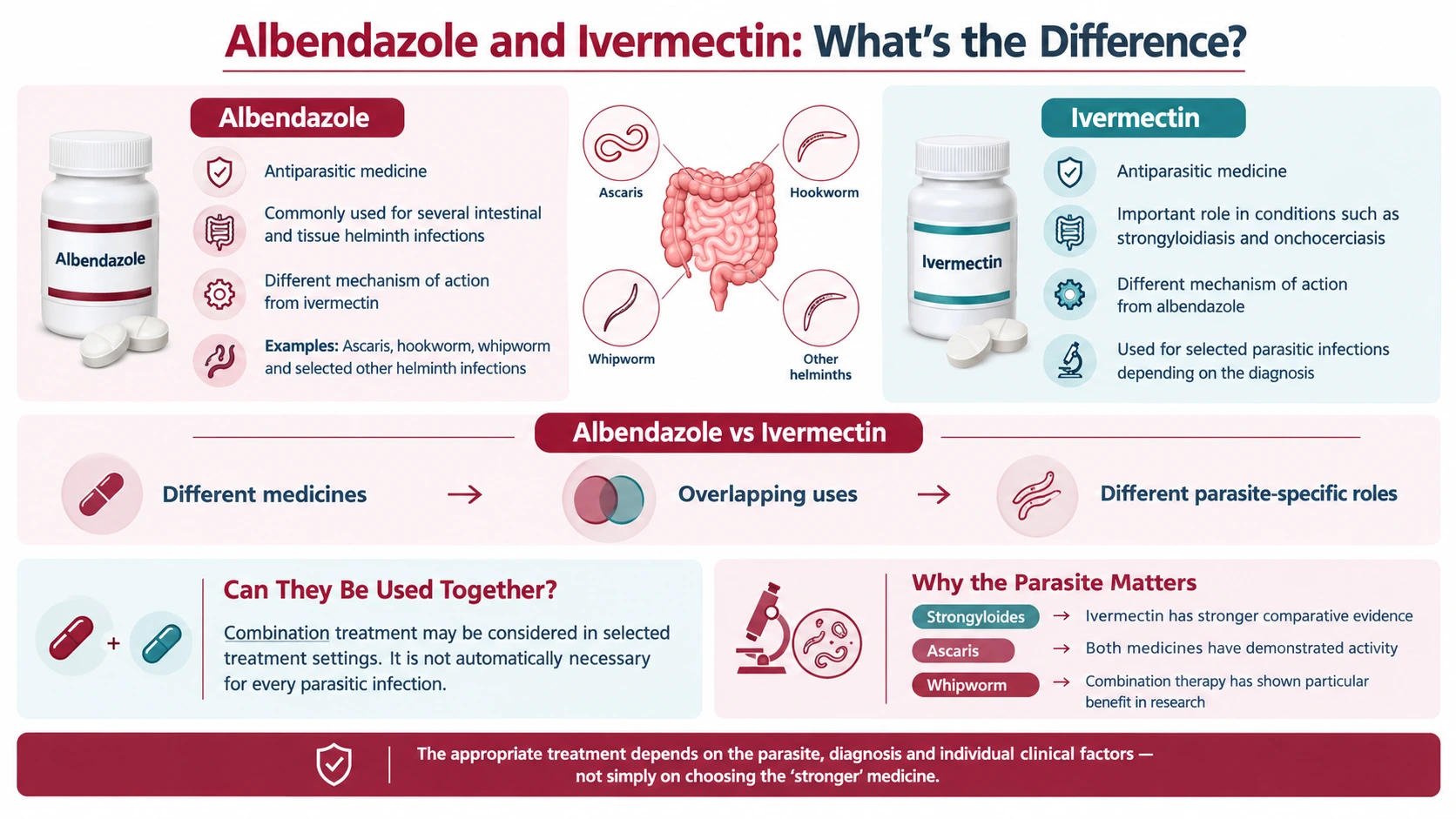
Why the Parasite Matters More Than Choosing a Stronger Medicine
Worm infection is a broad term that covers many different organisms. Roundworm, whipworm, hookworm, Strongyloides, and the parasite that causes onchocerciasis are biologically very different from one another. They have different life cycles and live in different parts of the body. They respond to medicines in different ways.
Two antiparasitic medicines can have overlapping activity and still have very different roles. In the albendazole vs ivermectin context, this is exactly what happens. Symptoms of parasitic infection often overlap too. This means a person cannot reliably tell which organism is involved from symptoms alone.
Treatment should therefore be based on the suspected or confirmed infection rather than on a general sense of which medicine seems stronger. Choosing the wrong medicine can mean the infection continues even though treatment was taken. This is why understanding the distinction between these two medicines matters before any decision is made.
Can Albendazole and Ivermectin Be Used Together?
Yes, combination treatment with albendazole and ivermectin exists in specific clinical and public health contexts. The two medicines work on different targets. Researchers have investigated whether using them together improves treatment outcomes compared with either medicine alone.
Their complementary mechanisms are the reason combination therapy has been studied, particularly for soil transmitted helminths. Using both together does not mean everyone should take both medicines though.
The fact that no major direct interaction is known between them does not make self combination appropriate. The parasite involved, the treatment objective, and the patient’s individual circumstances all determine whether using both together makes sense.
What Does Research Say About the Combination?
Whipworm (Trichuris trichiura)
For trichuriasis, combination therapy has shown a particularly relevant benefit. A systematic review and meta analysis found that ivermectin with albendazole significantly improved cure rates over albendazole alone, and also over ivermectin alone. This is the infection where the combination has the clearest evidence behind it.
Roundworm (Ascaris lumbricoides)
The evidence is different for ascariasis. The same meta analysis found no significant difference between the combination and albendazole alone for Ascaris. Since albendazole on its own already has strong activity against roundworm, adding ivermectin did not show the same clear advantage.
Hookworm
For hookworm, the findings vary depending on which comparison is being made. The combination performed better than ivermectin alone. There was no significant difference between the combination and albendazole alone though.
This reflects that albendazole already has a strong role against hookworm while ivermectin on its own has limited activity there.
Key takeaway: Combination treatment is parasite specific. More medicines do not automatically mean better treatment.
Albendazole and Ivermectin for Strongyloides
Strongyloides stercoralis deserves its own section because it behaves differently from many intestinal worms. The parasite can complete its life cycle inside the human body. This means infection can continue for years or even decades without symptoms flaring up.
Chronic strongyloidiasis can persist quietly and then become dangerous if the immune system is suppressed. This is why immunosuppression matters so much for Strongyloides.
When a person with chronic infection starts corticosteroids or other immunosuppressive treatment, the parasite can multiply rapidly. This can lead to hyperinfection or disseminated disease, which can be life threatening. Identifying and treating the infection before immunosuppression begins is important.
Ivermectin has an established role for strongyloidiasis. A Cochrane review comparing ivermectin with albendazole found that ivermectin cured more people, with moderate quality evidence. One comparative trial reported cure rates of 83 percent for ivermectin and 45 percent for albendazole.
This is why a person at risk of severe strongyloidiasis should not simply self treat based on general deworming advice. The infection needs proper assessment and the right medicine. The parasite can complete its life cycle inside the human body, so infection can persist for long periods without obvious parasite infection symptoms.
When Might Combination Treatment Be Considered?
Combination therapy may be considered in specific situations. These include particular soil transmitted helminth infections, certain public health programmes, and treatment strategies that are supported by evidence for the infection being addressed.
It may also be considered when broader antiparasitic activity is specifically intended. The key point is that combination therapy should be selected for the infection being treated rather than used simply because two medicines seem more powerful than one.
Side Effects and Safety
Both medicines are generally well tolerated when used as directed, but each has its own pattern of effects.
Albendazole commonly causes abdominal discomfort, nausea, headache, and dizziness. More information about albendazole side effects can help explain the safety profile of this medicine.
Ivermectin commonly causes dizziness, nausea, diarrhoea, headache, and fatigue.
Studies of combination treatment have generally reported mostly mild and transient adverse events. Individual suitability still matters though. The decision to use either medicine alone or together should account for the person’s health status.
Who Should Get Medical Advice Before Using These Medicines?
Several factors can change treatment decisions and call for medical advice before using these medicines:
- Pregnancy and breastfeeding, because the safety profile of each medicine in these situations is specific
- Young children, particularly those under 15 kilograms for ivermectin, because safety data in that group is limited
- Liver disease or kidney problems, which can affect how a medicine is processed and may change the monitoring needed
- Neurological conditions, which matter for some treatments
- Immunosuppression, which is especially relevant for Strongyloides
- Taking multiple medicines, which can create interactions
- Previous adverse reactions to either drug class
These factors do not always rule out treatment. They can change which medicine, which dose, and which monitoring plan is appropriate though.
Treatment Failure, Reinfection or Something Else?
When symptoms continue after treatment, three possibilities are worth understanding:
- Treatment failure, where the original infection was not adequately eliminated
- Reinfection, where treatment worked but the person became infected again afterwards
- Wrong diagnosis, where the original symptoms were never caused by the suspected parasite in the first place
Each of these calls for a different response. Persistent symptoms do not automatically mean another dose of albendazole, ivermectin, or both is needed.
Repeating treatment without reassessment can miss an ongoing infection, miss a new infection, or continue treating a problem that was never parasitic. Follow up testing helps clarify which situation applies.
How Is the Appropriate Medicine Chosen?
A practical process helps match the medicine to the situation, Understanding the available medicines for parasitic infection can also help explain why treatment varies according to the organism involved.
- Identify the parasite involved
- Determine where the infection is located in the body
- Assess the severity of the infection
- Consider the person’s age and any other health conditions
- Review other medicines being taken
- Select a treatment that the evidence supports for that specific infection
- Determine whether follow up testing is needed to confirm the infection has cleared
This process is what ties all the earlier sections together. The medicine follows the parasite, not the other way around.
Two medicines are not automatically better than one. The appropriate approach depends on the parasite being treated.
Key Takeaway
Albendazole and ivermectin are different antiparasitic medicines with overlapping but distinct treatment roles. The parasite being treated matters more than choosing a universally stronger medicine. Combination treatment has a role in selected situations, but the evidence varies by infection. Understanding the parasite, the treatment objective, and individual safety factors is essential before deciding between these medicines or using them together.
Medical Disclaimer
FAQ
Are albendazole and ivermectin the same?
No. They belong to different drug classes and work through different mechanisms. Albendazole is a benzimidazole that disrupts microtubules and energy use. Ivermectin is a macrocyclic lactone that paralyses the parasite through nerve and muscle signalling.
Can albendazole and ivermectin be taken together?
They can be combined in specific circumstances, and research supports this for certain infections such as whipworm. That does not make combination treatment appropriate for everyone or for every parasite.
Which is better, albendazole or ivermectin?
There is no single answer that applies to every parasite. Each medicine has infections where the evidence supports it more strongly. The right choice depends on which organism is being treated.
Can ivermectin and albendazole treat the same worms?
There is some overlap, particularly among soil transmitted helminths, but their treatment roles differ. For example, albendazole has a stronger role against hookworm while ivermectin has a stronger role against Strongyloides.
Is ivermectin used for Strongyloides?
Yes. Ivermectin has an established role for strongyloidiasis, and comparative evidence shows it cures more people than albendazole for this infection.
Does taking both medicines work better?
Not universally. The evidence differs according to the parasite. For whipworm the combination shows a clear benefit, while for Ascaris it does not show the same advantage over albendazole alone.
What if symptoms continue after treatment?
Persistent symptoms should be assessed rather than automatically treated with another dose. The cause could be treatment failure, reinfection, or a different problem altogether.

Years of Experience: 10+ years Education: B.Sc. in Biomedical Science (Monash University, Melbourne, Australia) PG Diploma in Health & Medical Communication (University of Sydney, Australia) Experience: Erica Wilson is an…

