

Albendazole vs Mebendazole: What Is the Difference?
By Erica Wilson, Sep-22-2026


 Dr. Arjun Srivastav Medical Reviewer (Pharm D)
 When you are dealing with a worm infection, two names tend to come up again and again, albendazole and mebendazole. Both are well established anti worm medicines that doctors have relied on for decades, and both are commonly reached for when intestinal parasite Infections are suspected. It is natural to wonder how they actually differ.
People compare albendazole vs mebendazole because the two share a drug class and treat several of the same worms, which makes them look interchangeable at first glance. The honest answer is more nuanced. They belong to the same family of medicines, but they are different drugs with different absorption, different treatment schedules, and different suitability for particular infections.
In an albendazole vs mebendazole comparison, the right option depends on the parasite being treated rather than simply picking one medicine over the other. Understanding where they overlap and where they diverge helps you make sense of why a healthcare professional might choose one rather than the other for your situation.
⚡ Quick Answer: Albendazole vs Mebendazole
Albendazole and mebendazole are different anti-worm medicines from the same benzimidazole family. They are both used for several intestinal worm infections, but they are not interchangeable for every parasite.
- Albendazole: Has broader systemic activity and is also used for certain tissue and organ infections.
- Mebendazole: Is mainly used for intestinal worm infections because it remains largely within the digestive tract.
- Both: Can be used for infections such as pinworm, roundworm, hookworm and whipworm, depending on the treatment guidance.
- Dosage: Varies according to the parasite, treatment plan and person being treated.
- Bottom line: The appropriate medicine depends on the specific worm and where the infection is located, not simply on which drug is considered stronger.
Albendazole vs Mebendazole at a Glance
A simple side by side comparison shows the main points:
- Drug class: Albendazole is a benzimidazole. Mebendazole is a benzimidazole.
- Main purpose: Albendazole treats various parasitic worm infections. Mebendazole treats various intestinal worm infections.
- Common infections: Albendazole covers pinworm, roundworm, hookworm, whipworm and some tissue infections. Mebendazole covers pinworm, roundworm, hookworm and whipworm.
- How it works: Both disrupt parasite microtubules.
- Absorption: Albendazole has greater systemic absorption. Mebendazole has limited systemic absorption.
- Treatment duration: Both depend on the infection.
Short takeaway: Both medicines can treat several of the same worms, but their clinical applications are not identical.
What Is Albendazole?
In the albendazole vs mebendazole discussion, albendazole is a broad spectrum anti parasitic medicine that has been used in human medicine since the early 1980s. It belongs to the benzimidazole class of drugs, a group known for targeting parasitic worms. It is prescribed for a range of parasitic infections, from common intestinal worms like pinworm, roundworm, hookworm and whipworm through to more complex infections involving tissues and organs. Understanding what mebendazole treats also helps explain why it is not suitable for every type of parasite.
What sets it apart is its active metabolite, albendazole sulfoxide, which forms quickly after the drug is taken and allows for systemic activity, meaning it can reach parasites located beyond the gut. This is why it has applications beyond routine intestinal deworming, including certain tissue and organ infections that require the medicine to circulate through the body. Treatment length varies according to the specific infection, from a single dose in some cases to longer courses for more involved conditions.
What Is Mebendazole?
On the other side of the albendazole vs mebendazole comparison, mebendazole is another benzimidazole anti worm medicine, first used in people back in 1971. Its common role is in treating intestinal worm infections, and it is widely recognised for use against pinworm, roundworm, hookworm and whipworm. It works largely where the worms are, in the digestive tract.
A defining feature of mebendazole is its relatively limited absorption from the digestive tract. Because it stays mostly within the gut rather than circulating widely through the body, it is particularly relevant to intestinal parasites where local concentration matters. The treatment regimen depends on the infection, with some worms responding to a single dose and others requiring a short course of treatment over several days.
How Do Albendazole and Mebendazole Work?
At a simple level, both medicines work the same way. They interfere with the parasite microtubules, the internal structures worms rely on to maintain their cells. By binding to a protein called beta tubulin, they block the formation of these microtubules. This disrupts essential processes inside the worm, particularly glucose uptake, which the parasite needs for energy and survival.
Once those processes break down, the parasite becomes unable to maintain normal cellular functions. The worm eventually dies or is cleared from the body through the digestive system.
The important distinction is that sharing the same general mechanism does not mean the two medicines have identical clinical use. The way each drug is absorbed, distributed and dosed shapes which infections they are best suited to treat. That is why a discussion of albendazole vs mebendazole always comes back to the specific parasite rather than the shared science behind them.
Albendazole vs Mebendazole for Different Worm Infections
The appropriate treatment depends on the parasite involved, where the infection occurs, and the treatment regimen required. Understanding parasite infection treatment can help put these differences into context.
Pinworm
Both medicines can be used for pinworm, one of the most common worm infections, especially in children. A key issue with pinworm is reinfection. Eggs spread easily between people and across household surfaces. Bedding, clothing, toilet seats and toys can all carry them. Because of this, hygiene plays a central role in preventing recurrence. Washing hands thoroughly, keeping fingernails short, and washing bedding and nightclothes in hot water all matter as much as the medicine itself.
Treatment instructions should be followed carefully, including any recommended repeat dose, because eggs laid before the first dose can hatch and start the cycle again.
Roundworm
Both medicines are used for roundworm infections as well. Treatment schedules can differ between the two drugs, and it is a mistake to assume one standard dose applies to every type of worm. Roundworm infections may respond to a single dose in some cases, but the appropriate course depends on the medicine chosen and the clinical situation.
Hookworm
Both medicines have activity against hookworm, but treatment effectiveness can differ depending on the regimen. Some hookworm infections respond better to a particular schedule or duration, which is a useful example of why albendazole vs mebendazole should not be treated as interchangeable. What works well for one person hookworm may not match the regimen needed for another.
Whipworm
Both medicines may be used for whipworm, though treatment can require a different regimen from pinworm or roundworm. Whipworm infections sometimes need a longer or repeated course rather than a single dose. Persistent infection may require medical reassessment rather than repeated self treatment, as ongoing symptoms could point to reinfection, an incomplete course, or a different parasite altogether.
Other Parasitic Infections
This is where the two medicines clearly separate. Albendazole has established uses for certain tissue or systemic parasitic infections, where treatment is more complex than routine intestinal deworming. Because it is absorbed and circulates through the body, it can reach parasites located in organs and tissues that mebendazole largely gut confined action does not reach as effectively. These more involved infections require a treatment plan built around the specific parasite and its location, often over weeks rather than days.
This section is where the article clearly separates the two medicines without repeatedly claiming one is simply better. The difference is about suitability for the infection, not overall superiority.
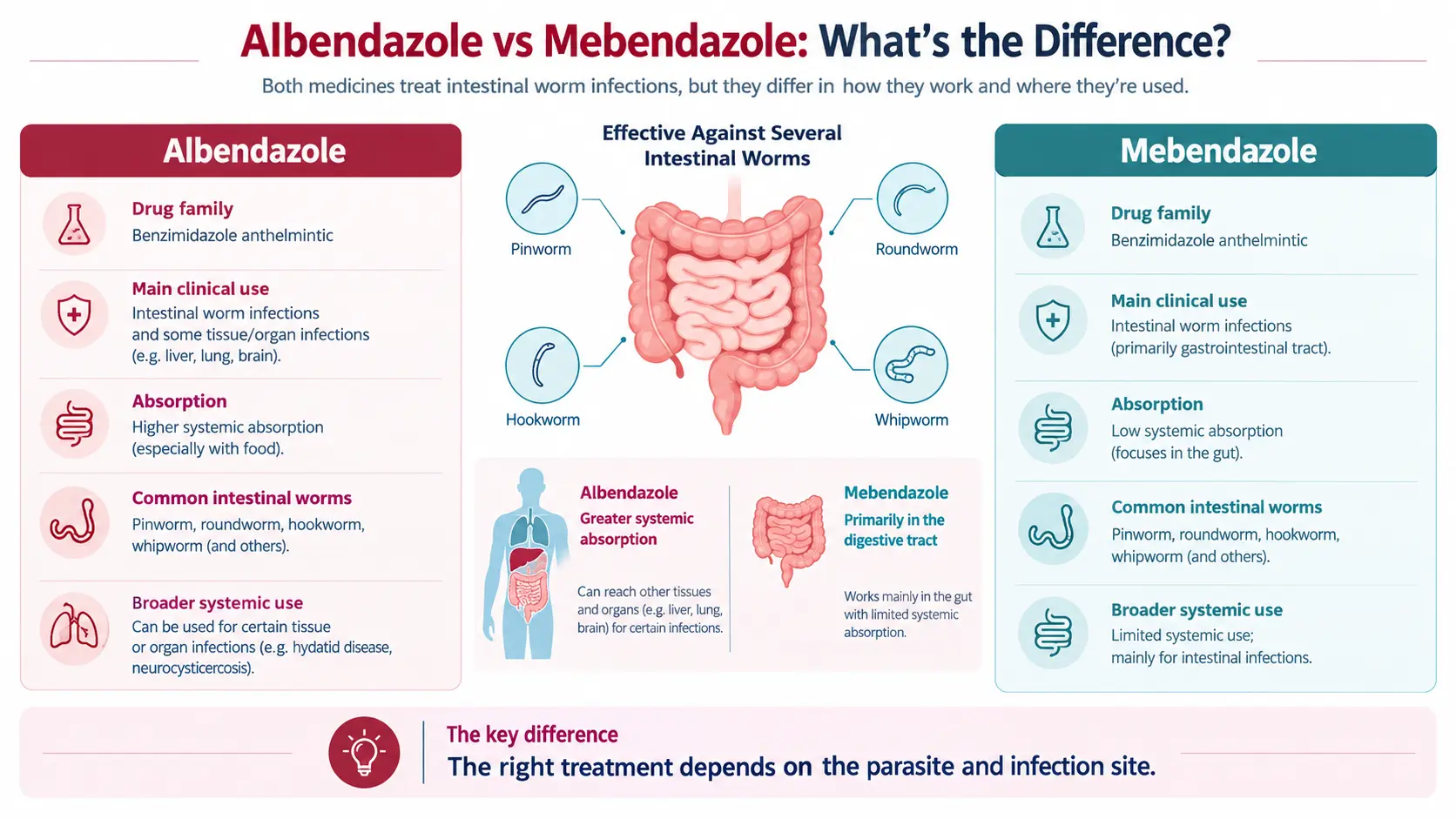
Key Differences Between Albendazole and Mebendazole
Four genuine differences matter when comparing these medicines in the albendazole vs mebendazole debate.
Absorption
Albendazole has greater systemic absorption. After it is taken, it is converted into its active metabolite, which circulates through the body and can reach parasites in tissues and organs. Mebendazole, by contrast, is absorbed to a much lesser extent and tends to stay within the digestive tract.
Clinical applications
Both treat several intestinal worms, but albendazole also has important uses in certain infections involving tissues or organs, where its systemic activity is an advantage. Mebendazole strength lies in intestinal infections.
Treatment schedules
The dose and duration can differ depending on the medicine and the parasite. What suits a single dose pinworm treatment may be completely wrong for a multi day course needed for another worm.
Response to different worms
The effectiveness of each medicine can vary according to the type of parasite and the treatment regimen chosen. Some worms respond well to a short course, while others need a longer or repeated approach.
The fact that two medicines belong to the same class does not mean they should automatically be substituted for one another.
Which Is More Effective, Albendazole or Mebendazole?
There is no single answer for every worm infection, and in the albendazole vs mebendazole question, asking which is more effective oversimplifies things. Both can be effective against several common intestinal parasites, but effectiveness varies according to the parasite in question. The treatment regimen also affects results. A single dose and a multi day course are not directly comparable even against the same worm.
Some infections respond differently to each medicine, particularly when the parasite is located beyond the gut. More complicated infections require a treatment plan based on the specific parasite, its location, and the person being treated, rather than a general preference for one drug.
Key point: The type of worm matters more than choosing a medicine based on a general stronger or better label.
Albendazole vs Mebendazole Dosage
Dosage depends on the specific infection, and age can affect the recommended regimen. Some worm infections may require only a single dose, while others call for treatment over several days. Tissue infections can require substantially different treatment approaches, sometimes stretching over weeks with medical supervision.
It is important not to use the dosage for one parasite to treat another. The same medicine at the same dose is not automatically right for a different worm. Always follow the prescribed or product specific instructions, and do not adjust the dose or duration based on what worked for someone else infection. The comparison of albendazole vs mebendazole dosage only makes sense when each is matched to the parasite it is being used for.
Treatment schedules can range from a single dose to several days or longer depending on the infection. For albendazole specifically, how to take albendazole for deworming depends on the type of worm, age and treatment plan.
Albendazole vs Mebendazole Side Effects
In the albendazole vs mebendazole comparison, both medicines can cause similar side effects, most of which are mild and short lived. The possible reactions also differ in their details, so reviewing mebendazole side effects separately can help distinguish common effects from symptoms that need medical attention. Common ones include:
- Abdominal discomfort
- Nausea
- Vomiting
- Diarrhoea
- Headache
- Dizziness
Side effects can depend on dose and treatment duration. A short course is generally a different experience from prolonged treatment, which exposes the body to the medicine for longer. Longer courses may require medical monitoring, particularly where blood counts or liver function need to be checked. Severe or unusual symptoms, such as persistent vomiting, signs of an allergic reaction, or anything that feels out of proportion, should receive medical attention rather than being brushed off as expected.
Can You Take Albendazole and Mebendazole Together?
A common question in the albendazole vs mebendazole conversation is whether they can be taken together. They come from the same broad drug family, and taking both does not automatically provide better treatment. Combining them without medical advice is unnecessary and could increase the chance of side effects without adding benefit. If a particular infection genuinely requires combination therapy, that treatment should be determined by a healthcare professional who can assess whether it is appropriate for the specific parasite and the person involved.
How Do You Know Which Treatment You Need?
Before choosing a treatment, it helps to understand what a parasite infection is and how different parasites can affect different parts of the body.
When weighing the albendazole vs mebendazole choice, a practical framework helps cut through the confusion:
- What parasite is causing the infection? Different worms can require different treatments, even when the symptoms look similar.
- Where is the infection located? An intestinal infection is not managed in exactly the same way as a tissue infection, and the location shapes the choice of medicine.
- Who is being treated? Age, pregnancy and other personal factors can affect treatment decisions, including whether a particular medicine is suitable at all.
- Has the infection been confirmed? Persistent or unusual symptoms may require testing rather than another dose of deworming medicine, since guessing can delay the right treatment.
When Should You Speak to a Healthcare Professional?
Some situations call for professional input rather than self treatment:
- Symptoms continue after treatment
- Infection keeps returning
- Severe abdominal pain
- Blood in the stool
- Unexplained weight loss
- Persistent diarrhoea or vomiting
- Suspected infection outside the intestine
- Pregnancy
- Treatment for a young child
- Other medicines or health conditions that could affect treatment
- Uncertainty about which parasite is causing symptoms
Key Takeaway
Albendazole and mebendazole are both established anti worm medicines, but they are not identical or universally interchangeable. They overlap in the treatment of several intestinal worms, while albendazole also has applications in certain tissue and systemic parasitic infections. The appropriate medicine, dose and duration depend on the parasite and the person being treated. When the question of albendazole vs mebendazole comes up, the answer always points back to the specific infection rather than a general preference for one drug. The whole point of an albendazole vs mebendazole comparison is to match the treatment to the parasite, not to crown a single winner.
FAQ
Is albendazole the same as mebendazole?
No. They are different medicines from the same benzimidazole family and have differences in absorption, clinical applications and treatment regimens.
Are albendazole and mebendazole used for the same worms?
They overlap for several intestinal worms, including pinworm, roundworm, hookworm and whipworm, but their uses are not completely identical.
Which is better for pinworms?
Both medicines can be used for pinworm. The appropriate treatment and repeat dosing schedule should follow current treatment instructions.
Is albendazole stronger than mebendazole?
The word stronger is not a useful way to compare them. Their effectiveness depends on the parasite, treatment regimen and clinical circumstances
Can you switch from mebendazole to albendazole?
Do not switch between them without checking whether the alternative is appropriate for the particular infection and treatment schedule.
Can you take both medicines at the same time?
They should not be combined unless a healthcare professional specifically recommends doing so.
How long does albendazole take to work?
The timing depends on the parasite and treatment regimen. Improvement in symptoms can also take time after the parasites are affected.
How long does mebendazole take to work?
The response varies according to the infection. Persistent symptoms do not necessarily mean that another dose should immediately be taken.

Years of Experience: 10+ years Education: B.Sc. in Biomedical Science (Monash University, Melbourne, Australia) PG Diploma in Health & Medical Communication (University of Sydney, Australia) Experience: Erica Wilson is an…

