

Does Mebendazole Kill All Parasites? What It Treats and What It Doesn’t
By Erica Wilson, Sep-02-2026


 Dr. Arjun Srivastav Medical Reviewer (Pharm D)
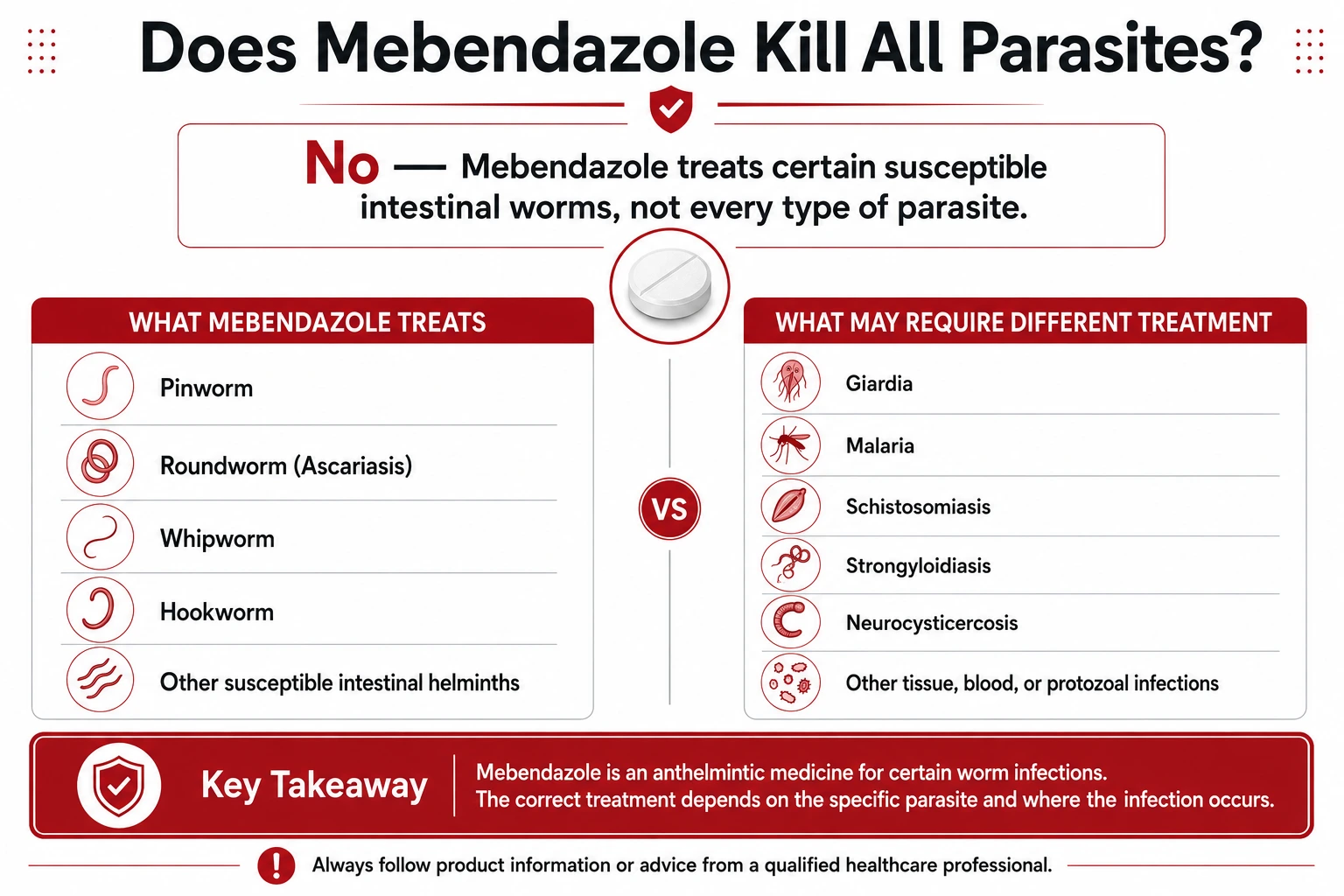
 Does Mebendazole Kill All Parasites? No. Mebendazole is an anthelmintic medicine used to treat several intestinal worm infections, including pinworm, roundworm, whipworm, and hookworm. However, it is not a universal antiparasitic medicine and does not work against every type of parasite.
Some parasitic infections, including malaria, schistosomiasis, strongyloidiasis, and certain protozoal or tissue-invasive infections, require different treatments. The appropriate medicine depends on the specific parasitic infection that occurs in the body.
Parasitic infections can affect different parts of the body and may be caused by worms, protozoa, or other organisms. Learn more about what a parasite infection is before considering antiparasitic treatment.
In this article, we’ll explain what parasites mebendazole treats, which parasites it does not treat, how it works, and why identifying the infection matters before treatment.
Quick Answer
Does Mebendazole Kill All Parasites?
No. Mebendazole treats certain intestinal worm infections, including pinworm, roundworm, whipworm, and hookworm, but it is not a universal antiparasitic medicine.
✓ Pinworm
✓ Roundworm
✓ Whipworm
✓ Hookworm
Other parasitic infections may require different medicines depending on the organism and where the infection occurs.
How Does Mebendazole Work?
Understanding how mebendazole works also helps explain does mebendazole kill all parasites and why its effects are limited to certain susceptible worms.
Interferes With Beta-Tubulin
Mebendazole binds to tubulin in susceptible worms and interferes with the formation of microtubules. This disrupts important cellular processes required for the parasite’s normal function. If you’re interested in what happens to the medicine after treatment, read more about how long mebendazole stays in the body.
Disrupts Glucose Uptake
Mebendazole-induced disruption of cellular processes interferes with glucose uptake and other essential functions in susceptible worms. This reduces the energy available for normal survival and reproduction.
Weakens and Eliminates Susceptible Worms
As essential cellular and metabolic processes are disrupted, susceptible worms become impaired and may eventually die. The exact effects can vary depending on the parasite and treatment circumstances.
Step-by-Step: What Happens After You Take It
- The tablet is ingested and travels through the digestive system.
- Very little is absorbed into the bloodstream, but instead remains in the wall of the gut, the exact place where the intestinal worms reside.
- Mebendazole attaches itself to beta-tubulin of the parasite’s cells.
- Formation of microtubules in the worm fails.
- Glucose uptake by the worm ceases practically.
- The worm’s energy stores are depleted in the coming days.
- The immobilized and starved worm is then excreted via bowel evacuation.
- It is not a quick kill but a gradual starvation; that is why the worm is cleared in a few days.
The time needed for symptoms to improve can vary depending on the infection and individual circumstances. See how long mebendazole takes to work for more information.
Why Doesn’t Mebendazole Treat Every Parasite?
Mebendazole works against certain susceptible helminths, particularly intestinal worms. It is not a universal antiparasitic medicine because different parasites have different biological structures, life cycles, drug targets, and locations within the body.
Mebendazole primarily acts on susceptible worms by interfering with tubulin and other essential cellular processes. Parasites belonging to different groups, or those located in tissues, organs, or the bloodstream, may require medicines that target their specific biology and location.
What Parasites Does Mebendazole Treat?
To understand does mebendazole kill all parasites, it is important to first know which worms mebendazole is designed to treat.
Parasites Commonly Treated With Mebendazole
| Parasite | Infection | Mebendazole treatment option |
|---|---|---|
| Enterobius vermicularis | Pinworm | Mebendazole may be used according to the recommended regimen |
| Ascaris lumbricoides | Ascariasis | Mebendazole is an established treatment option |
| Trichuris trichiura | Whipworm | Mebendazole is commonly used |
| Ancylostoma duodenale | Hookworm | Mebendazole is a treatment option |
| Necator americanus | Hookworm | Mebendazole is a treatment option |
Treatment regimen and duration can vary according to the infection, age, formulation, local guidelines, and individual circumstances. Follow the product information or advice of a healthcare professional. Because different parasites require different medicines, you can also learn about medicines used for parasite infections.
🔔 Reminder
Parasites That Usually Require Other Treatments
The answer to does mebendazole kill all parasites becomes clearer when you look at the types of parasites that require different treatments.
Mebendazole is not the standard treatment for every parasitic infection. The appropriate medicine depends on the organism involved and where the infection occurs in the body. Examples include:
Giardiasis:
Giardiasis is caused by Giardia duodenalis. Mebendazole is not a standard first-line treatment for giardiasis. When treatment is required, healthcare professionals may use medicines such as tinidazole, nitazoxanide, or metronidazole depending on the individual situation.
Amoebiasis:
Amoebiasis is caused by Entamoeba histolytica. Treatment may involve a medicine that acts against the infection in tissues followed by a luminal agent to clear organisms remaining in the intestine. The treatment approach depends on the clinical presentation.
Malaria:
Malaria is caused by Plasmodium parasites and requires specific antimalarial treatment. The medicine selected depends on the Plasmodium species, geographic exposure, drug resistance, and severity of the infection. Mebendazole is not a treatment for malaria.
Toxoplasmosis:
Toxoplasmosis is caused by Toxoplasma gondii. When treatment is required, healthcare professionals may use combinations such as pyrimethamine and sulfadiazine with folinic acid, depending on the patient’s clinical situation.
Intestinal Tapeworm Infection
Mebendazole is not a standard first-line treatment for intestinal tapeworm infections. Medicines such as praziquantel or albendazole may be used depending on the specific tapeworm and clinical circumstances.
Neurocysticercosis
Neurocysticercosis occurs when Taenia solium larvae affect the nervous system. Treatment is more complex than treatment of an intestinal worm infection and may involve albendazole or praziquantel along with other medicines when clinically appropriate.
Strongyloidiasis:
Ivermectin will be the most suitable drug for this infection.
Schistosomiasis:
Also known as blood flukes, Praziquantel is the right medicine in this case.
Filariasis:
Filariasis infections are caused by parasitic worms transmitted by insects. Mebendazole is not a standard treatment for most filarial infections. Treatment depends on the specific filarial parasite and may involve medicines such as ivermectin, diethylcarbamazine, or other therapies.
Trichinellids:
Occurring due to Trichinella spiralis, Mebendazole may be recommended in such cases, but it is usually in combination with other corticosteroids to keep inflammation in control.
Each of these needs a tailored antiparasitic, antiprotozoal, or anthelmintic approach that matches the organism’s biology, not a generic dewormer.
⚠️ Warning
Why Proper Diagnosis Matters
Taking medication on suspicion of “worms” without proper diagnosis is among the biggest errors made by many people with parasitic symptoms.
Symptoms of parasitic infections can vary widely and may include:
- Swelling
- Tiredness
- Stomach pain
But this does not mean that the type of infection you have is treatable using Mebendazole. Doctors will check for additional information from you, such as-
- If you have travelled to any country, specifically in Africa, recently
- What diet you have been on in the last few days
- Checking the complete list of symptoms
- If you have come in contact with contaminated water or soil
💡 Tip
How Are Parasitic Infections Diagnosed?
Stool microscopic examination
For detecting ova or cyst identification, where worm eggs, larvae, or protozoal cysts can be seen.
Stool antigen tests
It is helpful when there are some organisms, such as Giardia, that do not demonstrate well on microscopy.
Blood tests
Including eosinophil counts, which increase in some worm infections.
Tests involving serology
This involves tissue invasion by the parasite but cannot be detected via stool samples.
Imaging through ultrasounds and MRIs
It will be required in cases where parasites invade the organs, e.g., neurocysticercosis and hydatid cysts.
Tape test
A diagnostic procedure specifically for detecting pinworm eggs in the perianal area.
The tests used depend on the suspected parasite, symptoms, travel history, and location of the infection.
Why Treating Without a Diagnosis Can Be a Problem
The major problem with mebendazolecIf you have travelled to any country, specifically in Africa is regarding its dosage. Relying on reapplication of a course of medication where there hasn’t been any improvement and without knowing the actual reason for that can result in excessive medication, which in some cases may trigger such unwanted effects as stomach pain, dizziness, and allergy.
Diagnosis is not a formal procedure in this case. It determines whether the treatment will be effective at all.
🚨 Important Reminder
Can One Medicine Kill Every Type of Parasite?
Does Mebendazole Kill All Parasites? No single antiparasitic medication works against every parasite, and mebendazole is no exception.
An antiparasitic drug designed to interfere with tubulin in worms does not have a target in a unicellular protozoan such as Giardia. Likewise, a drug aimed at intestinal worms will not reach those parasites that are located in muscle tissue and blood cells.
That is the reason why infectious diseases are treated using drug classes instead of one that works universally: anthelmintics to treat worms, antiprotozoals for treating single-cell parasites, and antimalarials for Plasmodium infections, all designed to exploit a different vulnerability. Learn more about mebendazole side effects and why following the recommended treatment instructions matters.
Preventing Reinfection
Treatment of the infection is just the first step, as reinfections are frequent with intestinal worms, especially in families that have children or live together in proximity. Certain regular practices really do matter.
Hygiene Practices
- Always wash hands well before meals and after going to the bathroom, since the eggs of the worms are easily transferred via contaminated hands.
- Trim fingernails short, especially for children, since eggs are commonly found here.
- Wash bed linens and underwear in hot water while on treatment.
Food and Water Safety
- Do not consume undercooked meat since it can act as a source of infection from tapeworms and Trichinella.
- Properly wash fruits and vegetables, especially the ones that are consumed raw.
- Use filtered water or boil water in case you suspect contamination of water. For additional information about diet and parasite-related health claims, see foods that may help support parasite prevention.
Household-Level Precautions
- Consider all family members for treatment of pinworms as it spreads quickly among people in close contact.
- Clean objects frequently touched by hand, such as doorknobs and toilet seats, during an infection episode.
- Do not walk barefoot on soil in areas where hookworm is endemic, as it can enter the body through the skin.
Conclusion
Does Mebendazole Kill All Parasites? No. Mebendazole is an anthelmintic medicine that works against certain intestinal worm infections, including pinworm, roundworm, whipworm, and hookworm. However, it is not a universal antiparasitic treatment and does not work against every type of parasite.
Parasitic infections can differ significantly in their causes, locations, and treatment requirements. Some infections may require medicines such as ivermectin, praziquantel, or specific antiprotozoal or antimalarial treatments. If you have persistent or unexplained symptoms, identifying the underlying infection is important before repeating antiparasitic treatment.
FAQ
Does mebendazole kill all parasites?
No. Mebendazole does not kill all types of parasites. It is mainly used against certain intestinal worm infections, including pinworm, roundworm, whipworm, and hookworm. Other parasitic infections may require different medicines.
What parasites does mebendazole treat?
Mebendazole can be used to treat several intestinal worm infections, including pinworm, ascariasis (roundworm), trichuriasis (whipworm), and hookworm infections. Its use depends on the specific infection and medical advice.
Does mebendazole kill pinworms?
Yes. Mebendazole is used to treat pinworm infections. However, it does not kill pinworm eggs, so a second dose may be recommended after two weeks, along with hygiene measures to reduce reinfection.
Does mebendazole work for Giardia?
Mebendazole is not generally considered a standard first-line treatment for Giardia infection. Giardia is a protozoan parasite, and healthcare professionals may use medicines such as tinidazole, nitroimidazoles, or nitazoxanide depending on the individual case.
Does mebendazole treat tapeworms?
Mebendazole is not generally the standard first-line treatment for intestinal tapeworm infections. Treatment depends on the specific tapeworm and may involve medicines such as praziquantel or albendazole.
Does mebendazole treat Strongyloides?
Mebendazole is not the standard treatment for Strongyloides infection. Ivermectin is generally preferred, although treatment decisions depend on the individual and the infection.
Does mebendazole treat malaria?
No. Mebendazole is an anthelmintic medicine used for certain worm infections and is not an antimalarial treatment. Malaria requires medicines selected according to the Plasmodium species, infection severity, and other factors.

Years of Experience: 10+ years Education: B.Sc. in Biomedical Science (Monash University, Melbourne, Australia) PG Diploma in Health & Medical Communication (University of Sydney, Australia) Experience: Erica Wilson is an…

