

How Long Does Mebendazole Stay in Your System? Half-Life & Elimination Explained
By Erica Wilson, Aug-15-2026


 Dr. Arjun Srivastav Medical Reviewer (Pharm D)
 After taking Mebendazole for anti-worm infections, you may be asking yourself an obvious question. Just how long does Mebendazole stay in your system?
It is an understandable question since no one likes guessing. Let us look at it in clear and straightforward language. No complicated medical terms here. Only the truths, stated clearly in the simplest way possible – just like how your buddy would tell you.
At the conclusion of this blog post, you will know all about Mebendazole’s movement inside your body and what really determines its departure.
What Is a Parasitic Infection?
A parasitic infection occurs when a parasite lives in or on the body and uses the host to survive. Intestinal worms are one type of parasite that can affect humans. If you want to learn more about the causes, types and symptoms of these conditions, read what is a parasite infection.
What Happens After You Take Mebendazole?
It has quite a different mode of action than other medicines. Most of the time, other medicines will enter the bloodstream and show their effects. However, Mebendazole remains concentrated in the stomach and intestines, where it exerts its action on the parasites. This is also the reason why Mebendazole is so effective in the treatment of parasitic infections.
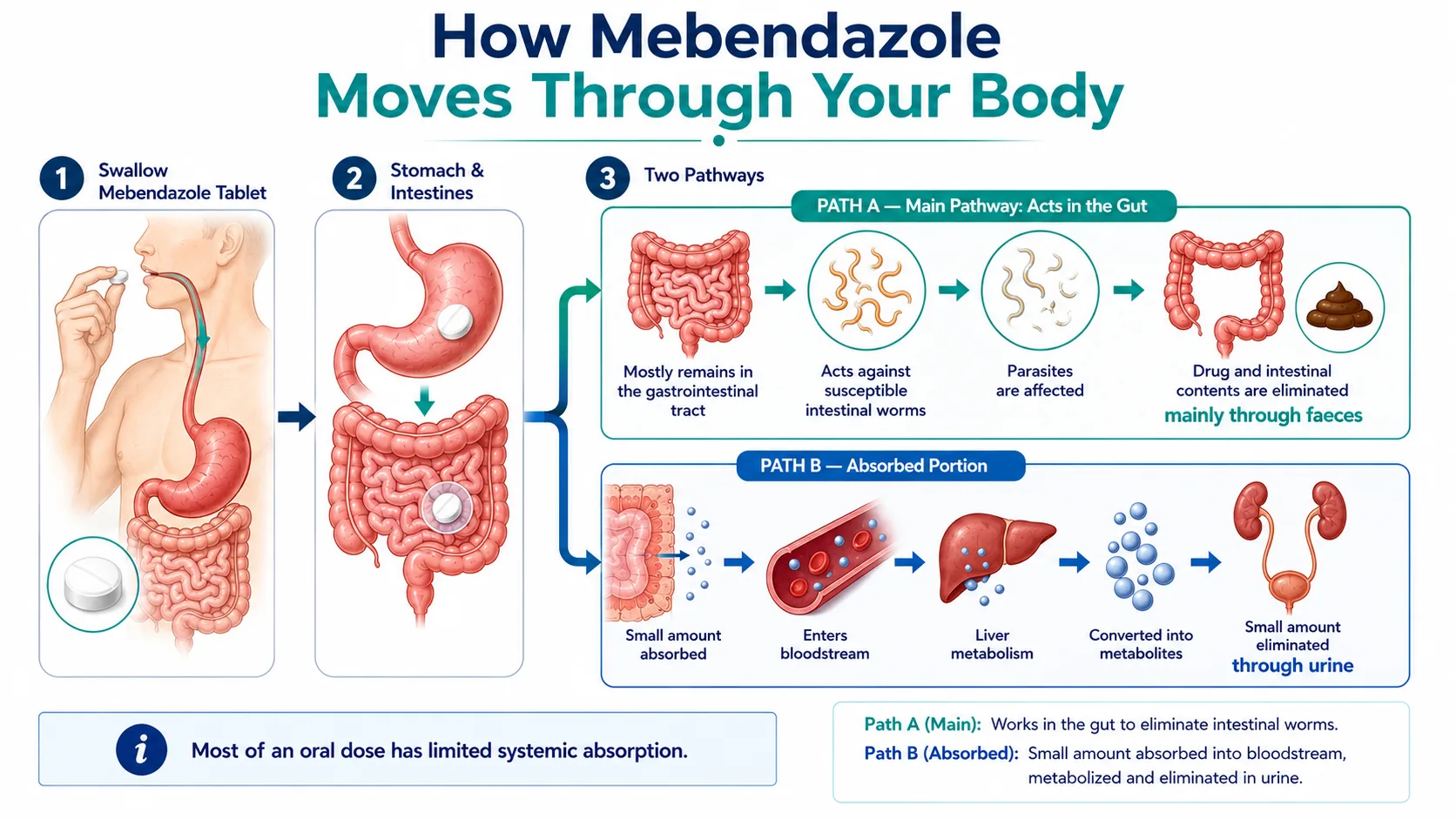
This is the route it takes step by step:
- You take the tablet, and it moves down your throat to your stomach and later to the intestines.
- The major part remains within the gut while only a few bits enter your bloodstream.
- It interferes with the process of sugar absorption by the worms. In this way, it stops the active energy production needed to move or reproduce within the parasites.
- A small part of this medicine is absorbed and goes to the liver, where it is converted into metabolites.
- The remaining drug and dead worms are excreted via the faeces. Most of the dose will be removed from the body by this means.
- A small fraction will be removed by urination. Only a minute fraction will be lost this way.
This process flow chart is like this:
Available Mebendazole Strengths
Common mebendazole tablet strengths and brands include:
- Mebendazole 100 mg – A 100 mg mebendazole tablet used for certain intestinal worm infections according to the recommended treatment regimen.
- Mebendazole 500 mg – A higher-strength mebendazole tablet used for certain intestinal worm infections as directed by a healthcare professional or in accordance with the product information.
- Mebex 100 mg – A mebendazole 100 mg tablet used to treat certain intestinal worm infections.
How Is Mebendazole Absorbed?
Mebendazole has relatively low oral absorption, which means most of an orally administered dose remains within the gastrointestinal tract. This is important because intestinal worms are located in the digestive tract, where mebendazole exerts much of its antiparasitic action.
The portion that is absorbed into the bloodstream undergoes extensive metabolism in the liver. Food can influence the amount of mebendazole absorbed, particularly meals containing a higher amount of fat. However, this does not mean that everyone needs to take mebendazole after a meal. Always follow the instructions provided with your specific product or those given by your doctor or pharmacist.
💡 Tip
How long does it take to absorb?
The maximum concentration of the drug reaches its peak after two to four hours of ingestion of the tablet. However, please note that it refers to the absorbed portion of the drug. The remainder continues its work in the gastrointestinal tract.
How Long Does Mebendazole Stay in Your Body?
If you’re wondering how long does mebendazole stay in your system, the answer depends on how the medicine is absorbed, metabolised, and eliminated.
It is eliminated relatively quickly from the bloodstream after an oral dose, but there is no exact 24- or 48-hour timeframe that applies to everyone. The apparent elimination half-life is around 3 to 6 hours in most patients, meaning blood concentrations decrease substantially over several hours. The absorbed portion is extensively metabolised, while most of the administered dose is ultimately eliminated through the faeces.
There is a distinction between “clearing the blood” and “complete clearance from the body”. Since much of the medication gets accumulated in the digestive tract and Mebendazole excretion occurs via faeces, it remains detectable in the faeces for a slightly longer period than in the blood.
⚠️ Warning
Mebendazole Elimination Timeline
Several factors influence how long does mebendazole stay in your system, including the dose, treatment duration, liver function, and other medicines.
It is processed and eliminated gradually rather than disappearing from the body at a specific time. After an oral dose, only a small portion is absorbed into the bloodstream, while much of the medicine remains in the gastrointestinal tract.
The absorbed portion is extensively metabolised, primarily by the liver, while the concentration of this medicine in the bloodstream decreases over several hours. Most of the administered dose is ultimately eliminated through the faeces.
The exact timeline varies depending on factors such as the dose, treatment duration, liver function, food, and other medicines.
Understanding Mebendazole’s Half-Life
The half-life of mebendazole refers to the approximate time required for the concentration of the drug in the bloodstream to decrease by 50%.
The apparent elimination half-life of mebendazole is around 3 to 6 hours in most patients. Although the reported value can vary depending on the study, dose, formulation, and individual circumstances.
For example, if we use a hypothetical half-life of 4 hours simply to understand the concept:
- After 4 hours: approximately 50% remains
- After 8 hours: approximately 25% remains
- After 12 hours: approximately 12.5% remains
- After 16 hours: approximately 6.25% remains
- After 20 hours: approximately 3.1% remains
This is a simplified example rather than a prediction of exactly how much it will remain in a particular person.
It is also important to understand that five half-lives do not mean that a drug is literally 100% eliminated. Instead, around 97% of the drug concentration would be expected to have declined under a simplified first-order elimination model. Individual pharmacokinetics can vary.
Mebendazole Half-Life vs. How Long It Works
Understanding the mebendazole half-life helps explain how quickly the medicine is cleared from the bloodstream.
The half-life describes how quickly the concentration of mebendazole in the bloodstream decreases. It does not tell you exactly how long the medicine will continue producing its antiparasitic effect.
It acts against susceptible intestinal worms, while the body gradually processes and eliminates the medicine. Therefore, a decline in blood concentration does not necessarily mean that treatment has immediately stopped working.
The appropriate treatment regimen depends on the type of worm infection and the dosing instructions for the specific product. If you want to understand the difference between drug elimination and treatment response, see our guide on how long Mebendazole takes to work.
Factors That Affect Elimination
These factors can affect how long mebendazole remains in the body and how much exposure a person has to the medicine. While elimination time is one consideration, it is also important to know what reactions may occur during treatment. Learn more about Mebendazole side effects and when medical advice may be needed.
Age
Age and body characteristics can influence how medicines are processed. However, dosing recommendations for mebendazole depend on the specific infection, product, and patient rather than simply on age.
Function of Liver
Because of the liver’s role in metabolizing the absorbed fraction of the medication, Impaired liver function may alter mebendazole metabolism and increase drug exposure.
Dosage
An increase in the dosage of the medication will result in an increase in the amount of the medication retained in the body. The dose and treatment duration can affect overall exposure to mebendazole. For information about dosing considerations, see Mebendazole 500 mg dosage for adults.
Interaction with other medicines
Some medicines can affect mebendazole metabolism and change the amount of drug present in the body. Tell your doctor or pharmacist about all medicines and supplements you take.
It is wise to inform your physician about any medical problems or ongoing medication intake.
📌 Important
Does Mebendazole Continue Working After It Leaves the Body?
It does not have to stay at high levels within the blood for several days to achieve the antiparasitic effect.
Mebendazole acts against susceptible intestinal worms in the intestinal tract, whereas the drug itself will be processed by the body. While blood levels drop, the results of the treatment and he effects of treatment and the body’s process of clearing the parasites may continue.
But this does not mean that a single dosage of the drug is good for all cases of parasitic infection. Different parasites have different treatment regimes.
Do not take an additional dose if symptoms persist. Consult a doctor or a pharmacist regarding the appropriate treatment regimen.
Does the Type of Worm Infection Change How Long Mebendazole Works?
The pharmacokinetics of mebendazole are not the only factor that determines treatment duration. The type of worm infection also matters.
Different antiparasitic medicines are designed to work against different types of parasites. For a broader overview of these medicines, their uses, and safety considerations, see our guide to antiparasitic medications.
For example, treatment for pinworm may involve repeat dosing because reinfection is common and eggs can remain in the environment.
Therefore, you should not determine whether you need another dose based solely on how long mebendazole remains in your bloodstream. Follow the treatment instructions for the specific infection.
🔔 Reminder
FAQ
1. How long does one dose of mebendazole remain active?
Mebendazole has a relatively short elimination half-life, but its therapeutic effect should not be judged solely by how long the medicine remains in the bloodstream. The duration of treatment depends on the type of worm infection and the recommended dosing schedule.
2. How Long Does Mebendazole Stay in Your System After One Dose?
Mebendazole has a relatively short elimination half-life, but there is no single timeframe that applies to everyone. The concentration in the bloodstream decreases substantially over several hours, while the medicine is gradually metabolised and eliminated.
3. How long does mebendazole take to leave the bloodstream?
Mebendazole has an apparent elimination half-life of approximately 3 to 6 hours. This means its concentration in the bloodstream decreases substantially over several hours, although individual elimination can vary.
4. Does mebendazole stay in the intestines?
Much of an orally administered dose remains in the gastrointestinal tract because mebendazole has relatively low systemic absorption. This allows the medicine to act against susceptible intestinal worms where they are located.
5. Does mebendazole remain in the body longer after multiple doses?
Repeated dosing can result in greater exposure to mebendazole and its metabolites compared with a single dose. How long the medicine remains in the body can also be influenced by factors such as liver function, dosage and interactions with other medicines.
6. Does drinking more water make mebendazole leave the body faster?
No. Drinking extra water does not reliably speed up the metabolism or elimination of mebendazole. The body primarily processes the absorbed medicine through metabolism and eliminates most of the administered dose through the faeces.
7. Can mebendazole be detected in blood tests?
Specialised laboratory testing can potentially detect mebendazole or its metabolites, but routine blood tests do not normally look for the medicine. Whether it can be detected depends on the type of test, the timing and the analytical method used.
8. Can mebendazole stop working before all the worms are gone?
The amount of mebendazole in the bloodstream and the overall treatment effect are not the same thing. The medicine can begin acting against susceptible worms while the body gradually processes and eliminates it. Whether additional treatment is needed depends on the specific infection and recommended regimen.

Years of Experience: 10+ years Education: B.Sc. in Biomedical Science (Monash University, Melbourne, Australia) PG Diploma in Health & Medical Communication (University of Sydney, Australia) Experience: Erica Wilson is an…

