

What Is cGMP and What Is Its Role in the Body?
By Ezra Allen, Aug-09-2025

 Dr. Arjun Srivastav Medical Reviewer (Pharm D)
Cells constantly receive signals that tell them how to respond to changes inside and outside the body. To turn those signals into an actual response, they rely on signalling molecules that work within the cell. One of these molecules is cGMP, which is involved in processes ranging from blood-vessel regulation to visual signalling.
It is also closely connected with the nitric oxide pathway involved in smooth-muscle relaxation and erectile function. Understanding what it is, where it comes from and how the body controls it makes the relationship between cyclic guanosine monophosphate, PDE5 and certain medicines much easier to understand.
What Is cGMP?
cGMP (cyclic guanosine monophosphate) is an intracellular second messenger that helps transmit signals within cells. It is produced from GTP by enzymes called guanylyl cyclases and later broken down by phosphodiesterases. cGMP participates in smooth-muscle relaxation, vascular regulation, visual signalling and several other cellular processes.
What Is cGMP?
It stands for cyclic guanosine monophosphate. It belongs to a group of molecules known as cyclic nucleotides and acts as a second messenger inside cells.
The term “second messenger” describes a molecule that helps carry a signal from an initial stimulus to processes within a cell. Rather than being a hormone or an enzyme itself, it is produced and regulated by enzymes that control cellular signalling.
Once generated, It can interact with proteins such as cGMP-dependent protein kinases (PKGs) and certain ion channels. The resulting response depends on the type of cell and the signalling pathway involved.
This means cyclic guanosine monophosphate does not have one single function throughout the body. Its effects vary according to where the molecule is produced and which cellular proteins respond to it.
What Does cGMP Do in the Body?
Cyclic guanosine monophosphate participates in several normal physiological processes. Its functions include:
- Supporting smooth-muscle relaxation
- Helping regulate blood-vessel tone
- Relaying signals within cells
- Contributing to visual signal processing
- Participating in pathways activated by nitric oxide
- Responding to certain natriuretic peptide signals
The same signalling molecule can therefore have different effects in different tissues. For example, it contributes to the regulation of vascular smooth muscle, while in the retina it is involved in the way photoreceptor cells respond to light.
How Is cGMP Produced?
The body produces cyclic guanosine monophosphate inside cells from guanosine triphosphate (GTP). The enzyme responsible for this conversion is called guanylyl cyclase.
The basic process is:
GTP → Guanylyl cyclase → cGMP
Guanylyl cyclase can be activated through more than one signalling pathway. Two important routes involve nitric oxide and natriuretic peptides.
Nitric Oxide Pathway
Nitric oxide (NO) can activate soluble guanylyl cyclase inside cells. This increases the conversion of GTP into cyclic guanosine monophosphate and starts downstream signalling. The NO-cGMP pathway is particularly relevant to vascular smooth muscle and erectile physiology.
Natriuretic Peptide Pathway
Certain natriuretic peptides interact with membrane-associated guanylyl cyclase receptors. This also stimulates Cyclic guanosine monophosphate production and contributes to physiological processes involving vascular function and fluid balance.
Therefore, nitric oxide is an important trigger for cyclic guanosine monophosphate production, but it is not the only pathway through which cells generate it.
How Does the NO-cGMP Pathway Work?
The NO-cGMP pathway is a useful example of how an external or physiological signal can produce a response inside a cell.
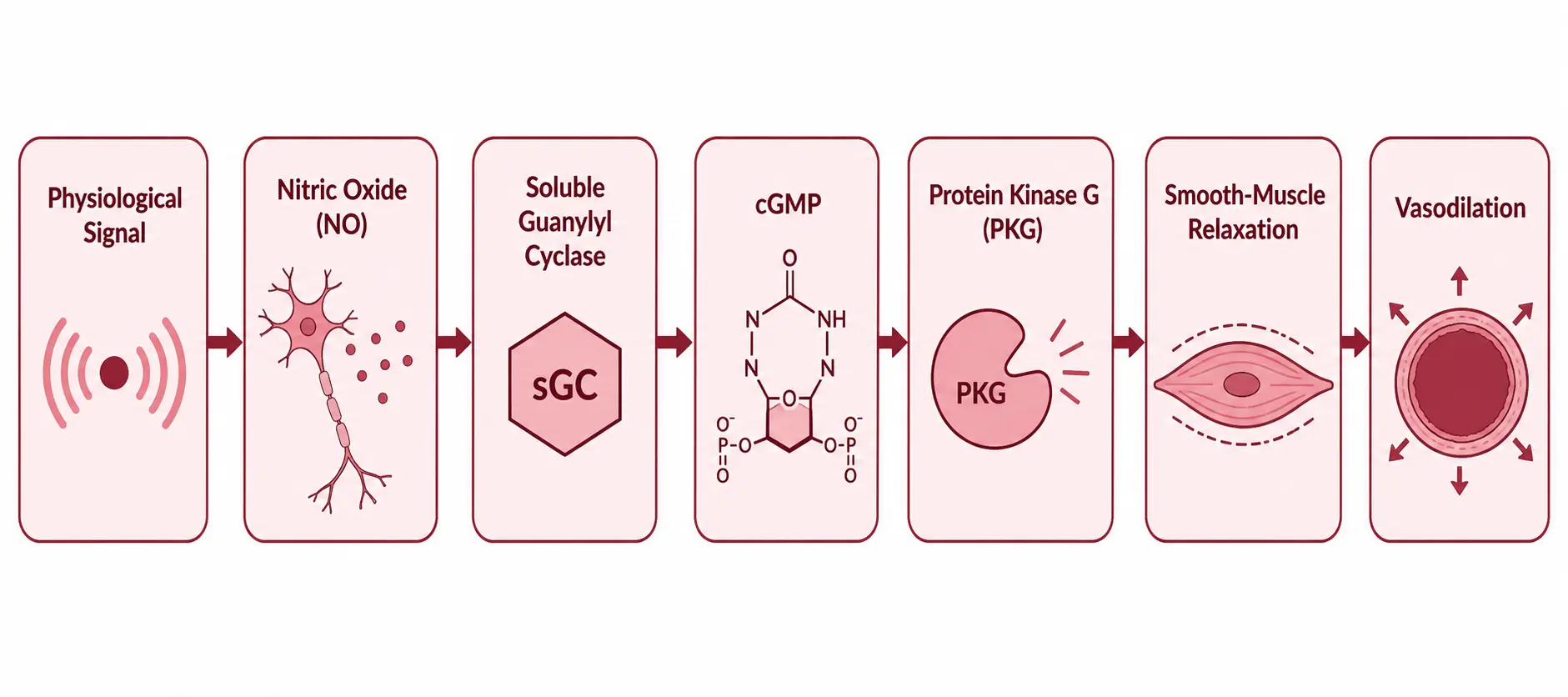
The sequence can be simplified as:
Signal → Nitric oxide → Guanylyl cyclase → cGMP → Downstream signalling → Smooth-muscle relaxation
Here is what happens:
- A physiological signal stimulates the release or production of nitric oxide.
- NO activates soluble guanylyl cyclase.
- Guanylyl cyclase increases cGMP formation from GTP.
- Cyclic guanosine monophosphate activates downstream targets, including protein kinase G.
- These signalling changes promote smooth-muscle relaxation in tissues where this pathway is active.
The direction of this process is important. Nitric oxide promotes Cyclic guanosine monophosphate production; cGMP does not activate nitric oxide.
How Does cGMP Affect Blood Vessels and Smooth Muscle?
It has an important role in controlling the behaviour of certain types of smooth muscle.
When cyclic guanosine monophosphate activates downstream proteins such as protein kinase G, it influences intracellular processes involved in muscle contraction and relaxation. In vascular smooth muscle, these changes can favour relaxation of the muscle surrounding blood vessels.
When that muscle relaxes, the vessel can widen, a process known as vasodilation. This contributes to the regulation of vascular tone and blood flow.
The effect is therefore not simply about increasing blood flow. It forms part of a signalling system that helps tissues respond appropriately to physiological signals.
What Is the Role of cGMP in Erectile Function?
Cyclic guanosine monophosphate is one component of the normal physiological process involved in an erection.
During sexual stimulation, nitric oxide is released in penile tissue. NO activates guanylyl cyclase, increasing cyclic guanosine monophosphate formation. The resulting signalling promotes relaxation of smooth muscle in the corpus cavernosum, allowing blood to enter the erectile tissue.
The pathway can be viewed simply as:
Sexual stimulation → NO release → cGMP formation → Smooth-muscle relaxation → Increased penile blood flow
It is then gradually broken down by phosphodiesterase enzymes. This helps regulate how long the signal remains active.
This is also why cyclic guanosine monophosphate is important when explaining how PDE5 inhibitors work. They do not produce it themselves; instead, they interfere with its breakdown.
What Does PDE5 Do to cGMP?
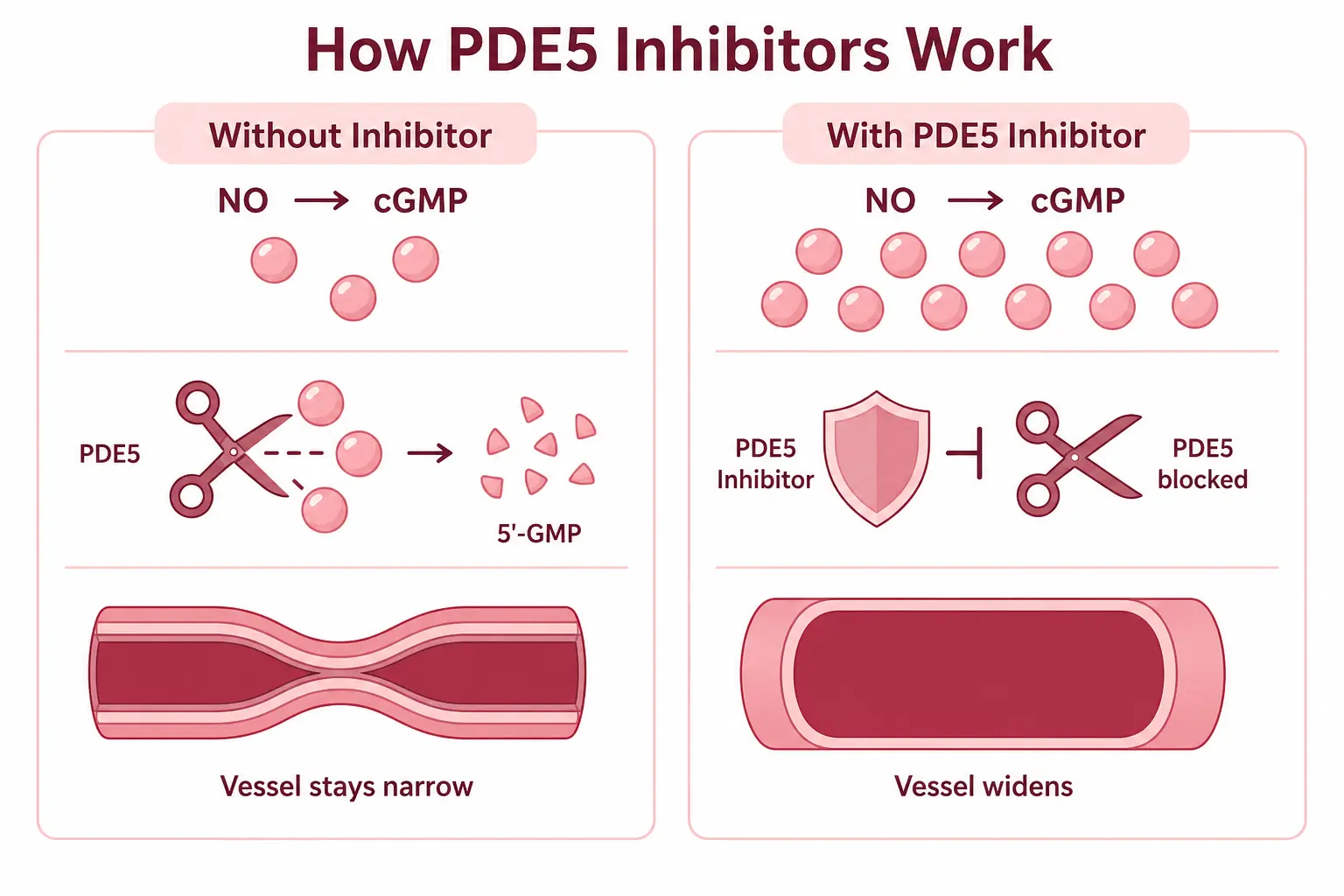
PDE5 (phosphodiesterase type 5) is an enzyme that breaks down it.
This is a normal part of cellular signalling. Once a cyclic guanosine monophosphate signal has served its purpose, phosphodiesterases help reduce its concentration by converting it into inactive products. This gives cells control over the strength and duration of the response.
The relationship can be summarised as follows:
| Component | What it does |
| Guanylyl cyclase | Produces cGMP from GTP |
| cGMP | Carries the intracellular signal |
| PDE5 | Breaks down cGMP |
| PDE5 inhibitor | Reduces PDE5-mediated cGMP breakdown |
This distinction matters because PDE5 and PDE5 inhibitors are not the same thing. PDE5 is the enzyme, while a PDE5 inhibitor is a medicine that reduces the activity of that enzyme.
How Do Sildenafil and Tadalafil Affect cGMP?
Sildenafil and tadalafil belong to the PDE5 inhibitor class. They work by inhibiting PDE5 rather than by directly creating cyclic guanosine monophosphate.
When sexual stimulation has already activated the NO-cGMP pathway, PDE5 inhibition reduces the breakdown of cyclic guanosine monophosphate. This allows the signalling pathway to remain active for longer than it otherwise would.
This mechanism also explains why these medicines do not simply cause an erection independently of sexual stimulation. The underlying physiological pathway still needs to be activated.
For readers researching erectile dysfunction, this relationship between nitric oxide, cyclic guanosine monophosphate and PDE5 provides the biological basis for understanding how PDE5 inhibitors work.
What Role Does cGMP Play in Vision?
Cyclic guanosine monophosphate also has an important function in the retina, showing that its role extends well beyond vascular and erectile physiology.
Photoreceptor cells use cyclic guanosine monophosphate as part of the signalling process that responds to light. In darkness, it helps regulate cyclic nucleotide-gated ion channels. When light activates the visual signalling pathway, cGMP levels change, influencing these channels and contributing to the electrical response generated by the photoreceptor.
That electrical information is then processed through the visual system, allowing the brain to interpret signals originating from light entering the eye.
cGMP vs cAMP: What Is the Difference?
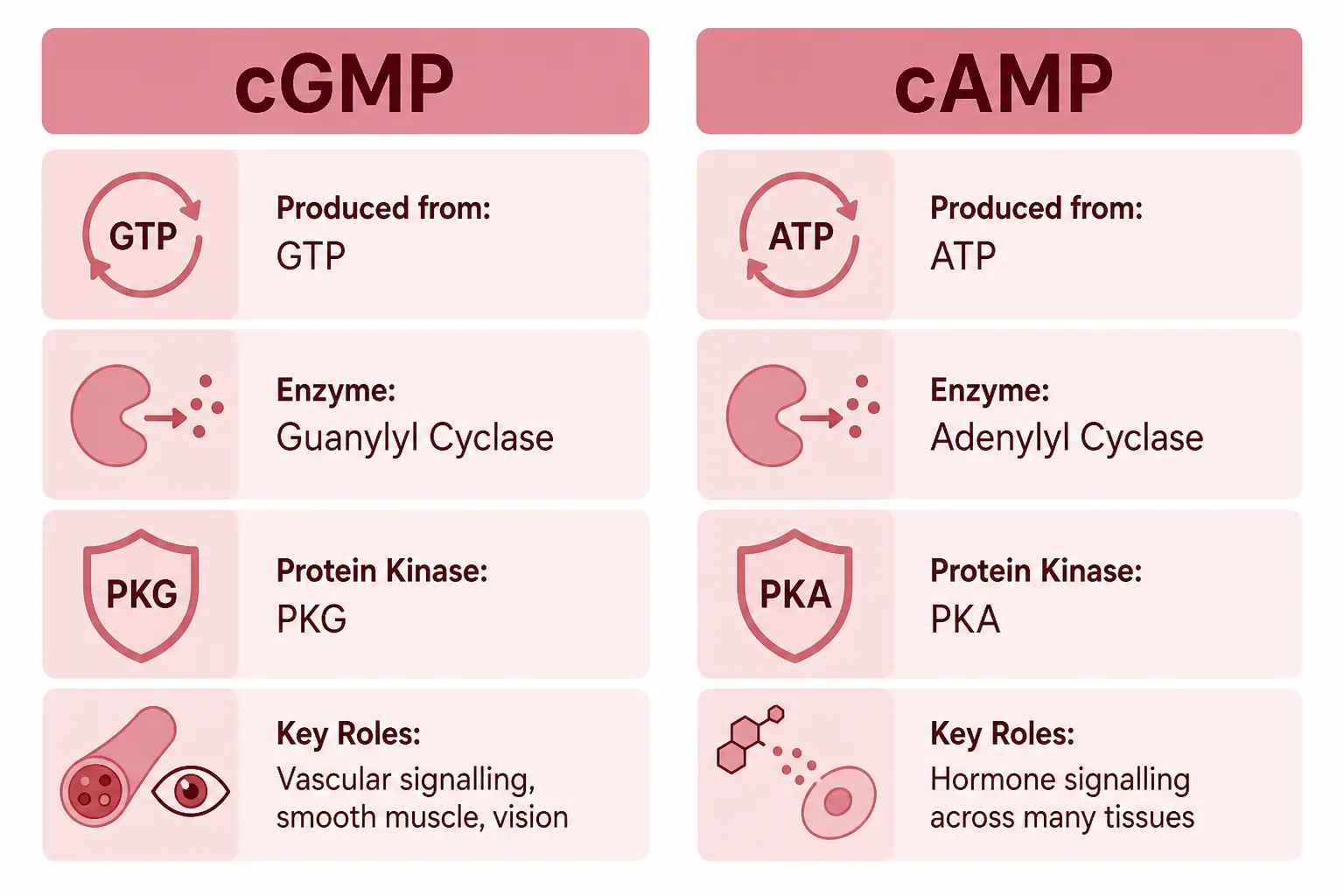
cGMP and cAMP (cyclic adenosine monophosphate) are both second messengers, but they are produced from different molecules and participate in different signalling systems.
| Feature | cGMP | cAMP |
| Full name | Cyclic guanosine monophosphate | Cyclic adenosine monophosphate |
| Produced from | GTP | ATP |
| Producing enzyme | Guanylyl cyclase | Adenylyl cyclase |
| Important protein kinase | PKG | PKA |
| Example functions | Vascular signalling, smooth-muscle regulation, vision | Hormone and cellular signalling across many tissues |
Although these pathways can interact, cyclic guanosine monophosphate and Cyclic adenosine monophosphate should not be treated as interchangeable. Their effects depend on the receptors, enzymes and signalling proteins present in each cell.
How Is cGMP Broken Down?
Producing cyclic guanosine monophosphate is only one part of the signalling process. Cells must also be able to remove it when the signal needs to be reduced.
Phosphodiesterases perform this job by hydrolysing cyclic guanosine monophosphate into 5′-GMP. Different phosphodiesterases are found in different tissues, which allows cells to control cyclic nucleotide signalling according to their specific needs.
PDE5 is one of the phosphodiesterases that specifically regulates cyclic guanosine monophosphate signalling and is particularly relevant to vascular smooth muscle and erectile physiology.
Why Is cGMP Important?
It is important because it helps cells turn biological signals into controlled responses. Its functions are spread across several systems rather than being limited to one part of the body.
Its established roles include:
- Regulating signalling in vascular smooth muscle
- Supporting vasodilation
- Participating in erectile physiology
- Contributing to visual signal processing
- Carrying signals from nitric oxide and other pathways
- Working with proteins such as PKG and specific ion channels
The exact response depends on the tissue, the source of the signal and the cellular machinery available to process it.
Conclusion
Cyclic guanosine monophosphate is a second messenger that helps cells respond to important biological signals. It is produced from GTP by guanylyl cyclase and regulated by phosphodiesterases. Its signalling contributes to smooth-muscle relaxation, vascular function and visual processing, while the NO-cGMP pathway also has an important role in erectile physiology. Understanding this pathway provides a clearer picture of how the body regulates these processes and how medicines that target PDE5 interact with the system.
FAQ
👇 What gland makes cGMP?
Is there any specific gland in your body that makes the cGMP hormone? Rather, it is made inside cells of the body in different parts.
👇 How long is cGMP hormone active in your body?
The duration for which the Cyclic Guanosine Monophosphate will remain active in your body will depend on many factors.
👇 What if GTP is not made in your body?
If a major hormone such as GTP is absent in your body or is present in low amounts, this can mean some major problems with basic processes inside your body. Things like energy transfer, the making of certain important proteins, and a lack of nerve impulse transmission can occur. Since it is also the hormone that produces cGMP, males with ED are likely to have erection issues. In case you have signs already, get to the doctor to use Sildenafil 100 mg.

Years of Experience: 12+ Years Education: Master of Sexology - [University of Sydney] MBBS (Bachelor of Medicine, Bachelor of Surgery) - [Torrens University Australia] BSc in Medical Laboratory Technology -…