

8 Ways To Overcome Today’s Anxiety
By Erica Wilson, Apr-25-2025


 Dr. Arjun Srivastav Medical Reviewer (Pharm D)
 Anxiety can show up in many forms at once. You might notice racing thoughts that refuse to slow down. Your body may feel restless and tense. Your breathing might become faster than usual.
You could have trouble concentrating on the task in front of you. Or you might carry a constant sense of being on edge without a clear reason. These feelings can arrive suddenly or build slowly over the day.
They can make ordinary situations feel much harder than they need to be. The aim here is not to make anxiety disappear instantly. What you can do is learn simple ways to respond to those anxious feelings. You can slowly regain a sense of control over your day.
When you have a few practical tools ready, the experience feels less overwhelming. You know there is something you can turn to.
This article walks through 8 practical ways to overcome anxiety that you can try today. The steps fit into a normal routine without needing special equipment or a lot of free time. These ways to overcome anxiety are simple enough to use at home, at work, or anywhere in between. You can combine several of them as you learn what works best for you.
🧘 Quick Answer: What Can Help With Anxiety Today?
When anxiety feels overwhelming, you do not have to solve everything at once. Start by slowing down and focusing on what you can manage in the present moment.
Simple strategies such as slow breathing, grounding exercises, a short walk, challenging anxious thoughts, reducing caffeine, and talking to someone you trust may help you manage anxious feelings.
Try this sequence: Slow your breathing → Ground yourself → Move your body → Challenge the thought → Choose one manageable next step.
If anxiety keeps interfering with your sleep, work, relationships, or everyday activities, consider speaking with a doctor or qualified mental-health professional for personalised support.
Why Does Anxiety Feel So Difficult to Control?
Anxiety can feel difficult to switch off because it tends to feed on uncertainty. Your mind naturally wants to predict what might happen next. When a situation feels unclear or risky, that forecasting process can go into overdrive. The result is a stream of thoughts that loop back to the same worries.
This keeps your nervous system alert even when there is no immediate danger in front of you. Understanding this pattern is one of the first ways to overcome anxiety. Recognising what is happening gives you a starting point for responding differently. You begin to see the worry as a process rather than a fixed truth.
Anxiety Can Affect Both the Mind and Body
The experience rarely stays in one place. It tends to move between your thoughts and your body.
That is why it can feel so hard to pin down. You might notice one or more of the following.
- Racing thoughts that jump from one worry to another
- Muscle tension, especially in the shoulders, jaw, or neck
- Restlessness that makes it hard to sit still
- Faster breathing that feels shallow or forced
- Difficulty concentrating on what someone is saying
- A general feeling of being on edge
Because both the mind and body are involved, approaches that address only one side often fall short. This is why learning how anxiety works can help you choose techniques that support both at the same time.
🧠 Did You Know?
Avoidance Can Sometimes Keep the Anxiety Cycle Going
There is a pattern that many people recognise once it is described. An anxious thought appears. You avoid the situation that triggered it. You feel a short burst of relief. Before long, the anxiety returns. The situation now feels even harder to face than before.
The cycle often looks like this. Anxious thought leads to avoidance, which brings temporary relief, which allows the anxiety to return, which makes the situation feel harder the next time. Avoiding every situation that causes anxiety can sometimes reinforce the fear rather than reduce it. Understanding this cycle is one of the key ways to overcome anxiety.
It shows why facing small, manageable steps can be more useful than retreating from the discomfort entirely. Over time, gentle and repeated practice with how to reduce anxiety in everyday moments can help break that loop. The techniques become easier to use the more familiar the cycle feels.
🧭 What Are You Feeling Right Now?
Choose the situation that feels closest to you and start with one simple response.
🧠 Racing thoughts
🫁 Fast breathing
😣 Tense or restless
🔄 Repetitive worry
🚪 Avoiding something
📱 Feeling overloaded
💡 Start with one small step. You don’t need to do everything at once.
8 Ways To Overcome Today’s Anxiety
The following sections offer practical actions you can take when anxiety shows up. None of them require perfect timing or a quiet room. Most can be adapted to fit wherever you happen to be. Together these eight ways to overcome anxiety form a toolkit you can draw from whenever the feeling arrives. You may find that some work better for you than others. That is perfectly normal.
1. Slow Your Breathing Before Trying to Solve the Problem
Anxiety can affect breathing patterns before you even notice it. Your breath might become quicker or shallower. That physical change can make the thoughts racing through your mind feel even more intense.
Before you try to solve the problem in front of you, pause for a moment. Take slow, comfortable breaths at a pace that feels natural rather than forced. The focus is on keeping the breathing controlled. It is not on taking unusually deep breaths that might make you feel light headed.
Give yourself a short period to settle before deciding what to do next. Even thirty seconds of slower breathing can create enough space for your thoughts to feel less crowded.
Try it now: pause for a moment, breathe slowly, relax your shoulders, and focus on your next breath. This is one of the simplest ways to overcome anxiety because it needs nothing except a few seconds of your attention.
2. Ground Yourself in What Is Happening Right Now
Anxious thoughts often focus on questions that have no certain answer. You might find yourself asking what if something goes wrong. You might imagine future situations in vivid detail. You could rehearse worst case scenarios. Or you might turn over things that are completely outside your control.
Grounding is a way to redirect your attention toward the present moment. It brings you back to where your body actually is, rather than the future your mind is predicting.
A simple 5 4 3 2 1 grounding exercise:
- 5 things you can see
- 4 things you can feel
- 3 things you can hear
- 2 things you can smell
- 1 thing you can taste
The purpose is not to force the anxiety away. It is to bring your attention back to the current moment so the thoughts lose some of their intensity. Grounding is a technique you can use almost anywhere. It works well in combination with the breathing step above.
3. Move Your Body for a Few Minutes
Physical activity can be part of an overall approach to managing anxiety. You do not need to wait until you have time for a full workout.
Try one of these options:
- Take a short walk, even if it is only around the block
- Stretch your body where you are standing
- Walk around your home or workplace for a few minutes
- Step outside if possible and notice the air and light
A few minutes of gentle movement can shift your focus away from looping thoughts. It gives your body something active to do.
The goal is small, consistent movement rather than a perfect exercise routine. This makes it one of the most accessible ways to overcome anxiety when you feel stuck in one place.
4. Challenge the Thought, Not Yourself
Anxious thoughts can feel convincing without necessarily being facts. When a worry repeats itself, it can start to seem certain, even when it is only one possible outcome among many.
Instead of accepting the thought at face value, take a moment to question it. Three questions can help:
- What am I worried will happen?
- What evidence do I actually have?
- Is there another reasonable way to look at this?
Example:
Anxious thought: I am definitely going to fail.
Balanced thought: I am worried that I might fail, but I do not know that this will happen.
This does not mean ignoring genuine problems. It means separating a possibility from a certainty. A worry is not the same as a fact. Noticing that difference can take some of the weight off the thought.
This technique is especially useful because it works directly with the thoughts that feel most convincing.
5. Stop Trying to Fix Everything at Once
Anxiety can make several problems feel urgent at the same time. Each one demands attention. Trying to address them all together can leave you frozen, unsure where to begin.
Instead of asking how am I going to fix everything, try asking what is the next small thing I can do.
Example:
Instead of: I need to sort out my entire week.
Try: I will write down the three things I need to handle tomorrow.
Breaking large tasks into smaller, manageable steps gives you a clear next action. This approach is central to learning how to manage anxiety.
It turns a vague sense of overwhelm into a specific step you can actually take. It also supports how to reduce anxiety over time, since each small action builds a little more confidence.
Of all the ways to overcome anxiety, this one is about giving yourself a single clear thing to focus on instead of a whole list.
6. Reduce Things That May Be Adding Fuel to Your Anxiety
Some everyday habits can make anxious feelings more noticeable, even if they are not the original cause. It can help to look at factors that might be adding fuel to the experience.
Possible contributors include:
- Too much caffeine
- Excessive screen time
- Constant notifications
- Poor sleep
- Skipping meals
- Using alcohol to cope
For some people, high caffeine intake can make feelings such as restlessness or jitteriness more noticeable. The same is true for interrupted sleep or long stretches of scrolling through news and social media.
Sleep can also influence how well you cope with stress and anxious feelings during the day. Along with reducing stimulants and excessive screen time, making practical lifestyle changes for better sleep may support a healthier daily routine.
Practical suggestion: if you already feel anxious, consider temporarily reducing unnecessary stimulation. Less scrolling, fewer notifications, less caffeine, and a quieter environment can give your nervous system less to react to.
These factors do not cause anxiety in everyone, and removing them will not resolve every worry. But reducing extra stimulation can make the techniques in the other sections easier to use. This is why this step pairs well with the rest of the article.
💡 Keep in Mind
7. Talk to Someone Instead of Carrying It Alone
Anxiety does not always need to be handled privately. Sometimes the act of putting a worry into words changes how it feels.
People may choose to talk to:
- A trusted friend
- A partner
- A family member
- A counsellor
- A psychologist
- A GP
Talking to someone does not mean they have to solve the problem. Often, simply saying the worry out loud can make it easier to understand what is actually bothering you.
A thought that felt overwhelming in your mind can seem more manageable once it is spoken and heard by someone else.
Professional support may be appropriate when anxiety is persistent or significantly affecting daily life. Reaching out is a reasonable step, not a sign that you have failed to cope on your own.
For many people, combining professional support with the ways to overcome anxiety in this article creates a more complete approach.
8. Face Small Steps Instead of Avoiding Everything That Feels Uncomfortable
This is where the earlier cycle of avoidance meets a practical alternative. The difference between avoidance and gradual progress is often just the size of the step you take.
Avoidance sounds like: this makes me anxious, so I will never do it.
A small step approach sounds like: this makes me anxious, so I will start with a manageable version.
Examples:
- Nervous about making a phone call, so write down what you want to say first
- Nervous about attending an event, so plan to stay for a short period
- Nervous about speaking, so practise with someone you trust first
- Nervous about a difficult task, so start with the easiest part
Gradually approaching manageable situations can help prevent avoidance from becoming the default response. Each small step teaches your mind that the situation can be faced, even if it still feels uncomfortable.
This is one of the ways to overcome anxiety that builds on itself over time. Each small win makes the next step feel a little more possible.
A note on safety: this is not about forcing yourself into situations that are dangerous or overwhelming. The steps should feel challenging but within reach, not so large that they leave you worse than before.
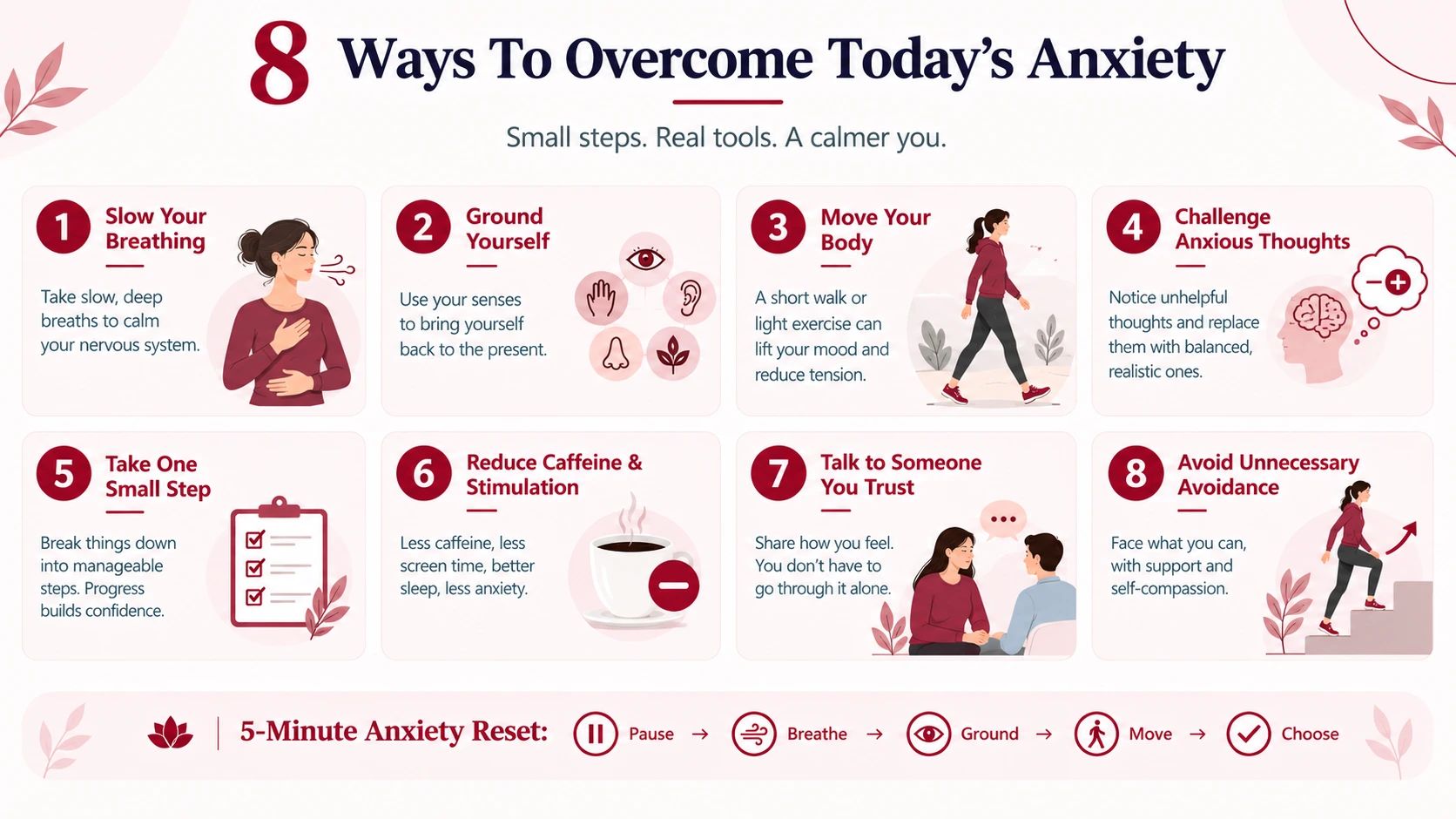
A 5 Minute Anxiety Reset You Can Try Today
When anxiety arrives and you are not sure where to start, this simple five minute reset can help. It gives you a clear sequence to follow. It brings together several of the ways to overcome anxiety from the sections above into one short routine. You can use it whenever the feeling builds.
5 Minute Anxiety Reset
1 Minute, Pause Stop what you are doing and notice what you are feeling. Name the sensation without trying to change it.
1 Minute, Breathe Slow your breathing and allow each breath to remain comfortable. Let your shoulders drop as you exhale.
1 Minute, Ground Notice what you can see, hear, and physically feel in the space around you.
1 Minute, Move Walk, stretch, or change your surroundings in some small way.
1 Minute, Choose Pick one small action you can take next. It does not need to solve everything, only move you forward.
You do not need to complete every step perfectly. The goal is to interrupt the momentum of anxious thinking and give yourself a manageable next step. If one minute runs long or another feels too short, that is fine. The sequence is a guide, not a rule.
🔔 Reminder
What Not to Do When You Feel Anxious
When anxiety is high, certain responses can quietly make the experience harder. Recognising them can help you choose a different path.
- Do not expect yourself to solve every problem immediately
- Do not repeatedly search online for reassurance
- Do not rely on alcohol or other substances to cope
- Do not criticise yourself for experiencing anxiety
- Do not automatically avoid every situation that makes you uncomfortable
- Do not assume the same technique will work for everyone
This section is practical rather than judgmental. The point is not to add guilt to an already difficult moment.
It is to highlight patterns that tend to keep anxiety going. Knowing what to avoid is itself one of the ways to overcome anxiety, because it helps you spot the habits that quietly make things harder.
When Should You Get Professional Help for Anxiety?
Self help techniques can be useful, but they are not appropriate as the only approach for everyone. If you are also wondering whether medication can provide immediate relief, understanding what anxiety medicines can and cannot do may help set realistic expectations. There are times when additional support makes a meaningful difference.
Recognising those times is an important step rather than something to struggle through alone.
Consider professional support when anxiety:
- Keeps returning or persists for a long time
- Interferes with work or study
- Affects relationships
- Disrupts sleep
- Causes significant avoidance
- Becomes difficult to manage
- Causes severe distress or frequent panic
Possible points of contact include a GP, a psychologist, a counsellor, or another qualified mental health professional. They can help you understand what you are experiencing and explore options that fit your situation.
For Australian readers, Lifeline offers support and can be reached in times of crisis. Emergency help is available where appropriate. This is not a large crisis support section, just a reminder that immediate help exists when it is needed.
Start With One Small Step
You do not have to solve everything today. Choose one technique from this article that feels manageable and try it the next time anxiety shows up.
Give yourself time rather than expecting instant results. Notice what works for you rather than what works for someone else.
The ways to overcome anxiety described here are meant to be tried one at a time, not all at once. If anxiety continues interfering with everyday life, professional support is a reasonable next step.
Reaching out is a sign of taking the situation seriously rather than a sign of failure.
Can Taking Zopiclone Get Rid of Daytime Anxiety?
Learn how zopiclone relates to sleep and daytime anxiety, and why it should not be assumed to be a treatment for anxiety.
FAQ
What is the quickest way to calm anxiety?
Slow your breathing, ground yourself in what you can see and hear, reduce extra stimulation, then focus on one immediate action. This short sequence is one of the fastest ways to overcome anxiety in the moment.
How can I reduce anxiety naturally?
Regular movement, consistent sleep, regular meals, less caffeine, grounding exercises, and social connection can all help. These habits are some of the most sustainable ways to overcome anxiety because they fit into an ordinary daily routine.
What should I do when anxiety suddenly gets worse?
Follow the simple sequence: pause, breathe, ground, move, choose. It gives your mind a clear path to follow and is one of the ways to overcome anxiety you can rely on when time is short.
Can walking help with anxiety?
Yes, a walk offers gentle movement, a change of scenery, and a break from the triggering situation. It does not need to be long or intense, which makes walking one of the ways to overcome anxiety that fits easily into most days.
Can caffeine make anxiety worse?
Caffeine may increase jitteriness or restlessness in some people. If anxious feelings get stronger after coffee or energy drinks, reducing your intake is one of the simple ways to overcome anxiety that often gets overlooked.
When should I see a doctor about anxiety?
See a doctor when anxiety is persistent, severe, or interfering with work, study, sleep, or relationships. Speaking with a GP is one of the important ways to overcome anxiety when self help methods are not enough.

Years of Experience: 10+ years Education: B.Sc. in Biomedical Science (Monash University, Melbourne, Australia) PG Diploma in Health & Medical Communication (University of Sydney, Australia) Experience: Erica Wilson is an…

