

Check How Long Does an Erection Lasts
By Erica Wilson, Sep-18-2024


 Dr. Arjun Srivastav Medical Reviewer (Pharm D)
 If you’re wondering how long does an erection last, the short answer is that there’s no single number that applies to every erection. How long an erection lasts depends on stimulation, arousal, age, overall health, medications, and the situation. It can range from a few minutes to around half an hour, and sometimes longer. One important thing to remember: erection duration is not the same as ejaculation time, even though the two are often confused. And if an erection ever lasts 4 hours or longer, it needs urgent medical attention.
⚡ TL;DR: Quick Answer
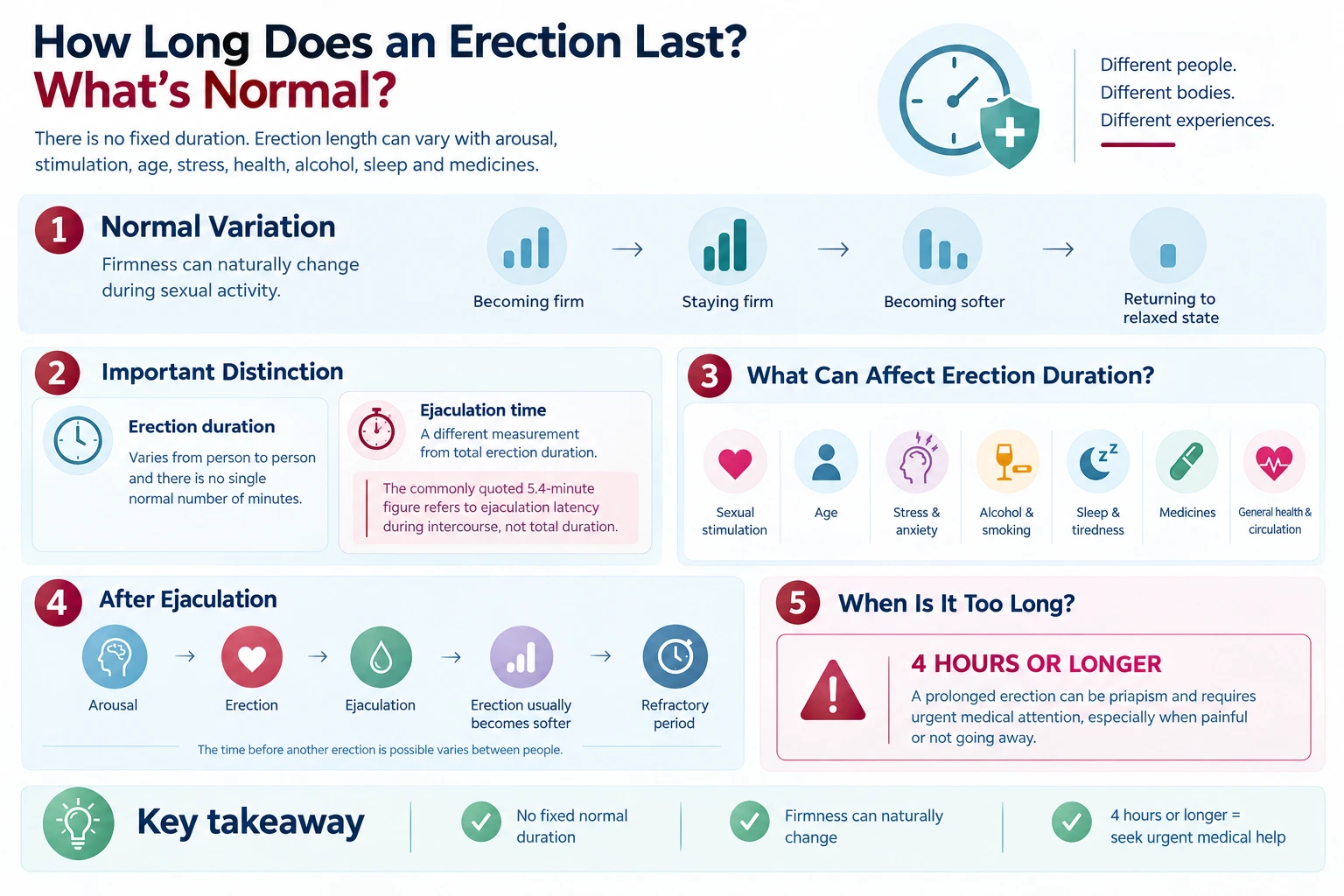
How long does an erection last? There is no fixed amount of time an erection should last. It can vary depending on sexual stimulation, arousal, age, stress, general health, sleep, alcohol and certain medicines. An erection may naturally become softer when stimulation decreases or after ejaculation. The duration of an erection should also not be confused with ejaculation time, as these are two different things. However, an erection that lasts 4 hours or longer requires urgent medical attention because it may be priapism.
How Long Does an Erection Last?
Here’s the honest answer most articles dance around: there’s no fixed normal duration for an erection. A typical erection during sexual enhancement lasts somewhere between a few minutes and roughly 30 minutes, but that range is wide for a reason. Your body isn’t running on a stopwatch.
Most urology experts put the unmedicated average at around 10 minutes, while noting that plenty of people fall well above or below that figure. Clinical guidelines similarly describe erection duration as highly individualized, with most men experiencing erections lasting between 5 and 30 minutes during sexual activity. So when people ask how long does an erection last, the most accurate response is that it depends on the person and the moment.
Why does it vary so much from person to person? Because an erection isn’t a single mechanical event. It’s the result of blood flow, nerve signals, hormones, and your mental state all working together. Change any one of those and the duration shifts. A spontaneous erection you get from a passing thought is going to behave differently than one sustained through focused sexual activity with a partner.
That’s also why comparing yourself to a number you read online is a losing game. What matters is whether your erections work for you and your sexual activity, not whether they match a statistic about how long does an erection last.
Is 5 Minutes a Normal Erection?
This is one of the most misunderstood numbers in sexual health, so let’s clear it up.
You’ll see 5.4 minutes quoted all over the internet as the average erection time. It comes from a well-known study of 500 couples across five countries that measured something called intravaginal ejaculation latency time (IELT), which is the time between vaginal penetration and ejaculation. In that study, IELT ranged from 33 seconds to over 44 minutes, with a median of about 5.4 minutes.
Here’s the key point most articles miss: that 5.4-minute figure measures time to ejaculation, not how long the erection itself lasted. An erection can begin before penetration and continue after the study’s clock stops. Treating premature ejaculation time as erection duration is like measuring how long a car runs by timing only one leg of the trip.
So is 5 minutes a normal erection? If you’re talking about ejaculation time during vaginal intercourse, it sits right around the median. If you’re talking about the erection itself, five minutes is on the shorter end but still within the wide range of normal, especially if sexual activity was brief or stimulation changed.
| Term | What it measures |
|---|---|
| Erection duration | How long the penis remains erect |
| Ejaculation time | How long it takes to ejaculate |
| Intercourse duration | How long sexual activity lasts |
This distinction is worth holding onto, because it clears up a lot of unnecessary worry.
What Happens During an Erection?
Keeping this simple: an erection is a blood-flow event triggered by signals from your nervous system. Understanding this helps explain how long does an erection last, because the same process that creates an erection also ends it.
When you’re sexually stimulated, through touch, thoughts, or arousal, nerve signals tell the blood vessels in the penis to relax and open up. Blood rushes in and gets trapped under pressure, which is what makes the penis firm and erect. As long as stimulation and arousal continue, the blood stays in and the erection holds.
When stimulation decreases, you orgasm, or arousal shifts, the muscles contract, the valves open, and blood flows back out. The penis becomes soft again, a process called detumescence. That’s the natural end of an erection, and it’s completely normal.
An erection can also change through several stages rather than staying equally firm from start to finish. Understanding the types and stages of erections can help explain why firmness naturally changes during sexual activity.
What Affects How Long an Erection Lasts?
No single factor decides how long you stay erect. It’s usually a combination, and the mix changes from one day to the next. Age, physical health, medications, stress and other factors can all influence sexual function. Understanding what affects erections can give you a clearer picture of why erection duration varies.
Sexual stimulation and arousal
This is the biggest one. An erection needs ongoing stimulation, physical or mental, to stay firm. If attention drifts or stimulation eases off, the erection will naturally soften. That’s not a malfunction; it’s how the system is designed.
Age
Erection duration and firmness tend to change with age. Age-related vascular, hormonal, and neurological shifts contribute to decreased rigidity and shorter duration over time. The refractory period also lengthens with age (more on that below).
These changes don’t mean that erections stop at a particular age. If you’re noticing persistent changes, understanding more about age and erections can help put those changes into context.
Stress and performance anxiety
Stress and anxiety are erection killers because they trigger the fight-or-flight response, which narrows blood vessels and works against the relaxation an erection needs. Performance anxiety creates a particularly nasty loop: you worry about losing the erection, the worry itself makes it harder to keep, and the cycle repeats.
Alcohol and smoking
A small amount of alcohol might lower inhibition, but too much depresses the nervous system and makes erections harder to achieve and maintain. Smoking damages blood vessels over time, which directly affects the blood flow an erection depends on.
Sleep and tiredness
Poor sleep lowers testosterone, raises stress hormones, and leaves you without the energy for sustained arousal. Tiredness is one of the most common, and most overlooked, reasons a normally reliable erection doesn’t last.
Medications
Certain medications affect erection duration, including some antidepressants, blood pressure drugs, hair-loss treatments, and cold or allergy medications. If you notice a change after starting a new medication, that’s worth mentioning to your doctor rather than assuming something is wrong with you.
General health and circulation
Because an erection is a blood-flow event, anything that affects your cardiovascular system affects your erections. Conditions like high blood pressure, high cholesterol, diabetes, and heart disease can all shorten erection duration or reduce firmness.
Hormonal factors
Testosterone plays a role in libido and the erectile response, though it’s not the only hormone involved. Low testosterone can reduce sexual desire, which in turn affects how long an erection lasts. No arousal, no sustained erection.
Why Does an Erection Go Soft?
An erection going soft isn’t always a problem. In fact, it’s usually just your body doing what it’s supposed to do. When people worry about how long does an erection last, they often forget that going soft is a normal part of the cycle. An erection naturally becomes softer when:
- Sexual stimulation decreases
- Ejaculation occurs
- Arousal changes or shifts
- You become distracted
- Stress or anxiety interrupts arousal
- Alcohol or fatigue dampens your sexual response
This is the important distinction: occasional loss of firmness is not automatically erectile dysfunction. Everyone loses an erection sometimes. It only becomes worth looking into when it happens repeatedly and interferes with sexual activity you’re satisfied with.
Is It Normal to Lose an Erection During Sex?
Yes. Occasionally, it’s completely normal. Losing an erection during sex now and then doesn’t necessarily indicate a medical problem. Distraction, a shift in mood, tiredness, or a brief spike in anxiety can all cause a temporary loss of firmness.
What’s more worth paying attention to is the pattern. If you repeatedly have difficulty getting or maintaining an erection, or if the change is persistent and worsening, that’s when it makes sense to speak with a healthcare professional. Performance anxiety can contribute too, especially if one off experience leads to worry that feeds into the next.
Avoid pinning the definition of ED to a specific number of minutes. Persistent difficulty getting or maintaining an erection sufficient for sexual activity is a more meaningful signal than any time limit you might read about how long does an erection last.
How Long Do Morning Erections Last?
Morning erections, often called morning wood, are a type of nocturnal erection that happens during sleep, usually during REM sleep. They’re not directly tied to sexual arousal; they’re a sign that your blood flow, nerves, and hormonal systems are working as they should.
Nocturnal erections can occur several times a night. Research suggests they typically last at least 10 minutes, and some can last up to 25 minutes. So if you’re asking how long does an erection last during the night, the answer is different from daytime erections because these happen unconsciously.
Their duration varies for the same reasons any erection varies. Age, sleep quality, stress, and overall health all play a part. And here’s something worth knowing: the presence or absence of a single morning erection isn’t a standalone diagnostic test. Most men have occasional mornings without one, and that alone doesn’t mean anything is wrong. What matters more is the overall pattern over time.
What Happens to an Erection After Ejaculation?
Why the erection usually becomes soft
After ejaculation, nerve signals shift and the muscles in the penis contract, letting blood flow back out. The erection becomes soft. This is detumescence, and it’s the normal, expected response to orgasm. It’s also a big part of why how long does an erection last is so hard to pin down, because ejaculation ends the erection for most people.
What is the refractory period?
The refractory period is the recovery time after orgasm during which you can’t get another erection. It’s sometimes called the latency period. In younger, healthy people it can be short, just minutes, but it generally lengthens with age. There’s no correct length; it varies considerably between people and can change with age, stimulation, and individual factors.
Can another erection happen afterward?
Yes, once the refractory period passes, another erection is possible with renewed stimulation. How quickly that happens depends largely on age and overall health.
What If Your Erection Doesn’t Last Long Enough?
This is where a lot of unnecessary anxiety lives, so let’s be careful with it.
Occasional short erections happen to everyone. If it’s a one-off, a stressful week, a late night, a bit too much to drink, there’s usually nothing to worry about. If you’re having repeated difficulty getting an erection in the first place, you may also want to understand the factors involved in getting an erection.
Repeated difficulty maintaining firmness is a different matter. It can have physical contributors (cardiovascular issues, diabetes, low testosterone, medication side effects) and psychological ones (stress, anxiety, depression, relationship concerns). Often it’s a mix of both.
minutes doesn’t automatically mean ED. What’s more relevant is persistent difficulty getting or maintaining an erection sufficient for sexual activity you’re satisfied with. If that pattern is persistent or worsening, it’s worth speaking with a healthcare professional, not because something is necessarily wrong, but because they can help figure out the cause and whether any treatment makes sense. This is a better way to think about how long does an erection last than chasing a single number.
Can ED Medicines Help You Maintain an Erection?
ED medications like sildenafil (Viagra) and tadalafil (Cialis) belong to a class called PDE5 inhibitors. They work by improving blood flow to the penis, which helps you get and maintain an erection when you’re sexually aroused.
A common misconception is that these medicines cause a continuous erection just by being active in your body. They don’t. Sexual stimulation is still needed for the medication to work. It supports the erection response rather than switching it on automatically. So if you’re taking ED medication and wondering how long does an erection last with it, the answer is still tied to arousal and stimulation.
Clinical guidelines recommend PDE5 inhibitors as first-line therapy for ED, with trials reporting efficacy rates of 60 to 85 percent across various patient populations. Different medications vary in how long they stay active in the body and their side-effect profiles, so what suits one person may not suit another.
It’s also important to understand the potential benefits and risks of erection pills rather than assuming that a longer-lasting erection is always the goal.
One clear rule: don’t increase doses or combine ED medicines without medical advice. A healthcare professional can help determine whether a medication is suitable for you and at what dose.
How Long Is Too Long for an Erection?
A prolonged erection is different from a normal one, and the difference matters. An erection that doesn’t go away, especially if it’s painful, is a cause for concern, not something to wait out. Most of the conversation around how long does an erection last focuses on erections being too short, but erections lasting too long are a serious medical issue.
The widely agreed threshold: an erection lasting 4 hours or longer needs urgent medical attention. Don’t wait for it to resolve on its own. Go to the nearest emergency room or urgent care center.
Some experts advise seeking emergency care even earlier, at the 2-hour mark, because tissue damage can begin 4 to 6 hours after the erection starts, and that damage can be permanent.
What Is Priapism?
Priapism is a prolonged erection unrelated to normal sexual activity. It happens when blood flows into the penis but can’t flow back out, often due to a blockage in the outflow channels. This is the medical condition that flips the question of how long does an erection last from “is it long enough?” to “is it too long?”
There are two main forms: one is painful, the other isn’t, but both need urgent treatment. Prolonged erections can damage penile tissue, and without treatment that damage may be permanent, potentially leading to long-term erectile dysfunction.
That’s why urgent treatment matters so much. This isn’t a wait-and-see situation. If an erection lasts far longer than usual and isn’t going down, painful or not, get medical help right away. Don’t try home remedies that could delay emergency care.
How Can You Maintain a Healthy Erection?
This isn’t about gimmicks to “make your erection last longer.” It’s about supporting the systems your erection depends on. If you want a clearer picture of how long does an erection last for you, supporting these foundations makes a real difference:
- Regular physical activity improves circulation, which is the foundation of erectile function
- A healthy diet supports cardiovascular and metabolic health
- Limiting excessive alcohol because heavy drinking dampens the nervous system response
- Avoiding smoking because smoking damages blood vessels over time
- Managing stress because chronic stress works against the relaxation an erection needs
- Adequate sleep because poor sleep lowers testosterone and raises stress hormones
- Managing underlying health conditions because blood pressure, cholesterol, diabetes, and weight all matter
- Talking to a healthcare professional about persistent problems rather than self-diagnosing or ignoring them
When Should You See a Doctor About Your Erections?
Use this as a simple checklist. It’s worth speaking with a healthcare professional if:
- Erections are repeatedly difficult to achieve
- You regularly lose firmness during sex
- The change is persistent or getting worse over time
- Erections are painful
- You have concerns about medication-related erection problems
- An erection lasts 4 hours or longer (seek emergency care)
None of these mean something is definitely wrong, but they’re all good reasons to get a professional opinion rather than worry alone about how long does an erection last.
Conclusion
There is no fixed answer to how long an erection should last. Duration can vary with arousal, stimulation, age, health, stress and other factors, and an erection naturally becomes softer when stimulation decreases or after ejaculation. Occasional changes are normal, but persistent difficulties should be discussed with a healthcare professional. If an erection lasts 4 hours or longer, seek urgent medical attention.
FAQ
How long does an erection normally last?
There's no single normal duration. A typical erection during sexual activity lasts from a few minutes to roughly 30 minutes, though it varies widely based on age, health, arousal, and circumstances. So when someone asks how long does an erection last, the honest answer is that normal covers a wide range.
How long does the average erection last?
Estimates vary. Most urology experts cite roughly 10 minutes for an unmedicated average, while clinical guidelines place most erections between 5 and 30 minutes during sexual activity.
Is 5 minutes a normal erection?
The often-quoted 5.4 minutes actually measures time to ejaculation during vaginal intercourse, not erection duration. Five minutes is on the shorter end for an erection but still within the wide range of normal, especially if sexual activity was brief.
Can you stay hard after ejaculating?
Usually not immediately. After ejaculation, the erection becomes soft and you enter a refractory period during which another erection isn't possible. This period is shorter in younger people and lengthens with age.
How long is too long for an erection?
An erection lasting 4 hours or longer is a medical emergency. Some guidance suggests seeking care at the 2-hour mark, since tissue damage can begin 4 to 6 hours after onset.
Does Viagra make an erection last longer?
Sildenafil (Viagra) and other PDE5 inhibitors improve blood flow to help you get and maintain an erection when aroused. They don't cause a continuous erection on their own. Sexual stimulation is still required.
What should I do if my erection lasts more than 4 hours?
Seek emergency medical care immediately. Don't wait for it to resolve on its own or try home remedies. An erection lasting this long can cause permanent tissue damage.

Years of Experience: 10+ years Education: B.Sc. in Biomedical Science (Monash University, Melbourne, Australia) PG Diploma in Health & Medical Communication (University of Sydney, Australia) Experience: Erica Wilson is an…

